Trex Crushes Revenue Expectations And Raises Guidance Again, But Gross Margin Keeps Slipping Beneath The Volume Surge
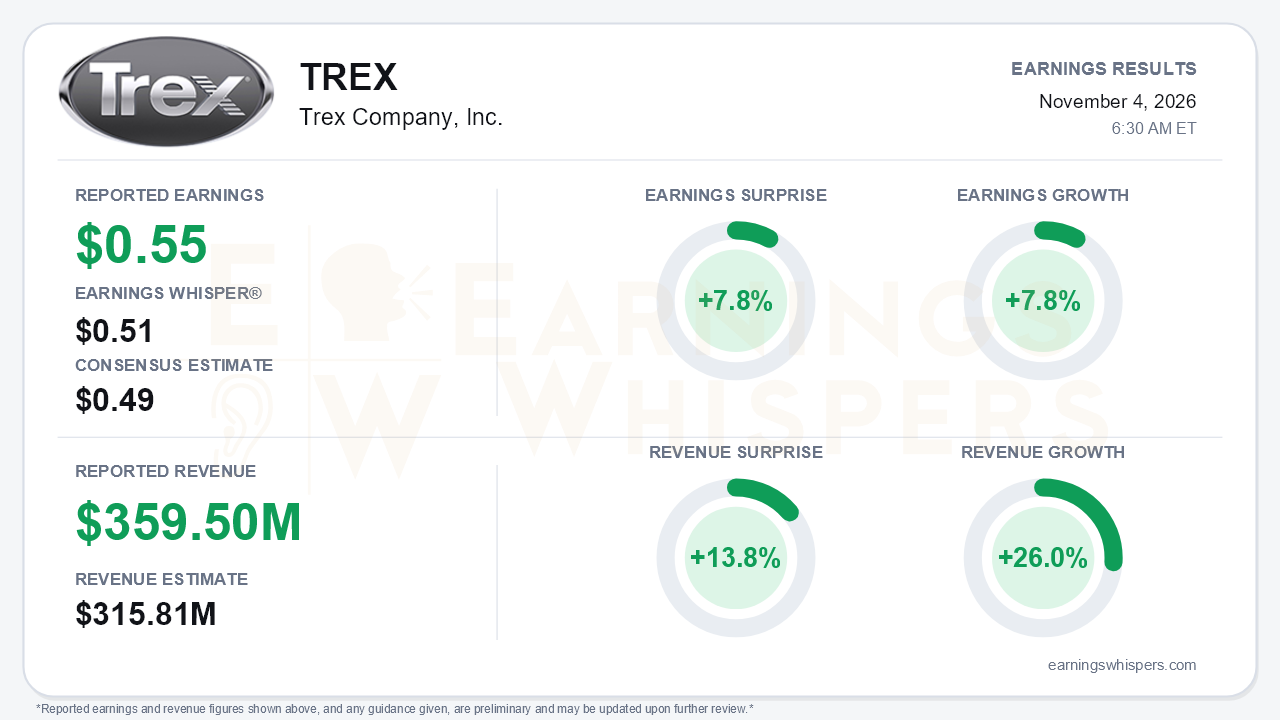
Trex delivered the kind of top-line quarter turnaround skeptics were not positioned for. Adjusted earnings of $0.55 per share beat the $0.49 consensus by 7.8% and cleared the $0.51 Earnings Whisper number. Revenue of $359.5 million topped estimates by 13.8% and grew 26.0% year over year. It also landed well above the $305-320 million range management had guided on the prior call. The acceleration is striking: sales growth went from roughly 1% in the first quarter to 8% in the second and 26% in the third. Yet earnings grew only 7.8%, a fraction of the revenue pace. That gap is the central tension. Trex is selling far more decking, but each incremental dollar is converting to profit less efficiently.
The quality of the beat deserves scrutiny. Roughly $30 million of revenue came from initial inventory load-in tied to the company's distribution overhaul. Stripping that out, underlying growth was about 15%. That is still impressive against an estimated 6% decking category and 9% composite category, but it is not 26%. Adjusted gross margin fell to 36.9% from roughly 40.9% a year ago, and GAAP gross margin dropped to 36.0% from 40.5%. The drivers were diesel and inbound freight inflation of more than $4 million, higher depreciation from new capacity, labor inefficiencies, and a mechanical issue that inflated Arkansas startup costs. Adjusted net income was essentially flat at $56 million versus $55 million. Much of the per-share growth therefore came from a diluted share count that fell to about 101.8 million from 107.3 million after aggressive buybacks. GAAP EPS rose to $0.52 from $0.48 on unchanged net income of $52 million.
The call nonetheless preserved a credible growth story built on share gains rather than market recovery, a distinction management emphasized. Trailing-twelve-month sell-out growth excluding load-in improved to about 9% from 7% in the second quarter and 6% in the first. Growth was double-digit across good, better and best tiers. Railing and accessory attachment rates rose about 500 basis points to roughly 30%. Management said the distribution transition was completed with minimal disruption and channel inventory comparable to last year. It also described early conversion of tertiary-brand dealers through new regional distributors as faster than expected, against a $100 million two-year opportunity. Tone shifted markedly from the cautious posture of earlier in the year, anchored by a stated goal of doubling the business toward a $2 billion 2030 target.
Guidance moved in two directions. Full-year sales guidance rose to $1.296-1.306 billion, and adjusted EBITDA guidance rose to $355-360 million from $335-350 million. Full-year adjusted gross margin guidance, however, was trimmed to 37.5-38% from roughly 38%. Management expects about a 350-basis-point depreciation headwind in the fourth quarter and sees no near-term diesel relief. It also said Little Rock efficiency benefits should arrive only in the second half of 2027. Bears have legitimate ammunition here. Next year must lap roughly $35 million of 2026 load-in revenue, no 2027 guidance was offered, and margin recovery is conditional on demand holding. Planned 2027 pricing actions and a possible diesel surcharge in the home center channel are the main offsets.
Cash generation was strong. Free cash flow of $135 million funded an $83 million revolver paydown and $55 million of repurchases, with full-year buybacks expected to reach about $300 million. Balance-sheet details show the load-in's footprint, however. Receivables stood at $223 million versus $48 million at year-end, partly a seasonal effect. Borrowings on the line of credit were $170 million against $133.5 million in December, and cash was just $3.3 million.
The market setup is more complicated than the surprise implies. Investor sentiment swung from modestly negative (-0.13) to clearly positive (+0.30), a meaningful shift in expectations. Shares closed at $50.00 ahead of the report, up 10.5% since the open after the prior release and about 16% above the 200-day moving average. The stock had climbed nearly 19% from its October 1 low of $42.10 and set a 52-week high of $52.38 just two days before the print. The Earnings Whispers trend signals are largely positive, though sequential growth reads only neutral. With optimism already rebuilt, the margin trajectory may matter more than the revenue beat.
The bottom line is that Trex proved its share-gain and distribution strategy is working, with accelerating sell-out, two consecutive guidance raises and robust cash flow. But revenue is outrunning profitability. Margins are still declining, the third quarter was flattered by one-time channel fill, and the relief from Little Rock efficiencies sits in the back half of 2027. Investors who chased the stock to new highs are now underwriting a margin recovery that management has described but not yet delivered.
Read our earnings preview for Trex Company, Inc.: https://www.earningswhispers.com/article/TREX/21750
This earnings review was originally published on Earnings Whispers.
This article is for informational purposes only and is not investment advice. Earnings Whispers and its staff may hold positions in the securities mentioned. It is AI-assisted, based on proprietary Earnings Whispers data and company reports, and edited by Earnings Whispers staff.
Mentioned In This Article
Latest News
| Nov-04 | |
| Nov-04 | |
| Nov-04 | |
| Oct-27 | |
| Oct-22 | |
| Oct-20 | |
| Oct-20 | |
| Oct-19 | |
| Oct-06 | |
| Sep-16 | |
| Sep-03 | |
| Sep-02 | |
| Aug-27 | |
| Aug-24 | |
| Aug-17 |
