Neuronetics Posts First GAAP Operating Profit And Raises Margin Outlook, But A Held Revenue Guide And Thin Cash Keep The Turnaround On Probation
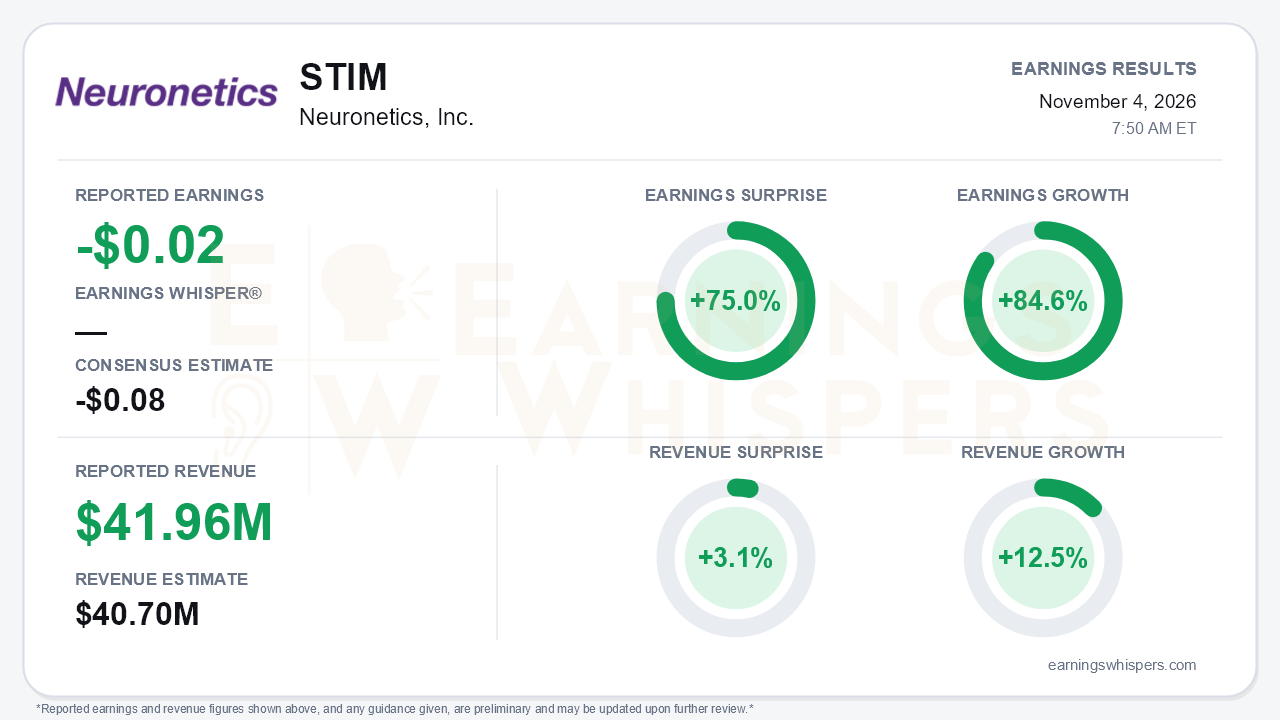
Neuronetics (NASDAQ: STIM) delivered the cleanest quarter of its post-Greenbrook era. The company lost $0.02 per share on revenue of $41.96 million, beating the consensus loss estimate of $0.08 by 75.0% and revenue consensus of $40.7 million by 3.1%. Earnings improved 84.6% year over year from a $0.13 loss, and revenue grew 12.5%. The bigger milestone sits above the bottom line. The company generated $0.5 million of GAAP operating income, its first quarterly operating profit, versus a $7.3 million operating loss a year ago. Operating plus investing cash flow was a positive $0.8 million. The central tension is that the profitability inflection is real, yet management only reaffirmed full-year revenue guidance. The stock has spent the quarter treating that inflection with skepticism.
The quality of the improvement is mostly operational, but it deserves some scrutiny.
- **Margins:** Gross margin expanded to 52.2% from 45.9% a year ago and from 51.1% in Q2 and 46.9% in Q1. Operating expenses fell 13% to $21.3 million, driven by a $3.4 million cut in sales and marketing.
- **Adjusted EBITDA:** It swung to $1.9 million from a $4.7 million loss, after $0.3 million in Q2 and a $6.6 million loss in Q1. That figure includes a $0.6 million restructuring add-back.
- **Stock-based compensation:** SBC fell to just $178,000 from $1.4 million, which flatters the GAAP comparison.
- **Dilution:** The per-share improvement came despite a share count that rose to 77.0 million from 67.3 million, reflecting ATM issuance.
- **Non-recurring benefit:** Management acknowledged that part of the gross margin gain came from prior-period revenue cycle management catch-ups that will not repeat, and that further RCM gains should become more modest.
Beneath the headline, both segments improved sequentially.
- **Greenbrook:** Clinic revenue growth accelerated to 20.1% ($26.2 million), from 16.8% in Q2 and 15% in Q1. The drivers were revenue cycle management, double-digit Spravato growth, and a SkyPoint AI coding tool that management said lifted first-month collections by a low double-digit percentage.
- **NeuroStar:** Device revenue turned positive at +1.8% after declines of 2.7% and 3% in the prior two quarters. It was helped by record system sales, a new sole-source national account, and a mix in which more than half of units were sold as capital or lease. That mix lifted ASP and NeuroStar gross margin, with segment cost of revenue falling to $3.6 million from $4.6 million.
- **Session revenue:** The offset is that treatment session revenue keeps declining and is guided slightly lower as the model shifts toward capital. Recurring utilization economics are still eroding even as box sales strengthen.
Guidance moved in the right direction on everything except the top line.
- **Gross margin:** Raised to 49–50% from 48–50% (originally 47–49%).
- **Opex:** Total opex guidance dropped to $92.5–95.5 million from $95–100 million.
- **Cash flow:** The operating plus investing cash flow range improved to -$10 million to -$12 million. With nine-month burn of roughly $10.3 million, that implies Q4 near breakeven to a modest outflow.
- **Revenue:** The $160–164 million revenue guide was held, implying Q4 of roughly $42–46 million. That leaves Q4 flat to modestly higher than Q3, not a beat-and-raise.
The catalyst slate is unusually crowded, though most items are 2027 stories.
- **Regulatory:** A 510(k) for an accelerated TMS protocol is under FDA review. The Wave Neuro PTSD partnership requires a separate NeuroStar compatibility clearance.
- **Product:** The TrakStar–AdvancedMD EHR integration goes live in Q4.
- **Compass:** The company expects Compass to complete its COMP360 submission shortly and targets a 1H27 launch, positioning Greenbrook for psychedelic therapy, though early reimbursement will likely depend on single-case agreements.
Bears have legitimate ammunition elsewhere. Clinic occupancy ranges from about 25% to 75%. The swap of direct-to-consumer advertising for eight additional Greenbrook field reps won't pay off until mid-2027. Total cash fell to $27.9 million from $34.1 million at year-end despite ATM proceeds, against about $62 million of long-term debt.
The market setup is more complicated than the surprise implies.
- **Sentiment:** Investor sentiment slid from 0.25 to 0.05 heading into the report. It remained marginally positive but meaningfully cooler.
- **Price:** Shares at $2.26 were down 17.2% from the open after the August report and 34% below the $3.44 52-week high set on that day. Much of the post-Q2 enthusiasm was surrendered.
- **Recovery:** The stock had rebounded about 23% from its October 15 low of $1.84 and sat roughly 20% above its $1.88 200-day moving average. The longer-term trend has improved even though the inter-earnings period was a retreat.
- **Trend signals:** Earnings Whispers trend signals are largely neutral, with AVWAP still negative, consistent with a stock that has not yet re-earned buyers' conviction.
The bottom line is that Neuronetics crossed a genuine threshold this quarter. It posted its first GAAP operating profit, accelerated Greenbrook growth, returned NeuroStar to growth, and raised its margin outlook for a second straight quarter. Management's tone shifted from Q2's warning of a 'choppier' second half to talk of being well-positioned for sustained growth in 2027. Even so, the unchanged revenue guide, fading RCM tailwinds, declining session revenue, and a shrinking cash cushion mean the story now hinges on execution of 2027 catalysts. The turnaround is gaining credibility, but it has not yet earned a premium.
Read our earnings preview for Neuronetics, Inc.: https://www.earningswhispers.com/article/STIM/21745
This earnings review was originally published on Earnings Whispers.
This article is for informational purposes only and is not investment advice. Earnings Whispers and its staff may hold positions in the securities mentioned. It is AI-assisted, based on proprietary Earnings Whispers data and company reports, and edited by Earnings Whispers staff.
Mentioned In This Article
Latest News
| Nov-04 | |
| Nov-04 | |
| Nov-04 | |
| Nov-04 | |
| Nov-04 | |
| Oct-27 | |
| Oct-21 | |
| Sep-08 | |
| Aug-11 | |
| Aug-11 | |
| Aug-11 | |
| Aug-11 | |
| Aug-03 | |
| Jul-31 | |
| Jul-28 |
