ArcBest Beats As Cost Cuts And An Asset-Light Rebound Drive Earnings, But LTL Yield Remains The Soft Spot
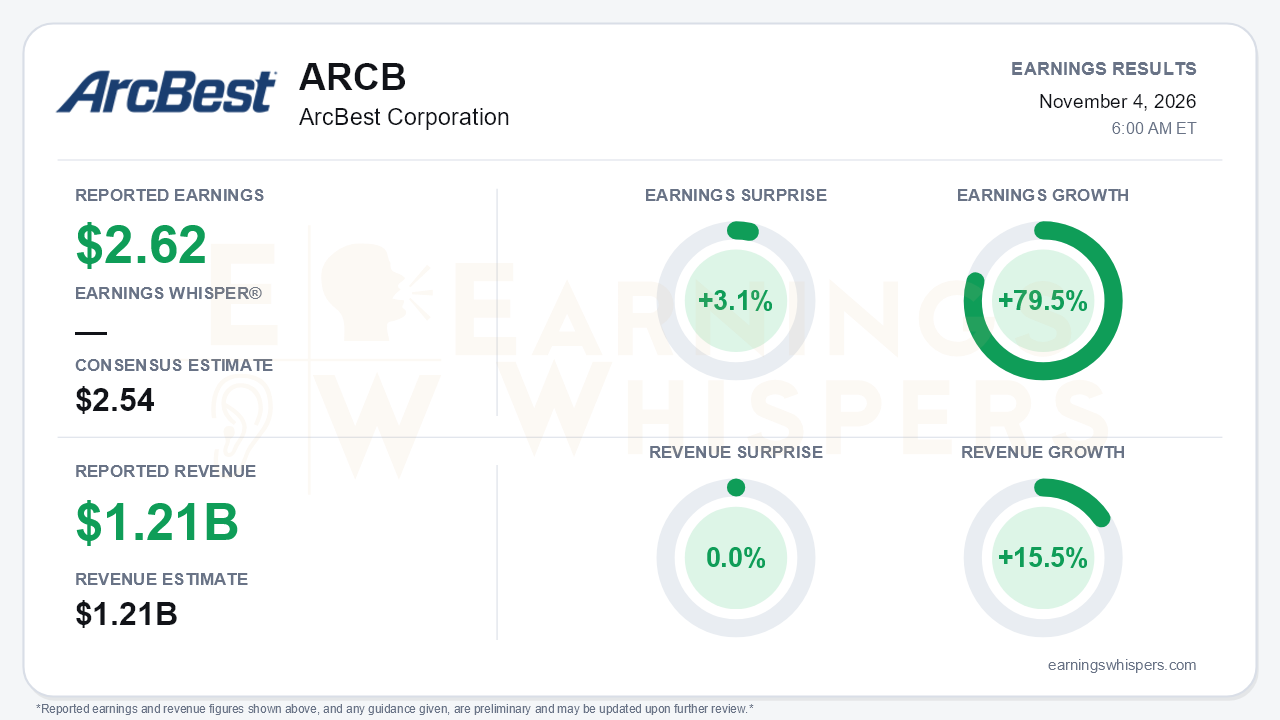
ArcBest (NASDAQ: ARCB) delivered a third quarter that improves the earnings trajectory more than the 3.1% beat suggests. Non-GAAP earnings of $2.62 per share topped the $2.54 consensus and grew 79.5% from a year ago. Revenue of $1.211 billion was in line with expectations and rose 15.5%. The sequential path matters more than the beat. Adjusted EPS has climbed from $0.32 in the first quarter to $2.38 in the second and now $2.62. Consolidated non-GAAP operating income reached $85 million, up from $74 million in Q2 and just $13 million in Q1. The central tension is how that profit was earned. Most of the improvement came from cost actions, freight mix, and fuel rather than underlying LTL pricing power.
The quality of the quarter is better on a GAAP basis than the comparison first implies. GAAP EPS rose to $2.30 from $1.72 even though the prior-year period included a $15.7 million gain on service-center sales. That gain flattered last year's asset-based GAAP operating ratio of 90.3%. On a non-GAAP basis, the asset-based operating ratio improved 210 basis points to 90.4% from 92.5%. Investors should note that the non-GAAP figures still exclude about $6 million of recurring Vaux and technology spending and $4.3 million of restructuring charges. Earlier in the year, the company also took $85 million of impairments, mostly against Vaux assets and the Panther trade name. Cash generation is a clear positive. Nine-month operating cash flow rose to $255 million from $184 million, capital spending fell by about two-thirds, and cash nearly doubled since year-end to $185 million.
Beneath the headline, the asset-based numbers deserve scrutiny. Tonnage per day jumped 9.6%, but shipments fell 3.0%. The tonnage gain came from a 13% increase in weight per shipment, which reflects a deliberate shift toward heavier freight. That mix drove the 14.2% gain in billed revenue per shipment. However, revenue per hundredweight excluding fuel declined in the low single digits. Contract renewals also cooled to 5.1%, from 5.8% in Q2 and 6% in Q1. Margin expansion came largely from labor efficiency, with salaries, wages, and benefits falling to 48.1% of revenue from 51.0%. Restructuring delivered $6 million of savings in the quarter.
Asset-Light was the upside story. Non-GAAP operating income rose to $14.4 million from $1.6 million, well above the $6 to $8 million management had guided. Revenue per shipment rose 23.8% as truckload capacity tightened. Purchased transportation held essentially flat at 85.0% of revenue, so the profit gain came from leaner overhead rather than wider spreads. Growth here also slowed sharply. Shipments per day rose only 1% versus 15% in Q2, and productivity gains narrowed to 8% from 35%.
The call tilted forward-looking metrics upward. October asset-based tonnage rose 15% and shipments turned positive at +1%. Management guided the Q4 asset-based operating ratio to deteriorate only 50 to 150 basis points, compared with a roughly 180 basis point seasonal norm. Asset-Light Q4 operating income is guided to $7 to $10 million, putting the full-year figure in the low $30 millions versus $1.5 million in 2025. Restructuring savings should reach the full $10 million per quarter by Q1 2027. An insurance renewal cut base premiums, and buybacks totaled $40 million across Q3 and October. Management expects 2027 to bring further improvement toward its 2028 targets without assuming a meaningful freight recovery. Bears still have legitimate ammunition:
- Weight-per-shipment comparisons get tougher in November and December.
- The fuel tailwind is transitory.
- Union wage inflation runs near 3.2%.
- The Q4 actuarial review could adjust liability reserves.
- The yield-focused strategy continues to shed shipments.
The market setup is more complicated than the fundamentals imply. Investor sentiment fell from a modestly positive 0.25 after the prior report to a slightly negative -0.08 heading into this one, a meaningful swing toward skepticism. Shares opened at $149.55 after the July report, which marked the high of the inter-earnings period. They then slid to a low of $123.03 on October 28, just a week before this release. By November 3 the stock had recovered to $134.48. That leaves it 10.1% below the post-July open but 7.7% above its 200-day moving average. The trend readings are mixed, with momentum positive while AVWAP remains negative. That pattern fits a stock that has rebounded but has not reclaimed its post-July levels.
The bottom line is that ArcBest's earnings recovery is real and increasingly driven by self-help that management controls: restructuring savings, a profitable Asset-Light segment, lower insurance costs, and stronger cash flow. The weak link is core LTL pricing, where ex-fuel yield is slipping and renewal increases are moderating. Better-than-seasonal Q4 guidance and October tonnage strength give the improvement story credibility. Investors entered the report more skeptical than they were in July, and sustaining the rebound likely depends on whether volume gains can eventually come with firmer yields rather than just heavier freight.
Read our earnings preview for ArcBest Corporation: https://www.earningswhispers.com/article/ARCB/21669
This earnings review was originally published on Earnings Whispers.
This article is for informational purposes only and is not investment advice. Earnings Whispers and its staff may hold positions in the securities mentioned. It is AI-assisted, based on proprietary Earnings Whispers data and company reports, and edited by Earnings Whispers staff.
Mentioned In This Article
Latest News
| Nov-04 | |
| Nov-04 | |
| Nov-04 | |
| Nov-04 | |
| Nov-04 | |
| Oct-30 | |
| Oct-27 | |
| Oct-13 | |
| Oct-01 | |
| Sep-24 | |
| Sep-09 | |
| Sep-08 | |
| Aug-03 | |
| Jul-31 | |
| Jul-29 |
