Havertys Misses Badly Once Tariff Refunds Are Stripped Out, As Written Comps Slow From 12.3% To 2.3%
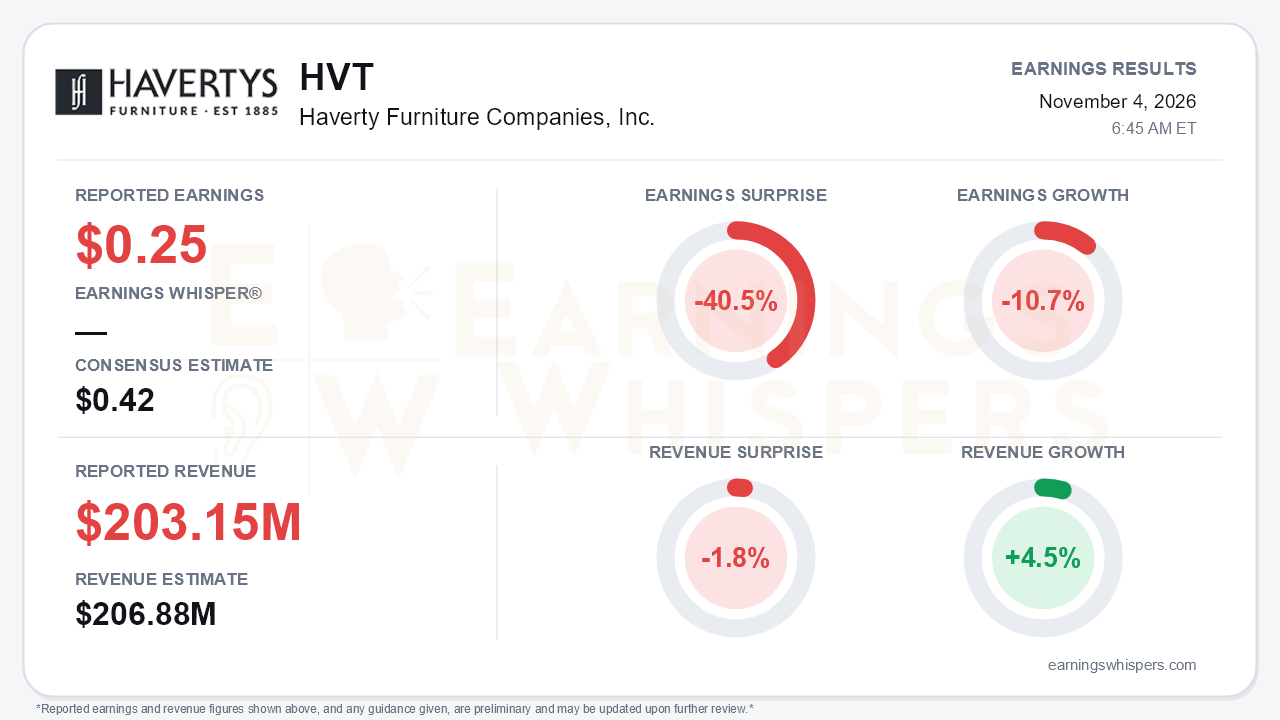
Haverty Furniture's third quarter looked healthy on a GAAP basis and weak underneath it. Diluted EPS rose to $0.39 from $0.28, but that figure includes about $3.2 million of IEEPA tariff refunds. Excluding them, adjusted EPS was $0.25, which missed the $0.42 consensus by 40.5% and was down 10.7% from a year ago. Even the refund-boosted GAAP figure fell short of consensus. Revenue rose 4.5% to $203.15 million but missed the $206.88 million estimate by 1.8%. The central tension is that a one-time refund is supporting both the headline profit and a raised margin outlook at the moment demand is clearly losing momentum.
The quality of the quarter deserves scrutiny. Reported gross margin of 62.3% looks impressive, but excluding refunds it was 60.7%, only modestly above last year's 60.3%. Adjusted for both refunds and LIFO, it was 61.3%. The full-year gross margin guide rose to 61.3%-61.5% from the 60.5%-61.0% range held since late 2025, and management tied the increase to refunds rather than to the core business. Operating costs moved the wrong way. SG&A deleveraged to 58.6% of sales from 57.8% as administrative expenses rose $4.1 million, driven by about $2 million of accelerated stock vesting plus higher incentive pay and group insurance costs. The variable SG&A guide was raised for a second straight quarter, to 19.2%-19.4% from 18.7%-18.9%, citing delivery, transportation and third-party credit costs. Refund-adjusted EPS of $0.25 was flat with the second quarter's comparable figure, so the underlying earnings base is not expanding.
The call made the deceleration plain. Comp-store written business slowed to +2.3% from +12.3% in the second quarter, and delivered comps eased to +4.1% from +8.0%. August and September written sales rose just 1.7%, and the Labor Day event was flat. Traffic swung from slightly positive in the second quarter to down mid-single digits. Average ticket growth roughly halved to +7.4% from +14%, and management described the gain as mostly price-driven with flat units. The design business, a key differentiator, cooled as well:
- Design consultants' share of written business slipped to 34.6% from 36.5%.
- Custom order growth eased to +16.9% from +23.6%.
Management acknowledged that leverage is becoming more difficult and blamed midterm-election noise for disrupting marketing. It now describes that disruption as behind the company.
The forward cost picture adds to the pressure. Management cited diesel near $6 a gallon, container rates up 25%-30%, mid-single-digit material inflation, and rising LIFO and health insurance costs. New tariff risks include a possible Section 232 increase from 25% to 30% on January 1, 2027 and a potentially higher Vietnam reciprocal tariff. Vietnam supply-chain strains include labor availability, a mandated 7% wage increase in January 2027, CBP inspections and longer lead times. Inventory fell to $86.7 million, below the roughly $95 million target, which management called an over-correction, and the year-end target was lowered to $90-$100 million. Management also tightened no-interest credit promotions outside promotional periods to curb credit costs, which could weigh on conversion.
There are genuine offsets. The balance sheet is debt-free, with $120.3 million in cash, up from $104.3 million last quarter, and $100 million of credit availability. Year-to-date operating cash flow rose to $52.4 million. The company repurchased about 723,000 shares for $16.6 million and added a $15 million authorization in August, leaving roughly $16.8 million available. Unit growth remains intact. Five fourth-quarter openings, including entry into Pittsburgh as an 18th state, should bring the store count to 133. The new Fredericksburg store is beating expectations, and several 2027 leases are in negotiation. E-commerce written sales grew double digits again.
The market setup is more complicated than the stock chart implies. Shares entered the report at $29.43, up 11.2% since the post-August open. That is 17.3% above the 200-day moving average and just 3.8% below the 52-week high of $30.60 set on November 2. The Earnings Whispers trend signals were mostly positive heading in. Investor sentiment, however, slid from slightly positive (0.07) to modestly negative (-0.12), a meaningful shift that suggests some skepticism had already crept in. With the stock priced near its highs, the gap between the chart and the slowing order book is where bears have legitimate ammunition.
The bottom line is that Havertys' headline earnings growth and higher margin guidance rest largely on tariff refunds. The core business produced a sizable miss, decelerating written comps, falling traffic and a rising cost guide. The balance sheet, buybacks and store expansion give the long-term story credibility. The near-term question is whether demand can re-accelerate before cost inflation and tariff risks erode the margin gains the refunds are currently masking.
Read our earnings preview for Haverty Furniture Companies, Inc.: https://www.earningswhispers.com/article/HVT/22424
This earnings review was originally published on Earnings Whispers.
This article is for informational purposes only and is not investment advice. Earnings Whispers and its staff may hold positions in the securities mentioned. It is AI-assisted, based on proprietary Earnings Whispers data and company reports, and edited by Earnings Whispers staff.
Mentioned In This Article
Latest News
| Nov-06 | |
| Nov-04 | |
| Nov-04 | |
| Oct-28 | |
| Oct-28 | |
| Sep-18 | |
| Aug-07 | |
| Aug-04 | |
| Aug-04 | |
| Jul-28 | |
| May-15 | |
| May-05 | |
| Apr-28 | |
| Mar-03 | |
| Feb-24 |
