Traeger Misses As Q3 Revenue Drops 40%, Leaving Its Unchanged Full-Year Outlook Dependent On A Lowe's-Driven Fourth Quarter
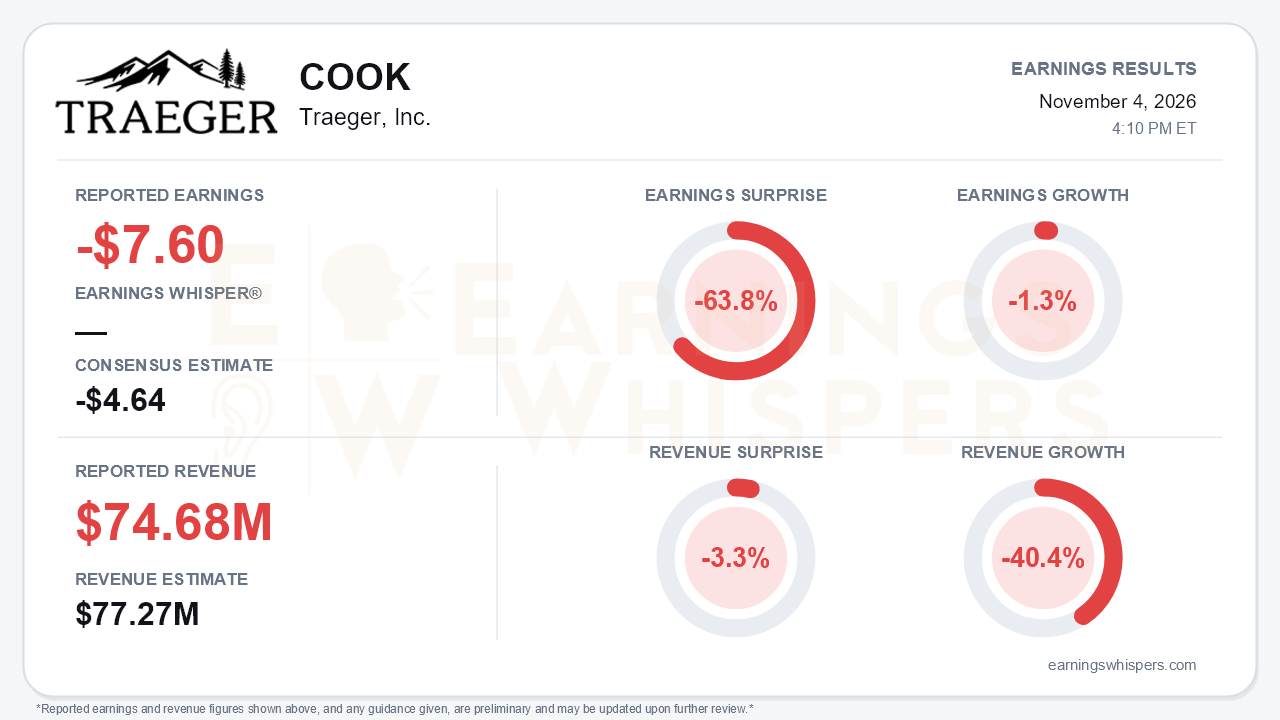
Traeger (NYSE: COOK) delivered a weak third quarter and asked investors to look past it. The company reported a loss of $7.60 per share on an Earnings Whispers-normalized basis, against a consensus loss of $4.64, a 63.8% miss. The loss was 1.3% wider than a year ago. Revenue fell 40.4% to $74.68 million, 3.3% below the $77.27 million consensus. The normalized figure sits between Traeger's GAAP loss of $10.33 per share and its own adjusted loss of $6.77. On either basis, the quarter fell short. Management nonetheless held the midpoints of its full-year revenue and adjusted EBITDA guidance, narrowing the ranges to $440-$460 million and $59-$65 million. That is the central tension: a quarter that deteriorated badly, paired with an outlook that now rests heavily on a single, event-driven fourth quarter.
The quality of the quarter deserves scrutiny. Grill revenue fell 48.1% to $39.7 million, consumables dropped 23.1%, and accessories declined 34.1% on softer MEATER and branded-accessory sales. Part of the grill decline reflects lapping roughly $20 million of elevated retailer purchases a year ago. Still, the trajectory worsened from a 17% decline in Q2 and a 34% decline in Q1. Gross margin compressed 520 basis points to 33.5%, down from 39.5% in Q2. Management cited trade-spend timing, warehouse deleverage, and MEATER pressure. Adjusted EBITDA swung to a $3.3 million loss from a $13.8 million profit last year and $17 million in Q2. The GAAP loss narrowed to $28.5 million from $89.8 million, but that comparison is flattered by last year's $74.7 million goodwill impairment. Project Gravity cost cuts reduced sales and marketing and G&A spending, yet those savings could not offset the revenue shortfall.
The call framed Q3 as a timing problem. CEO Jeremy Andrus said revenue came in at the low end of the company's pacing. Container constraints and a typhoon pushed shipments into Q4, and he argued consumer demand is "healthier than our reported revenue suggests." There is some supporting evidence:
- Sell-through of grills priced under $600 is growing double digits.
- Influencer impressions rose more than 50%.
- Home Depot return on ad spend doubled.
That same mix shift, however, keeps pushing average selling prices lower. Pellets, previously a steady category, now face lower-priced competition and lost exclusivity in certain channels. That is a structural concern rather than a timing one.
The forward story hinges on Lowe's. The rollout moved from announcement to execution: Lowes.com went live November 2, pellets are slated for stores before Black Friday, and fixtures arrive in a subset of doors in February-March 2027. Management expects the Q4 load-in to drive a return to year-over-year revenue and adjusted EBITDA growth. The math is demanding. Nine-month revenue of $288.9 million implies roughly $151-$171 million in Q4 to hit guidance. Nine-month adjusted EBITDA of $31.2 million implies about $28-$34 million in the quarter. The 40-41% gross margin target also requires a sharp Q4 recovery. Year-to-date margin of 40.0% includes a 3.2-point benefit from the IEEPA tariff refund; excluding it, margin is 36.8%. Bears have legitimate ammunition. A one-time load-in creates concentration and execution risk, and fiscal 2027 must lap roughly $16.5 million of tariff refunds amid freight and fuel headwinds. Management nonetheless explicitly targets 2027 revenue and EBITDA growth even after cycling that benefit.
The balance sheet is the clearest bright spot. Year-to-date free cash flow reached $49.4 million, well above the reiterated floor of at least $30 million. Cash rose to $67.8 million from $19.6 million at year-end, inventory fell to $79.5 million, and net debt declined to $335 million from $384 million at the end of fiscal 2025. Some of that cash came from working-capital release and a $11.6 million employee retention credit, and total liquidity eased to $167 million from $188 million in Q2. Roughly $400 million of notes remain a meaningful overhang.
Investor sentiment flipped from mildly positive at 0.16 after the prior report to mildly negative at -0.15, a meaningful swing that reflects eroding confidence. The stock entered the report at $50.91, down 26.7% from the $69.50 open after the August release, which marked the inter-earnings high. Shares bottomed at $42.80 in late September and have since rebounded about 19%, landing almost exactly on the $50.93 200-day moving average. The trend readings are mixed, with price trend negative while AVWAP remains positive.
The bottom line is that Traeger's quarter was weak on revenue, margin, and EBITDA, and the unchanged guidance midpoints shift nearly all of the burden of proof onto Q4. Cash generation and the Lowe's rollout give management a credible path. With pellets under pressure, ASPs falling, and a tariff refund to lap, investors will want evidence that the Q4 rebound reflects durable demand rather than a one-time channel fill.
Read our earnings preview for Traeger, Inc.: https://www.earningswhispers.com/article/COOK/22016
This earnings review was originally published on Earnings Whispers.
This article is for informational purposes only and is not investment advice. Earnings Whispers and its staff may hold positions in the securities mentioned. It is AI-assisted, based on proprietary Earnings Whispers data and company reports, and edited by Earnings Whispers staff.
Mentioned In This Article
Latest News
| Nov-04 | |
| Nov-04 | |
| Nov-04 | |
| Oct-28 | |
| Oct-21 | |
| Aug-06 | |
| Aug-05 | |
| Aug-05 | |
| Aug-04 | |
| Jul-22 | |
| May-12 | |
| May-11 | |
| May-11 | |
| May-08 | |
| Apr-28 |
