Nuvation Bio Beats On Revenue, Misses On EPS As Ibtrozi's First-Line Momentum Stalls
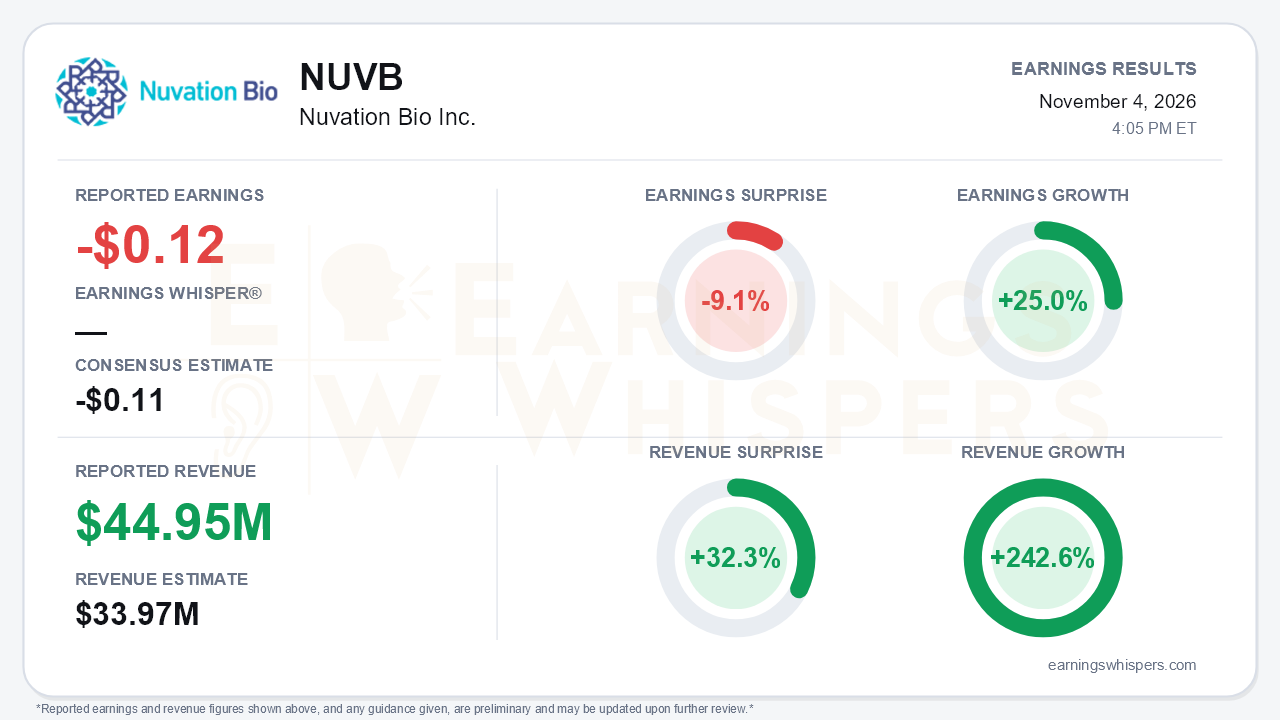
Nuvation Bio's third quarter looked strong on revenue, but the call showed something more important: the first visible crack in Ibtrozi's demand story. The company reported a loss of $0.12 per share, missing the -$0.11 consensus by 9.1%, on revenue of $44.95 million, which beat the $33.97 million estimate by 32.3%. Earnings improved 25.0% year over year as the net loss narrowed from $55.8 million, or $0.16 per share, to $41.9 million. Revenue grew 242.6%. The central tension is that Ibtrozi sales are still climbing while the patient-start trends that should drive future revenue have stopped improving.
The quality of the revenue beat deserves scrutiny. Ibtrozi net product revenue was $27.5 million, up 18% sequentially, but collaboration and license revenue did much of the heavy lifting. It rose to $17.5 million from $8.5 million in the second quarter. That line included a $5.0 million sales milestone from Innovent and a $7.6 million year-over-year increase in product supply revenue. Supply revenue carries a substantial cost: cost of collaboration revenue was $9.8 million. As a result, the top-line beat did not carry through to the bottom line. Total operating expenses, R&D plus SG&A, were $75.2 million, up modestly from $73.3 million in the second quarter, and the operating loss was still $42.2 million. Partner momentum is real, since China and Japan launches are running ahead of plan with $7.7 million in milestones and royalties. Even so, milestone-driven revenue is lumpy, and it should not be confused with the U.S. franchise's underlying growth rate.
That underlying rate is decelerating. Sequential Ibtrozi growth slowed to 18% from 25% in the second quarter. Total new patient starts were flat at roughly 160, well below the approximately 200-per-quarter pace seen through the first quarter. The more troubling detail is the mix. First-line patients made up about 65% of new starts, down from about 85% in the second quarter. That implies first-line starts fell to roughly 104 from about 136, after growing around 30% the prior quarter. The press release presents the 65% figure as evidence that Ibtrozi is becoming the first-line standard of care, but the call math points the other way. Absolute first-line starts declined, which undercuts the revenue-stacking narrative behind a long-duration therapy. Management attributed the weakness to a roughly 15% sequential decline in total ROS1 TKI starts and about 25% fewer lab testing alerts, calling it ultra-rare-disease lumpiness. That explanation is plausible, and Ibtrozi's first-line share did rise above 60% from above 50%. However, management also acknowledged that the pool of pretreated patients available to switch is largely depleted. Growth now depends on newly diagnosed patients, the very segment that softened.
Forward visibility also dimmed. Management declined to explicitly endorse the roughly $108 million full-year revenue consensus and offered only a vague comment on the fourth quarter. The call's tone moved from second-quarter confidence to defensive explanations and comparisons with ALK-market dynamics. Competitive risk is also building, with GSK's zidesamtinib heading toward a first-line filing. On the positive side, the FDA approved the label update showing a 49.7-month median duration of response four months early. A major community pathway named Ibtrozi its primary first- and second-line ROS1 TKI. Management also described Ibtrozi as commercially self-sustaining for the first time. The balance sheet is solid, with $663.4 million in cash and securities, though that figure was bolstered by $287.5 million in convertible notes. A roughly $30 million EU milestone is reaffirmed for the first half of 2027. Safusidenib, meanwhile, added Fast Track designation, SNO data are due next week, and readouts in two glioma cohorts are expected in 2027.
The market setup is more complicated than the revenue surprise implies. Investor sentiment improved meaningfully into the report, moving from -0.15 to +0.11, a shift from mildly negative to mildly positive. The stock tells a harsher story. As of the pre-report snapshot, shares were at $4.69, down 22.6% from the $6.06 opening price after the August report and 12.9% below the 200-day moving average. They had fallen 38.1% from the August 19 inter-earnings high of $7.58 and sat just 7.9% above the October low. The Earnings Whispers trend readings are split along the same lines: sequential growth and momentum are positive, while price and AVWAP remain negative. Investors had already discounted some demand risk, and this call gave bears legitimate ammunition to argue the discount was justified.
The bottom line is that Nuvation delivered a revenue beat built partly on partner milestones and supply sales, while the U.S. growth engine showed its first real stall. Flat new starts, falling first-line volume, a depleted switch pool, and noncommittal guidance matter more than the headline beat. A strong balance sheet, label durability, and the safusidenib pipeline keep the longer-term story credible. Near term, however, the stock likely needs evidence that the third quarter's first-line softness was lumpiness rather than a ceiling.
Read our earnings preview for Nuvation Bio Inc.: https://www.earningswhispers.com/article/NUVB/21891
This earnings review was originally published on Earnings Whispers.
This article is for informational purposes only and is not investment advice. Earnings Whispers and its staff may hold positions in the securities mentioned. It is AI-assisted, based on proprietary Earnings Whispers data and company reports, and edited by Earnings Whispers staff.
Mentioned In This Article
Latest News
| Nov-04 | |
| Nov-04 | |
| Nov-02 | |
| Oct-29 | |
| Oct-27 | |
| Oct-21 | |
| Sep-17 | |
| Sep-15 | |
| Sep-02 | |
| Aug-20 | |
| Aug-06 | |
| Aug-04 | |
| Jul-22 | |
| Jul-20 | |
| Jul-20 |
