Matson Beats On A China Peak-Season Surge, But The Biggest Tailwinds May Not Outlast Early 2027
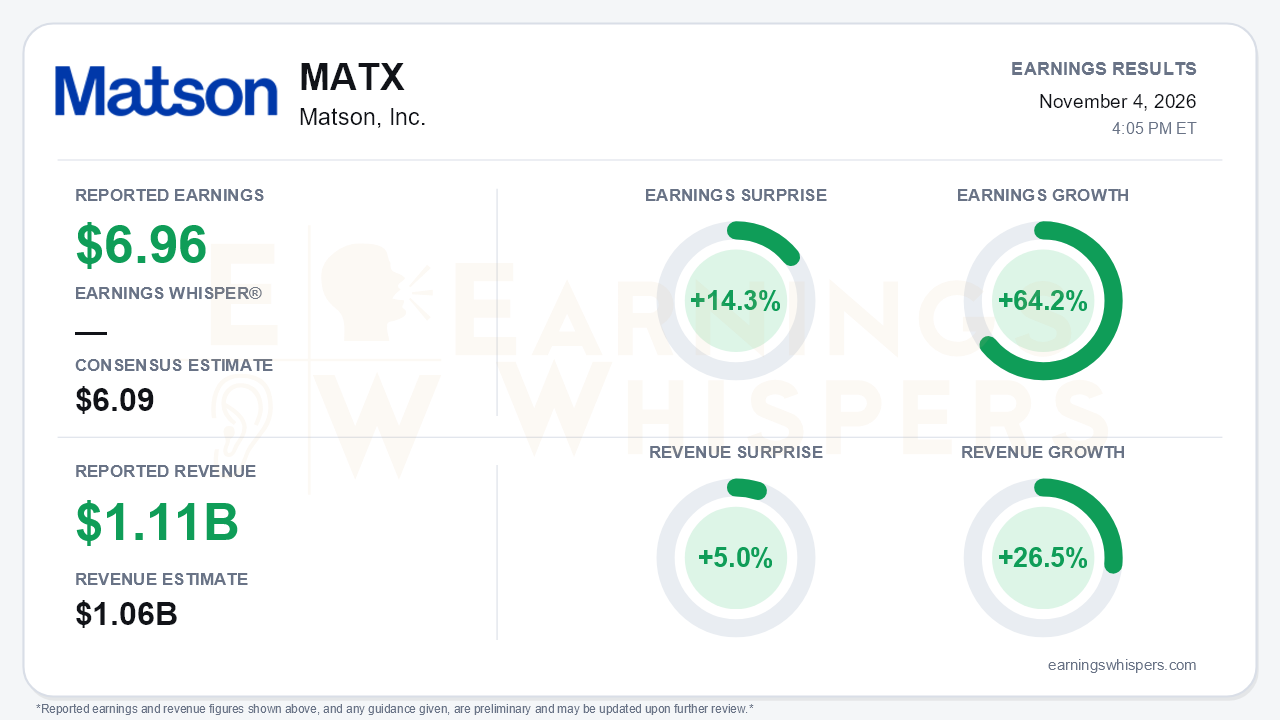
Matson delivered the kind of quarter that changes the conversation around a stock, at least for the next two quarters. Third-quarter EPS of $6.96 beat the $6.09 consensus by 14.3% and rose 64.2% from a year ago. Revenue of $1.114 billion topped the $1.06 billion estimate by 5.0% and grew 26.5%. Management also raised its outlook, guiding fourth-quarter consolidated operating income about 50% above the $143.7 million earned a year ago. The central tension is what is driving the surge. Nearly all of it came from the China expedited service, where storms, port congestion and blank sailings have tightened Transpacific capacity. Management itself concedes some of those conditions may be temporary. The result is a powerful near-term earnings story built on a foundation investors will need to stress-test for 2027.
The composition of the beat is lopsided but genuine at the operating level. Ocean Transportation operating income jumped 62.2% to $239.1 million on revenue up 24.1%, and segment margin expanded to 26.8% from 20.5%. China volume rose 16.0%, and the company cited higher freight rates plus fuel-surcharge revenue that more than covered higher fuel costs. Consolidated operating income climbed to $255.2 million from $161.0 million. Per-share growth also got a lift from capital returns. Diluted shares fell to 30.1 million from 31.8 million, which helps explain why EPS growth outpaced the 55.5% increase in net income. Matson bought back another $59.8 million of stock in the quarter. Below the operating line, interest income fell to $5.1 million from $7.6 million as Capital Construction Fund balances were drawn down for vessel payments. Logistics grew operating income 18.4% to $16.1 million on brokerage and forwarding strength, but segment margin slipped to 7.2% from 8.4% as warehousing weakened.
The call underscored how quickly the China narrative has inflected. China volume swung from a 9.5% decline in the first quarter to a 16% gain in the third. Full-year guidance for China volume progressed from "modestly higher" to expecting to exceed 2025, with ships full or nearly full in the fourth quarter. Management's tone moved from cautious yield management earlier in the year to describing the service as multiple times oversubscribed. It credited speed and reliability amid Asian port congestion, El Niño-related storms and blank sailings. It also cited AI and data-center demand tightening air freight and pushing e-commerce cargo toward ocean expedited. Peak season has already run through October, and the company expects strong demand and elevated rates to persist into early 2027.
The weaker threads were in the domestic franchise, the historical bedrock of the investment case. Hawaii volume dipped 0.3% as softer tourism and energy-related inflation slowed the state's economy. Alaska volume fell 4.8% on lower seafood shipments and a tough sailing comparison. Full-year guidance for both trades was cut from comparable to modestly lower. SSAT's terminal contribution fell to $7.4 million from $9.3 million and is now expected to come in below last year's $32.5 million. The forward risks are more consequential than these domestic soft spots:
- **Competition:** Zim is reintroducing a third expedited Transpacific string in December.
- **Capacity:** Global newbuild deliveries and a possible Red Sea normalization could loosen the market.
- **Matson's own growth:** Incremental China capacity from the Aloha-class vessels is now expected at about 12,000 containers a year, down from 15,000. The first of those ships, Makua, is due in the first quarter of 2027.
Investors should also note that fourth-quarter EPS growth will likely trail operating income growth. Management guides a tax rate of about 20%, versus 5.2% a year ago, when a one-time $0.59-per-share benefit flattered results.
The market setup is more complicated than the surprise implies. Investor sentiment remained positive but weakened meaningfully into the report, falling from 0.42 to 0.14. That suggests enthusiasm had cooled even as fundamentals were improving. Shares closed at $221.57 the day before the release, down 2.8% since the open after the August report. That price is 8% below the 52-week high of $240.87 set in mid-September but still 14.6% above the 200-day moving average. The stock had already given back part of a peak-season rally, which may reflect the same durability worries the call acknowledged. Momentum readings remain constructive, though the AVWAP trend is negative.
The bottom line is that Matson delivered a clean beat, accelerating growth and a raised outlook. The release also showed strong cash generation and a balance sheet with debt down to $331.2 million. The quality of the earnings is real, but their durability is the open question. China rates and volumes are carrying results while Hawaii, Alaska and SSAT soften. Several drivers behind those rates are disruptions rather than structural gains. Bulls have visibility through early 2027. Bears have legitimate ammunition in new competition, potential capacity normalization and a smaller-than-planned Aloha-class capacity boost.
Read our earnings preview for Matson, Inc.: https://www.earningswhispers.com/article/MATX/21868
This earnings review was originally published on Earnings Whispers.
This article is for informational purposes only and is not investment advice. Earnings Whispers and its staff may hold positions in the securities mentioned. It is AI-assisted, based on proprietary Earnings Whispers data and company reports, and edited by Earnings Whispers staff.
Mentioned In This Article
Latest News
| Nov-04 | |
| Nov-04 | |
| Nov-04 | |
| Oct-27 | |
| Oct-21 | |
| Oct-20 | |
| Oct-19 | |
| Oct-12 | |
| Aug-06 | |
| Aug-04 | |
| Aug-04 | |
| Aug-03 | |
| Aug-03 | |
| Jul-15 | |
| Jul-15 |
