QuinStreet Crushes Q1 Expectations As Auto Insurance Accelerates Again, But A Measured Raise And Seasonal Q2 Guide Temper The Upside
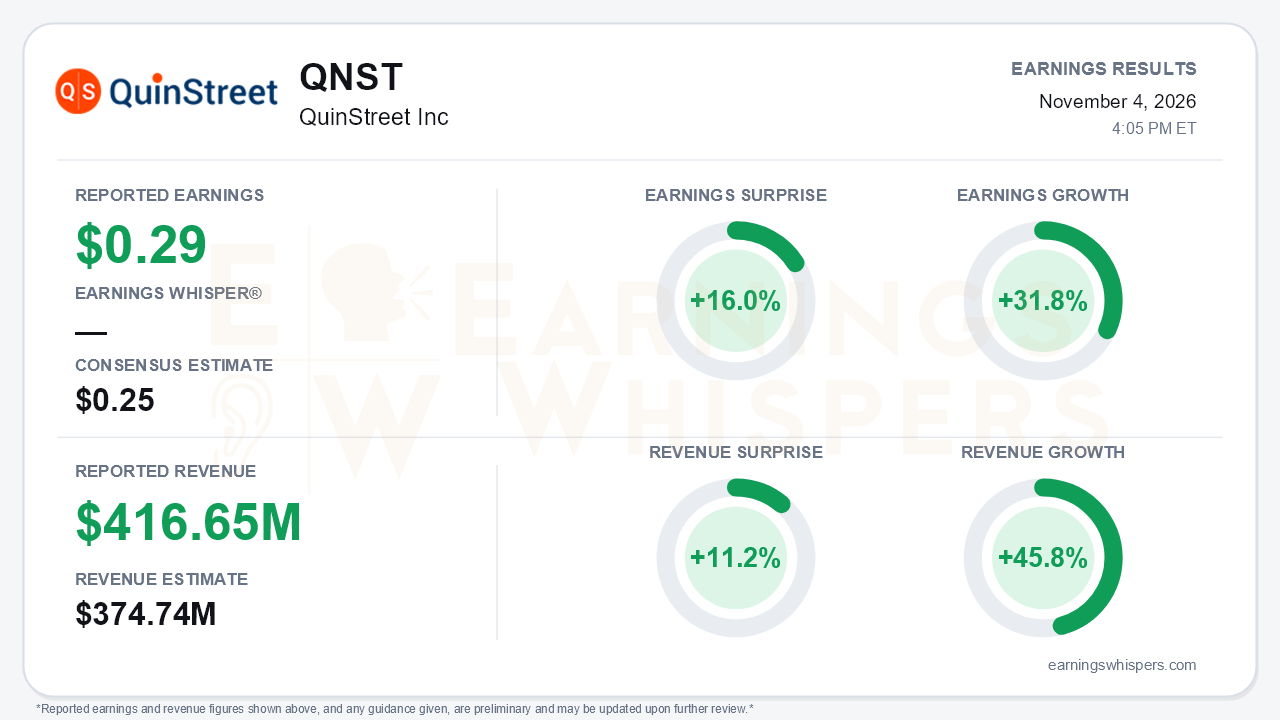
QuinStreet opened fiscal 2027 with a decisive beat. GAAP earnings of $0.29 per share topped the $0.25 consensus by 16.0%, and revenue of $416.65 million beat the $374.74 million estimate by 11.2%. Earnings grew 31.8% year over year and revenue rose 45.8%. On an adjusted basis, net income more than doubled to $0.50 per share from $0.22, and adjusted EBITDA rose 108% to $42.7 million, above the company's own $38-40 million guide. The central tension is that the quarter was far stronger than the raise that followed. Management lifted full-year revenue guidance to $1.5-1.6 billion and adjusted EBITDA to $155-165 million, a move Earnings Whispers characterizes as in line with estimates. With Q1 revenue landing roughly $42 million above the guidance midpoint and the full-year midpoint rising $50 million, the outlook for the remaining three quarters moved only modestly.
The quality of the beat holds up well. Gross profit nearly doubled to $53.3 million on 46% revenue growth, so this was more than volume flowing through a thin-margin marketplace. Operating income rose to $23.3 million from $4.8 million. Higher interest expense of $2.2 million and a more normal tax provision absorbed part of that gain, which is why GAAP net income of $17.0 million trails the adjusted figure by a wide margin. Stock-based compensation of nearly $11 million remains the largest reconciling item. Cash generation was solid but not spectacular. Operating cash flow was $23.3 million and free cash flow was $20.3 million, held back by a $27 million increase in receivables as the business scaled. Net debt fell to roughly $10 million from $22 million last quarter and $54 million two quarters ago. One trade-off came with that deleveraging: buybacks paused after $14.6 million of repurchases in Q4.
The operating story is about acceleration in the company's largest franchise. Auto insurance growth has stepped up on every call: -2% in fiscal Q2 2026, then +27%, +37%, and now +42%. The vertical now runs above an $800 million annual rate, with about eight carriers spending more than $1 million per month. Financial Services overall grew 31%, up from 24% and 16% in the prior two quarters. Home Services was arguably more impressive, rising 86% to $145.7 million and now running above $500 million annually, helped by the HomeBuddy integration. Beneath the strength, the call showed soft spots. Banking revenue fell year over year on rate uncertainty, and personal loans were flat, although both grew sequentially. Adjusted EBITDA margin of 10.2% was up 300 basis points year over year but dipped from 11.1% in Q4.
The forward debate centers on fiscal Q2. Management guided revenue to $360-380 million and EBITDA to $32-33 million, a seasonal sequential decline that implies growth slowing to 29% and 54%. That guide excludes any December-quarter auto insurance budget flush, which gives the company a plausible source of upside. Management also repeated that there may be room to grow revenue and expand margins further. Catalysts include:
- the post-quarter Get the Referral acquisition;
- integration with OpenAI's ad platform across nearly all verticals;
- talks with AI shopping agents about a gateway role;
- a retooled personal loans unit targeting a 5-10x footprint expansion.
Bears still have legitimate ammunition. The AI disintermediation narrative has not gone away, and some clients are blocking agents. Auto demand is outrunning media supply, which could cap conversion of carrier budgets. Rising rates or a softer consumer could also pressure Home Services.
The market setup is more complicated than the surprise implies. Investor sentiment improved modestly ahead of the report, from -0.31 to -0.25, but remained negative. The stock has been volatile. It set a 52-week high of $22.29 on August 10, just after the prior report, then fell to $13.96 by late September. Shares entered this report at $18.29, about 7% below the post-report opening price of $19.69 and nearly 18% below the August peak. They had nonetheless rebounded 31% off the low and sat about 26% above the 200-day moving average. The internal trend readings are mixed, with momentum positive while AVWAP remains negative, consistent with a stock that has recovered but has not reclaimed its post-August highs.
The bottom line is that QuinStreet delivered a high-quality beat backed by accelerating auto insurance growth, near-doubling Home Services revenue, and a cleaner balance sheet. Investors still have reason to question why a quarter this strong produced only an in-line raise and a seasonally softer Q2 guide. With sentiment still negative and the stock well off its August high, the bar is not demanding. Proving that auto supply can keep pace with demand, and that AI strengthens rather than erodes the marketplace, will determine whether the market pays for the conservatism management appears to have built into the outlook.
Read our earnings preview for QuinStreet Inc: https://www.earningswhispers.com/article/QNST/21918
This earnings review was originally published on Earnings Whispers.
This article is for informational purposes only and is not investment advice. Earnings Whispers and its staff may hold positions in the securities mentioned. It is AI-assisted, based on proprietary Earnings Whispers data and company reports, and edited by Earnings Whispers staff.
Mentioned In This Article
Latest News
| Nov-04 | |
| Nov-04 | |
| Nov-04 | |
| Oct-27 | |
| Oct-13 | |
| Sep-24 | |
| Aug-14 | |
| Aug-12 | |
| Aug-07 | |
| Aug-06 | |
| Jul-23 | |
| Jun-02 | |
| May-11 | |
| May-08 | |
| May-07 |
