Enact Misses As Credit Costs Normalize, Leaning On Buybacks And A Bigger Capital-Return Pledge While MI-Cancellation Risk Emerges
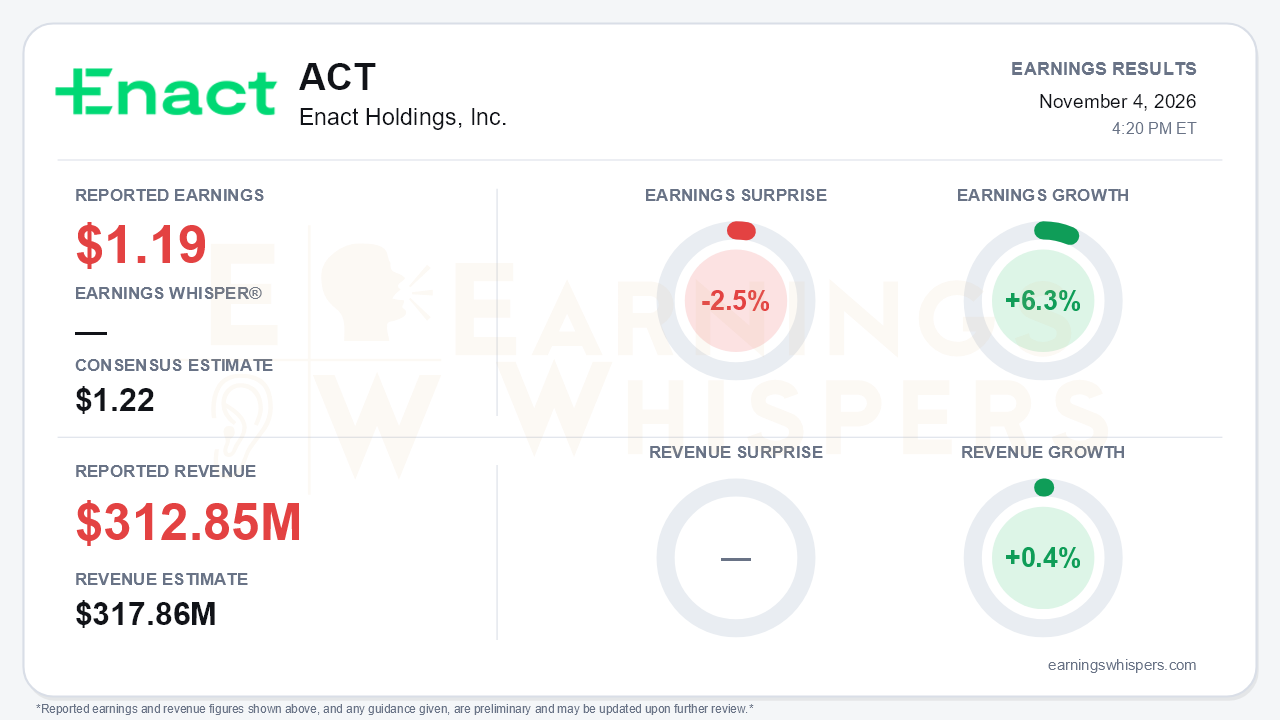
Enact Holdings delivered a modest third-quarter miss. Adjusted operating earnings were $1.19 per share against a $1.22 consensus, a 2.5% shortfall. Revenue of $312.85 million came in 1.6% below the $317.86 million estimate. On paper, earnings still grew 6.3% year over year while revenue rose just 0.4%, but the headline growth rate flatters the underlying business. Adjusted operating income actually slipped to $164 million from $166 million a year ago. The per-share gain came entirely from a diluted share count that fell to roughly 138 million from 148 million. Sequentially, the picture is plainly softer: adjusted EPS dropped from $1.26 in the second quarter and $1.21 in the first, and adjusted operating ROE fell to 12.4% from 13.2%. That is the central tension. Enact is shrinking its share base and raising its capital-return promise faster than its earnings power is expanding.
The quality of the quarter deserves scrutiny on the credit side. Losses incurred jumped to $47 million from $33 million in Q2, lifting the loss ratio to 20% from 14% and from 15% a year ago. The reserve release was $37 million, unchanged from Q2 but below last year's $45 million. Excluding releases, losses rose on seasonally higher new delinquencies and on newer books maturing along their expected loss curves. The top line offered little offset. Net premiums earned slipped 1% to $242 million as quota share reinsurance ceded more premium, and the net earned premium rate fell 0.7 basis points to 33.4 bps on lower profit commissions. The cushions were expense discipline and the investment portfolio. Operating expenses fell to $50 million, and net investment income rose to $74 million, up 9% year over year, on a 4.7% book yield.
The call reinforced a picture of a business holding steady at the top line while margins compress. New insurance written fell 7% sequentially to $14 billion as higher rates curbed refinancing, and 93% of volume was purchase originations. That same rate backdrop helped persistency tick up to 81%, keeping primary insurance in-force at $275 billion, up 1% year over year. Delinquency trends are the more consequential shift. New delinquencies rose to 14,400 from 12,300, and the delinquency rate reached 2.8%. Management now expects gradual increases into 2027 as the 2022-2024 vintages season. That outlook signals that the era of near-zero credit costs propped up by large reserve releases is fading. Analysts characterized the tone as confident but more defensive in Q&A.
Management kept nudging the controllable levers in shareholders' favor:
- **Capital return:** full-year guidance rose to approximately $600 million, up from $550-600 million last quarter and roughly $500 million at the start of the year.
- **Third-quarter payout:** Enact returned $151 million, including $118 million of buybacks at an average $48.19.
- **Continued repurchases:** it bought another $57 million at $45.68 through November 3, leaving about $200 million on the authorization.
- **Expense guidance:** the opex outlook moved to the low end of $205-210 million, versus $215-220 million originally.
- **Ratings and reinsurance:** AM Best upgraded the operating subsidiaries to A, and a forward quota share now covers about 35% of 2028 NIW.
PMIERs sufficiency fell to 158% from 161% after a $200 million dividend from EMICO to the holding company, but $1.8 billion of excess capital remains ample.
Bears have legitimate ammunition beyond credit normalization. A presidential executive order directing an FHFA pilot on mortgage insurance cancellation for new originations, based on automated valuations and home price appreciation, introduces a policy overhang whose parameters remain unknown. Unrealized investment losses widened by $248 million to $345 million. As a result, reported book value per share fell to $38.30 from $39.06, even as book value excluding AOCI rose to $40.47. Genworth CEO Tom McInerney's departure from the board is a governance footnote worth monitoring given Genworth's ownership stake.
Investor sentiment remained negative but improved meaningfully heading into the report, rising to -0.17 from -0.48. Skepticism has eased without disappearing. The stock has gone essentially nowhere since the last report, at $48.24 versus a $48.06 post-report open. The lower average price on October-November repurchases suggests shares dipped before recovering. Shares sit about 8.5% above their 200-day moving average of $44.44, so the market has not been punishing the name despite flattening earnings. The Earnings Whispers trend readings are mixed, with momentum positive but AVWAP negative.
The bottom line is that Enact's quarter was a small miss that exposed a business whose earnings power has plateaued. Rising delinquencies, thinner reserve releases and premium-rate pressure are eroding margins, while buybacks and expense cuts carry the per-share story. The larger capital-return commitment and the AM Best upgrade support the shareholder-yield case. Still, the credit cycle and the MI-cancellation executive order are now the variables that matter most, and neither moved in Enact's favor this quarter.
Read our earnings preview for Enact Holdings, Inc.: https://www.earningswhispers.com/article/ACT/21768
This earnings review was originally published on Earnings Whispers.
This article is for informational purposes only and is not investment advice. Earnings Whispers and its staff may hold positions in the securities mentioned. It is AI-assisted, based on proprietary Earnings Whispers data and company reports, and edited by Earnings Whispers staff.
Mentioned In This Article
Latest News
| 6 hours | |
| Nov-04 | |
| Nov-04 | |
| Oct-30 | |
| Oct-30 | |
| Oct-27 | |
| Oct-23 | |
| Oct-08 | |
| Oct-08 | |
| Oct-01 | |
| Sep-22 | |
| Sep-18 | |
| Sep-15 | |
| Sep-03 | |
| Sep-02 |
