LCI Industries Beats On Self-Help Margins, But A Deepening RV Slump Forces Another Guidance Trim
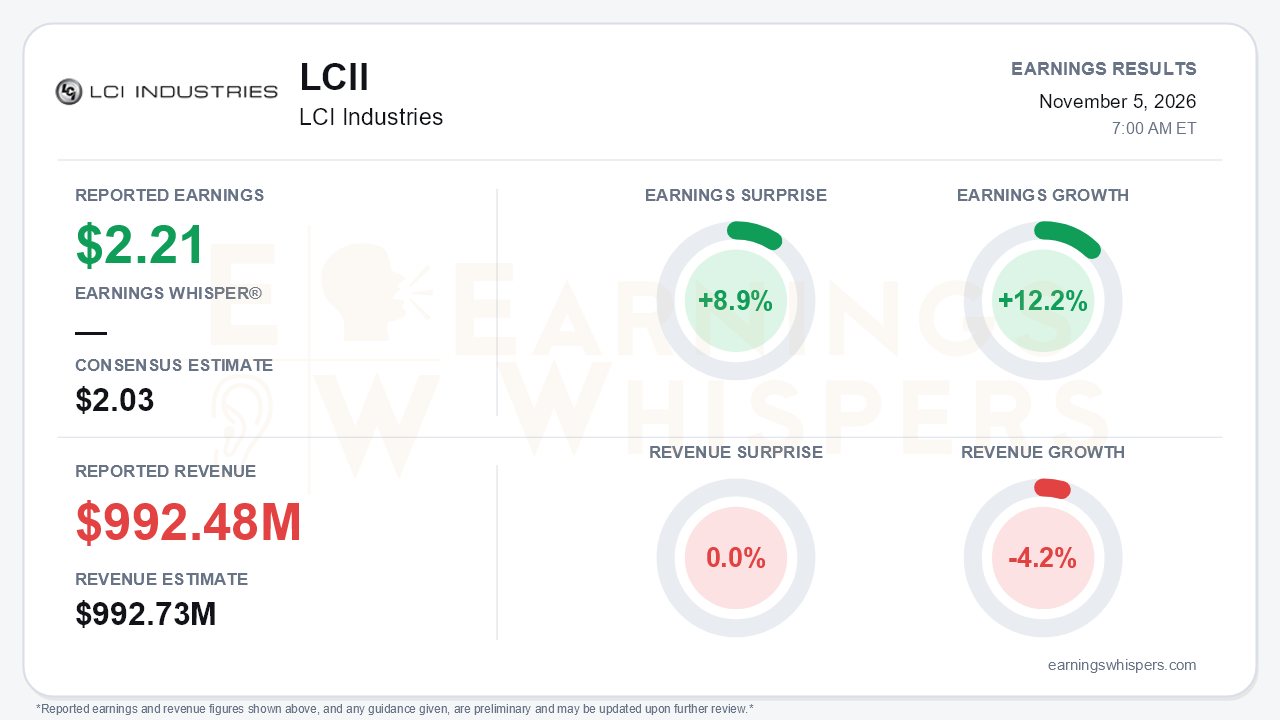
LCI Industries delivered a clean earnings beat in a quarter where the top line offered no help. Adjusted EPS of $2.21 topped the $2.03 consensus by 8.9% and grew 12.2% year over year. Revenue of $992.48 million matched the $992.73 million estimate but fell 4.2%. The central tension is that LCI's profit story is entirely self-help while its core RV volume story is getting worse. Management narrowed full-year guidance again by trimming the high end, and October sales are tracking down 10%, a steeper decline than the third quarter itself.
The quality of the beat deserves scrutiny from two directions. On a GAAP basis, diluted EPS fell 20% to $2.05 from $2.55. Most of that gap is a comparison problem rather than an operating one: the prior-year quarter included a $0.80-per-share gain on real estate. The current quarter absorbed $0.21 of merger expenses and $0.10 of restructuring costs tied to plant consolidations. Underneath, the margin gains are real:
- Gross profit rose to $263.8 million from $252.6 million on lower sales, reflecting sourcing savings and index-linked pricing.
- Adjusted operating margin expanded 100 basis points to 8.3%.
- Adjusted EBITDA margin improved to 11.2%.
The improvement is not friction-free, though. Warehouse and transportation costs jumped roughly $10 million year over year, and reported operating profit was essentially flat at $75.0 million. The segment picture also split:
- OEM margin improved to 6.0% from 5.5%.
- Aftermarket margin slipped to 11.9% from 12.9%, pressured by tariffs, metals, freight, and capacity investments.
The deterioration in RV is sharper than the consolidated numbers suggest. RV OEM sales fell 17%, compared with a 4% decline in the first quarter. Travel trailer and fifth-wheel sales dropped to $337.9 million from $412.5 million, a steeper decline than the roughly 13% drop in industry towable wholesale production. Mix explains the difference. Demand is tilting toward lower-content single-axle and 'good'-tier units, and management expects that trend to persist into 2027. That reverses the fifth-wheel mix tailwind the company anticipated earlier in the year. Towable content per unit still rose 6% to $5,733, but growth has slowed from 13% in Q1 and 11% in Q2, and content actually declined sequentially from $5,831.
The diversification thesis is the offset, and it is becoming structurally meaningful. Adjacent Industries OEM sales grew 7% to $342.4 million, driven by transportation, marine, and manufactured housing. That business is now nearly as large as RV OEM. Aftermarket rose 6%, and management framed it as approaching $1 billion in annual revenue. Management also enlarged its addressable-market framing to about $20 billion of replaceable parts and roughly 2 million RVs entering the repair cycle, up from $15 billion and 1.5 million cited earlier. Even so, aftermarket growth slowed from 11% in Q2. Product-level catalysts include:
- Ranch Hand's Texas consolidation, which adds roughly 2.5x capacity against a 20-week backlog.
- New heavy-duty bus seating.
- Window supply for off-road vehicles.
Guidance tells the forward story. Full-year revenue was narrowed to $3.9 billion to $4.0 billion, and adjusted EPS to $8.25 to $8.50. Against nine-month adjusted EPS of $7.50, that range implies a modest fourth quarter. The RV wholesale forecast now sits at 285,000 to 295,000 units, versus 335,000 to 350,000 at the start of the year. The 7.5% to 8.0% adjusted margin target held for a fourth straight call, which shows cost discipline is offsetting volume declines. It also means margin is carrying the entire earnings case.
Strategic uncertainty adds a separate layer of risk:
- The board rejected an unsolicited Monomoy Capital proposal and reaffirmed the all-stock Patrick Industries merger. That deal targets about $150 million of run-rate synergies, with a shareholder vote on November 18 and closing expected in the first half of 2027.
- Leadership remains interim.
- OEM customers are reportedly waiting for 'proof' on affordability, and some may diversify suppliers away from the combined company.
- Steel and aluminum costs remain elevated, with index pass-through lagging one to two quarters.
- No 2027 wholesale outlook was offered.
On the positive side, the balance sheet is solid. Leverage fell to 1.4x, liquidity stands at $841 million, and the company retired $92 million of convertible notes this year.
Investor sentiment improved meaningfully heading into the report, rising from roughly neutral at 0.05 to a moderately positive 0.27. Price action has been volatile. Shares hit a 52-week low of $77.58 on October 12, then rallied 34% to $104.28. That leaves the stock just 3% below its open after the August report and 4.9% below the quarter's high. It still sits about 6% under its 200-day moving average of $110.98. The Earnings Whispers trend signals are mostly negative, with sequential growth and momentum still deteriorating, though AVWAP is positive after the rebound.
The bottom line is that LCI beat because it is running a tighter operation, not because its end markets improved. Margin expansion, diversification, and deleveraging give bulls a credible case. Bears have legitimate ammunition, however: RV OEM is down 17%, content growth is slowing, October sales are down 10%, and guidance keeps drifting lower. With the stock having already rebounded sharply from its October low, the next leg likely depends less on cost execution and more on whether the merger closes cleanly and RV volumes find a floor.
Read our earnings preview for LCI Industries: https://www.earningswhispers.com/article/LCII/22129
This earnings review was originally published on Earnings Whispers.
This article is for informational purposes only and is not investment advice. Earnings Whispers and its staff may hold positions in the securities mentioned. It is AI-assisted, based on proprietary Earnings Whispers data and company reports, and edited by Earnings Whispers staff.
Mentioned In This Article
Latest News
| 1 hour | |
| 5 hours | |
| 6 hours | |
| Oct-30 | |
| Oct-28 | |
| Oct-28 | |
| Oct-28 | |
| Oct-28 | |
| Oct-22 | |
| Sep-15 | |
| Sep-01 | |
| Aug-07 | |
| Aug-07 | |
| Aug-05 | |
| Aug-05 |
