Centuri's Margin Inflection Delivers A Big Beat And Higher Guidance, But The Cash Flow Cut Undercuts A Clean Quarter
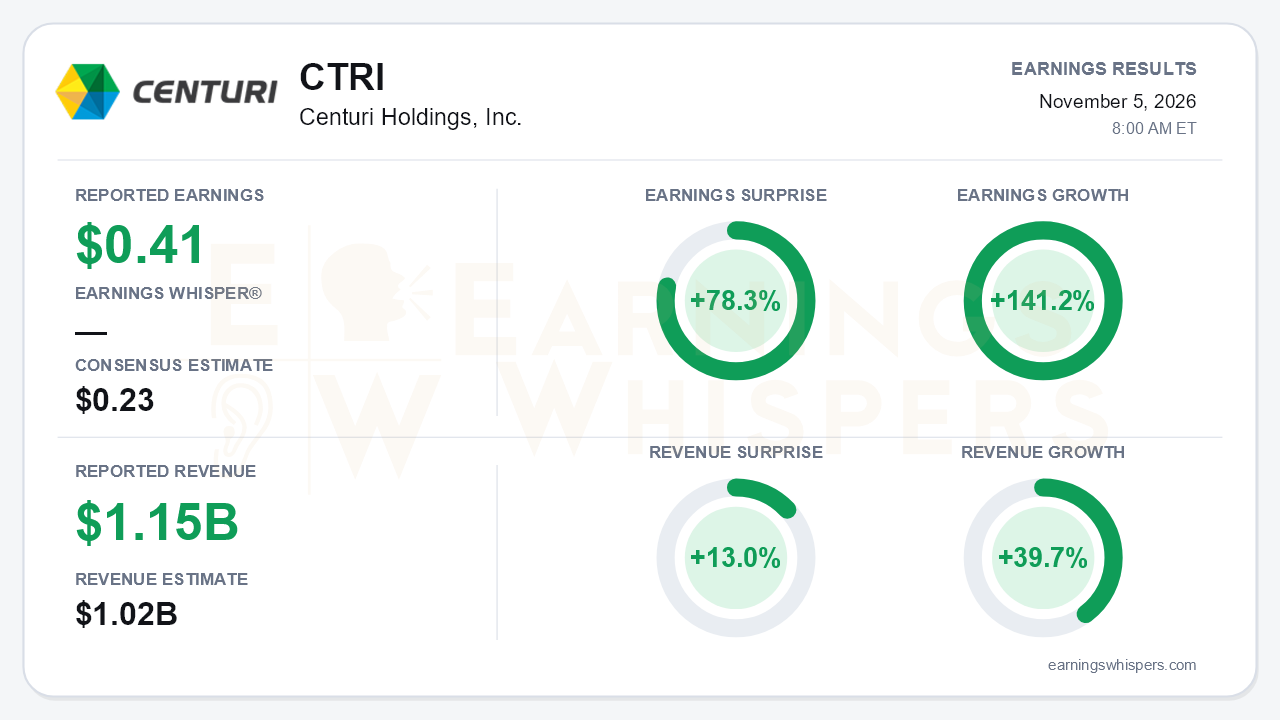
Centuri Holdings delivered the kind of quarter that its first-half labor build was supposed to produce. Adjusted earnings of $0.41 per share beat the $0.23 consensus by 78.3% and grew 141.2% year over year. Revenue of $1.153 billion topped the $1.02 billion estimate by 13.0% and rose 39.7%. The company's own presentation is slightly higher: total revenue of $1.192 billion including related-party work for its former parent, and Adjusted EPS of $0.42. Either way, the conclusion is the same. Revenue growth accelerated, profitability rebounded sharply, and management raised full-year revenue and adjusted net income guidance for the second consecutive quarter. On a GAAP basis, net income rose to $26.9 million, or $0.27 per share, from just $2.1 million a year earlier.
The quality of the beat is better than a typical volume-driven surprise because margins did the heavy lifting. Consolidated gross margin reached 9.5%, up from 7.2% in the second quarter, and the incremental gross margin on the $342 million revenue increase was 10.4%. U.S. Gas, where the workforce expansion was largest, was the standout. Its margin doubled sequentially to 8.2% from 4.2%, comfortably ahead of the 7.5% second-half target management had set last quarter. Adjusted EBIT rose 79% to $73.0 million, and the margin widened to 6.1% from 4.8%.
There are caveats:
- Union Electric's 65% growth was flattered by the JJ White acquisition, and its margin slipped to 8.9%.
- Canadian margins compressed year over year.
- Storm restoration contributed $21.3 million of revenue.
- Centuri stopped reporting base revenue and base gross profit excluding storm work, which modestly reduces comparability.
The call reinforced that demand is not the constraint. The opportunity pipeline reached $19 billion, up from $16 billion in the second quarter and $13 billion in the first. Outstanding bids nearly doubled to $4.8 billion, including roughly $2 billion of MSA renewals that will carry updated pricing for fuel and fleet cost escalation. Management now expects 2026 book-to-bill of at least 1.3x, against its 1.2x target, even though the year-to-date ratio stands at only 1.01x. That leaves a lot riding on fourth-quarter renewals. The more consequential disclosure was a preliminary 2027 framework:
- mid-teens revenue growth to above $4.4 billion;
- gross margin of 8.5% to 9%;
- $3.7 billion of revenue already covered.
Management characterized that outlook as ahead of its 2029 plan and signaled that those longer-term targets are likely to be refreshed.
Bears still have legitimate ammunition. Full-year free cash flow guidance was cut to $25-50 million from more than $75 million, as working capital ballooned. Third-quarter free cash flow was negative $30 million, and accounts receivable climbed to $584 million from $315 million at year-end. Despite the revenue raise, the adjusted EBITDA range of $290-300 million was only narrowed around a similar midpoint. That implies a softer fourth-quarter margin, partly because a shift toward leasing equipment creates roughly a 90-basis-point drag. The year-end leverage goal also loosened to "low two times" from about 2.0x, although leverage has already fallen to 2.6x from 3.8x a year ago. Backlog dipped to $6.2 billion from $6.4 billion in the second quarter, and its year-over-year growth slowed to 5% from 21%. A CFO transition adds another variable. Fourth-quarter storm work in early October is excluded from guidance, which gives the numbers some cushion.
The market setup is more complicated than the surprise implies. Shares entered the report at $20.54, down 18.0% since the open following the August report. That decline came from an inter-earnings high of $27.08 set on that first day. The stock touched a 52-week low of $18.60 on October 23 and sits about 25% below its 200-day moving average. Investor sentiment moved from mildly positive (0.09) to negative (-0.19), a meaningful shift that suggests expectations were reset lower heading into the print. Momentum and AVWAP readings had turned positive even as the broader price trend remained negative, consistent with a stock attempting to stabilize off its lows.
That backdrop matters because the quarter answers the central question that likely drove the selloff: whether the costly first-half hiring would translate into margins. It did, and convincingly. What it does not yet answer is whether Centuri can convert that growth into cash. Receivables growth and a halved free cash flow outlook are exactly the issues that can keep a contractor's valuation compressed even as earnings climb.
The bottom line is that Centuri turned a margin question into a margin proof point. Revenue accelerated, U.S. Gas profitability recovered faster than promised, and a 2027 outlook running ahead of long-term targets gives the growth story real credibility. Investors who sold the stock to a 52-week low were positioned for execution risk, not a 9.5% gross margin. The cash flow cut, flat EBITDA guidance and decelerating backlog growth mean the next leg depends on working-capital discipline and on landing the $4.8 billion bid slate, rather than on demand alone.
Read our earnings preview for Centuri Holdings, Inc.: https://www.earningswhispers.com/article/CTRI/22079
This earnings review was originally published on Earnings Whispers.
This article is for informational purposes only and is not investment advice. Earnings Whispers and its staff may hold positions in the securities mentioned. It is AI-assisted, based on proprietary Earnings Whispers data and company reports, and edited by Earnings Whispers staff.
Mentioned In This Article
Latest News
| Nov-05 | |
| Nov-05 | |
| Nov-05 | |
| Oct-28 | |
| Oct-22 | |
| Sep-28 | |
| Sep-10 | |
| Aug-17 | |
| Aug-13 | |
| Aug-12 | |
| Aug-04 | |
| Aug-04 | |
| Aug-04 | |
| Aug-03 | |
| Jul-27 |
