Blink Charging Reaches Breakeven EBITDA Early, But A Second Guidance Cut Shows The Revenue Base Is Still Shrinking
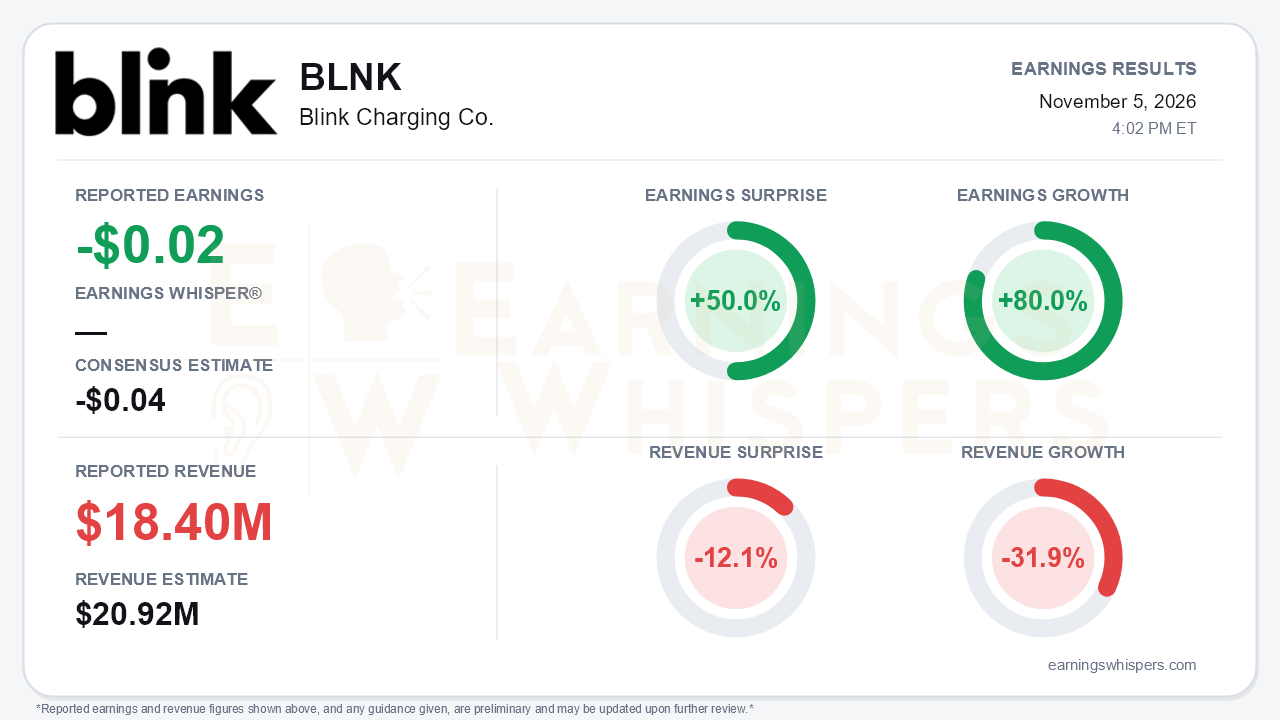
Blink Charging delivered the milestone management had been promising, a quarter early, and paid for it with a top line that keeps contracting. The company reported a loss of $0.02 per share for the September quarter, beating the consensus estimate of a $0.04 loss by 50.0% and improving 80.0% from a year ago. Adjusted EBITDA turned positive at $0.2 million, the first positive quarter in Blink's history, compared with a $7.3 million loss a year earlier. Revenue, however, fell to $18.4 million, missing the $20.92 million consensus by 12.1% and declining 31.9% year over year. Management also cut full-year revenue guidance again. That is the central tension: Blink has largely fixed its cost structure, but it has not yet shown it can grow into it.
The quality of the quarter deserves scrutiny on both sides. On a GAAP basis, the net loss widened to $0.05 per share from roughly breakeven a year ago. Part of that reflects an $11.7 million non-cash fair-value gain that flattered the prior-year period. The rest came from an approximately $3 million write-off of legacy manufacturing inventory left over from the shift to contract manufacturing, which pushed GAAP gross margin down to 26.3%. Excluding that charge, gross margin was 41.7%, up from 38.9% in the second quarter. That is a more credible measure of improvement than the headline 55.0% non-GAAP gross margin, which also strips out depreciation. The cost story is unambiguous. Non-GAAP operating expenses fell 46% year over year to $10.0 million, down from $13.9 million in the first quarter. Compensation dropped 42% and G&A shrank by two-thirds.
The revenue picture is weaker than the portfolio-cleanup explanation suggests. Product revenue roughly halved year over year to $6.4 million. Service revenue had been the growth engine, rising 25% year over year in the first quarter. It has now slid from $13.3 million in Q1 to $11.5 million in Q2 and $10.0 million in Q3, a 6.9% year-over-year decline. Charging service revenue fell 11.5%, which management attributed to the deliberate non-renewal of a large European contract. Recurring network fees were a bright spot, up 6.3% to $2.9 million. Management's own core-revenue figures, which exclude the divested Envoy car-sharing unit and the European contract, show $18.0 million, $19.7 million and $18.4 million over the first three quarters of 2026. In other words, the core business is flat at best and slipped sequentially. Blink said Q3 also fell short of internal projections because certain customer projects slipped into the fourth quarter.
That slippage makes the guidance revision more telling. Full-year revenue guidance is now $78 million to $81 million, down from $83 million to $90 million last quarter and $105 million to $115 million at the start of the year. With $60.9 million booked through nine months, the new range implies fourth-quarter revenue of roughly $17 million to $20 million. That is essentially the Q3 run rate, even with the delayed projects expected to land. Management guided to positive adjusted EBITDA again in Q4, held its roughly 38% full-year gross margin target excluding the inventory charge, and promised a return to revenue growth in 2027. It offered no formal 2027 numbers. The growth case now rests on the "Blink Energy" pivot. EnergyConnect has expanded from 11 sites at the last call to 52 U.S. Blink-owned sites plus more than 30 in Europe, with early demand-fee reductions of 21% across nine high-capacity sites. Further growth levers include SaaS subscriptions, project-financed battery storage, a larger sales organization and 33 DC fast-charging sites under construction, most of which are expected to go live by the end of Q1 2027. Management itself expects the new energy services to contribute only modestly in 2027.
Liquidity is adequate but not loose. Cash fell to $30.5 million from $34.0 million, with no debt, so the business is still consuming cash despite breakeven EBITDA. Nine-month operating cash use of $6.6 million was cushioned by a $14.7 million drawdown in receivables, a source that cannot repeat indefinitely. The storage strategy will also depend on project financing.
Investor sentiment improved meaningfully heading into the report, rising from 0.06 to 0.37, which suggests expectations had tilted toward the profitability milestone. The stock has not followed. Shares sat at $0.45 the day before earnings, down 16.4% since opening at $0.54 after the August report. They are about 28% below the $0.63 200-day moving average and well off the $0.63 inter-earnings high set on the first post-report day in August. The stock hit a 52-week low of $0.38 on October 26 and has since rebounded nearly 20%. Price and AVWAP trend readings remain negative, consistent with a market that has kept selling into rallies.
The bottom line is that Blink has delivered a real operating inflection on costs and margins, and the early EBITDA breakeven gives the turnaround credibility it lacked a year ago. But two guidance cuts, a shrinking service line and continued cash use mean the story has shifted from survival to whether the business can grow again. Until 2027 guidance and the energy-management initiatives show measurable revenue, bears retain legitimate ammunition.
Read our earnings preview for Blink Charging Co.: https://www.earningswhispers.com/article/BLNK/22437
This earnings review was originally published on Earnings Whispers.
This article is for informational purposes only and is not investment advice. Earnings Whispers and its staff may hold positions in the securities mentioned. It is AI-assisted, based on proprietary Earnings Whispers data and company reports, and edited by Earnings Whispers staff.
Mentioned In This Article
Latest News
| Nov-05 | |
| Nov-05 | |
| Nov-05 | |
| Oct-29 | |
| Oct-28 | |
| Oct-28 | |
| Sep-14 | |
| Aug-18 | |
| Aug-07 | |
| Aug-06 | |
| Aug-06 | |
| Aug-05 | |
| Jul-28 | |
| Jul-28 | |
| Jul-07 |
