Verastem Misses As Co-Pack Sales Stall, But VS-7375 Data And A $250 Million Raise Reset The Investment Case
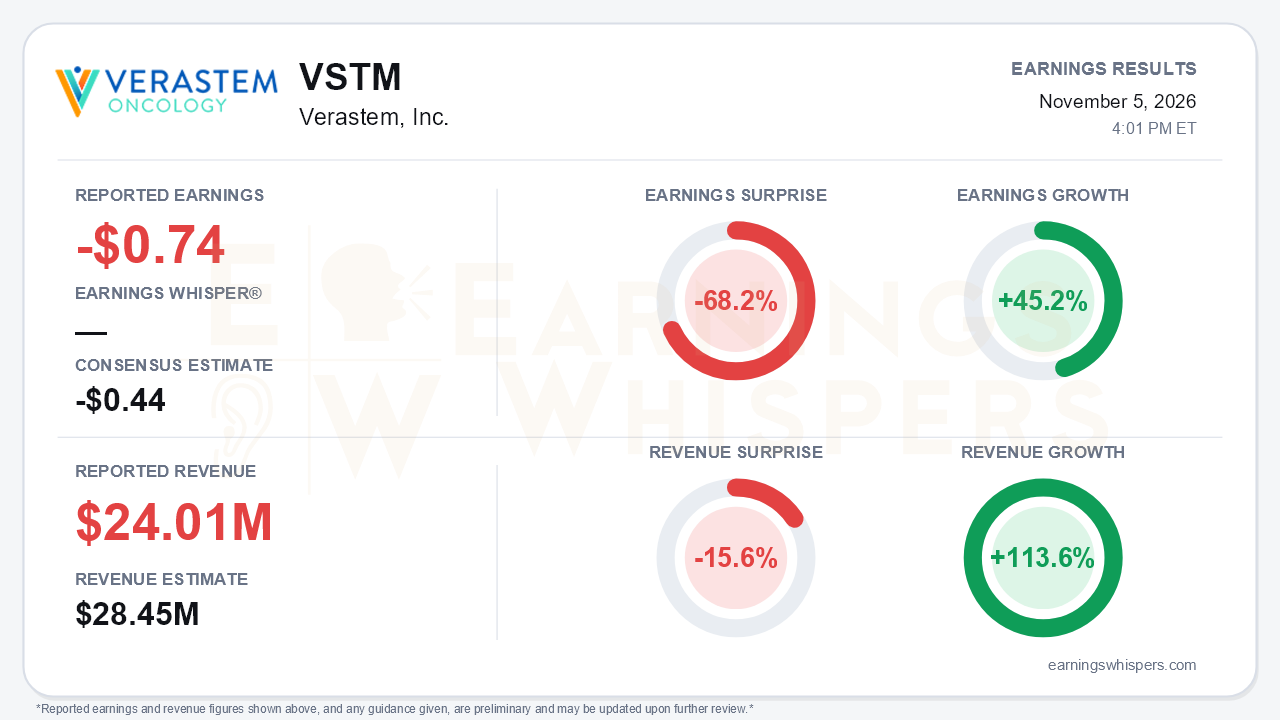
Verastem (NASDAQ: VSTM) missed badly on the numbers. The quarter that mattered, though, played out in the clinic and on the balance sheet rather than in the income statement. The company reported a third-quarter loss of $0.74 per share against a consensus estimate of -$0.44, a 68.2% miss. Revenue of $24.01 million fell 15.6% short of the $28.45 million consensus. On paper, earnings grew 45.2% year over year and revenue rose 113.6%. Neither figure says much about the current trajectory. The central tension is that the commercial business stalled just as the VS-7375 KRAS G12D program produced the data, regulatory alignment and funding needed to become the clear center of the story.
The quality of the year-over-year improvement deserves scrutiny. The GAAP loss narrowed from $1.35 per share to $0.74, but almost entirely because last year's quarter carried a $55.9 million non-cash warrant liability charge. On an adjusted basis the loss widened to $0.72 per share from $0.53, or $72.8 million versus $39.1 million. Spending explains the gap. R&D jumped 137% year over year to $68.8 million and rose sharply from $41.3 million in the second quarter as three registration-directed Phase 2 trials ramped. Total operating expenses roughly doubled to $99.2 million. A loss of that size against a sub-$25 million revenue base is the profile of a development-stage company, and that is how the market is now valuing Verastem.
The commercial picture is the soft spot. AVMAPKI FAKZYNJA CO-PACK revenue slipped to $24.0 million from $25.1 million in the second quarter. That breaks a ramp that had run from $17.5 million to $18.7 million to $25.1 million over the prior three quarters. Management had said in the second quarter that momentum was carrying into the third, and that did not translate into growth. Refills carried the quarter while new patient starts moderated. Management cited seasonality, changes to the commercial team and shifting off-label use. On the call, management also flagged that off-label pancreatic use should erode as RAS inhibitors gain approval and trials open. Management now expects a "more gradual sales ramp" in recurrent low-grade serous ovarian cancer (LGSOC), which effectively resets near-term expectations. Two offsets temper the disappointment. Management said the LGSOC franchise reached self-sustaining status this quarter, ahead of its prior end-2026 target. The blister-pack NDA also received Priority Review, with a decision due by February 7, 2027.
VS-7375 is where the investment case moved forward. First U.S. data showed confirmed response rates of:
- 41% in second-line-plus pancreatic cancer (50% in second line), with a 67% six-month progression-free survival rate;
- 43% in second-line-plus lung cancer at 600 mg;
- 75% in early first-line lung combination data, based on eight patients.
At the 900 mg dose, only 2% of patients discontinued because of adverse events. The FDA agreed to the design of a three-arm first-line pancreatic Phase 3, which the company plans to open by year-end, and first-line colorectal and lung Phase 3s are targeted for the first half of 2027. Several caveats remain:
- the colorectal signal rests on six patients;
- lung Phase 2 enrollment completion slipped to the second quarter of 2027;
- the field is crowded, with Revolution Medicines running a first-line G12D colorectal Phase 3 and daraxonrasib already approved.
The balance sheet changed materially. The October offering raised $250 million gross, lifting pro forma cash to $422.8 million from $201.4 million at the prior report. Projected runway now extends into the first half of 2028, compared with the second half of 2027 previously. The cost is dilution of roughly 31 million shares plus pre-funded warrants, against about 101 million weighted shares in the quarter. That is a raise bears note the company had previously avoided. Leadership is also changing: Michael Bailey succeeds retiring CEO Dan Paterson on January 1.
The market had already rewarded the pipeline news before this report. Shares closed at $9.85 on November 4, up 48.1% from the $6.65 open after the August report. That leaves the stock about 64% above its inter-earnings low of $6.02 and within 4% of the October 28 high of $10.25. Investor sentiment improved meaningfully, from -0.38 to -0.12, but it remains net negative. That suggests skepticism has eased rather than flipped. Price, momentum and AVWAP trend readings are positive, while sequential growth is neutral, consistent with a commercial line that has flattened.
The bottom line is that the miss is real but not decisive. Verastem's near-term revenue story weakened, with sequential decline, softer new starts and a slower ramp outlook, and adjusted losses are widening fast. The quarter's real deliverables, however, were competitive VS-7375 efficacy, an FDA-aligned frontline pancreatic Phase 3 and funding into 2028. With shares near the top of their post-August range, the stock is now trading on execution of the TARGET-D program rather than on co-pack sales. That raises the stakes for the 2027 data readouts and trial starts.
Read our earnings preview for Verastem, Inc.: https://www.earningswhispers.com/article/VSTM/22409
This earnings review was originally published on Earnings Whispers.
This article is for informational purposes only and is not investment advice. Earnings Whispers and its staff may hold positions in the securities mentioned. It is AI-assisted, based on proprietary Earnings Whispers data and company reports, and edited by Earnings Whispers staff.
Mentioned In This Article
Latest News
| Nov-05 | |
| Nov-05 | |
| Nov-05 | |
| Nov-02 | |
| Oct-28 | |
| Oct-22 | |
| Oct-15 | |
| Oct-15 | |
| Oct-14 | |
| Oct-14 | |
| Oct-14 | |
| Oct-14 | |
| Oct-14 | |
| Oct-14 | |
| Oct-11 |
