Brookfield Infrastructure Holds Its 10% FFO Line For A Third Quarter As Data Growth Cools And Investors Turn Wary
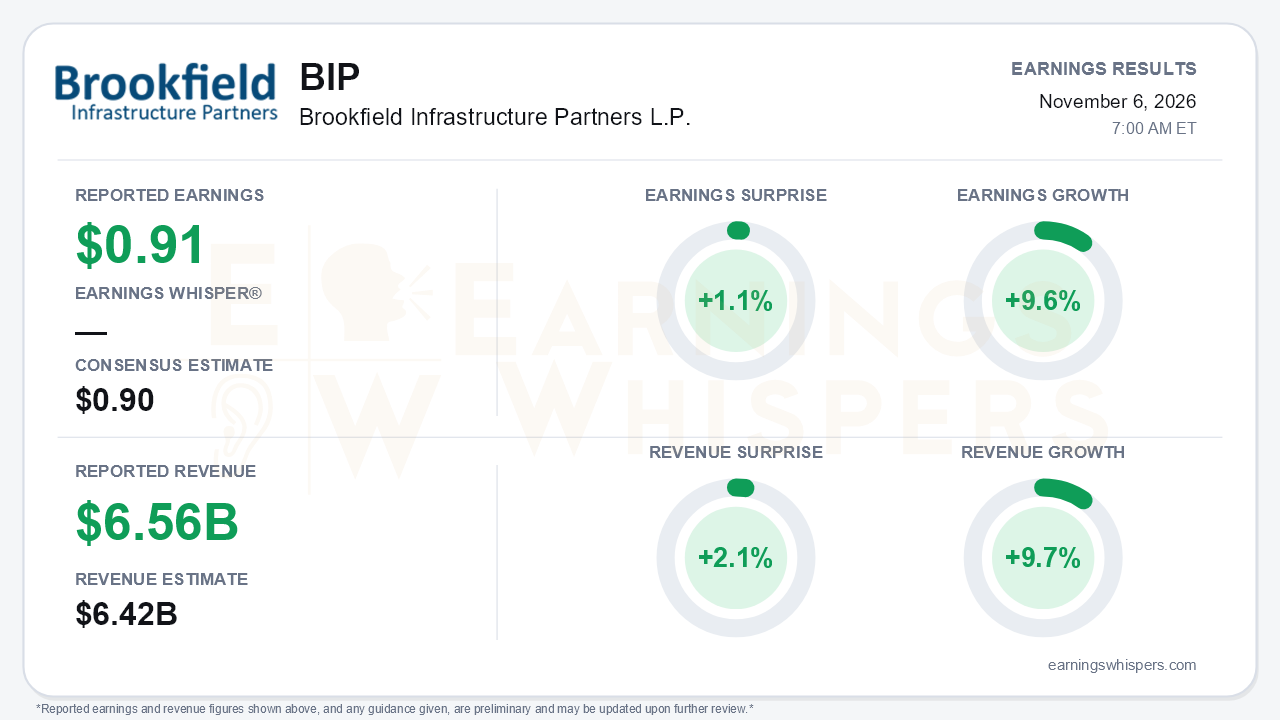
Brookfield Infrastructure Partners delivered another quarter at its growth target. The market, however, has grown less willing to pay for that consistency. Funds from operations (FFO) came in at $0.91 per unit, edging past the $0.90 consensus by 1.1% and growing 9.6% year over year. Revenue of $6.556 billion topped the $6.42 billion estimate by 2.1% and rose 9.7%. This was the third straight quarter at management's 10% FFO-per-unit target, and per-unit FFO stepped up sequentially from $0.89 in Q2 and $0.90 in Q1. That is steady compounding, not acceleration. The central tension is that the headline is intact while the two segments that drove the upside story, data and midstream, are losing momentum.
The quality of the quarter is mostly sound on an FFO basis. Organic growth landed at the high end of the target range, helped by inflation indexation, strong utilization and roughly $1.4 billion of capital commissioned from the backlog. The IFRS picture looks very different. Net income attributable to the partnership fell to $69 million from $440 million, and limited partners swung to a loss of $0.04 per unit from a $0.44 profit. Management attributes the gap largely to larger asset-sale gains in the prior-year period, and the sharp drop in other income and equity-accounted earnings supports that explanation. Two items deserve scrutiny. Corporate-level FFO costs widened to $148 million from $116 million, and consolidated interest expense rose to $1.05 billion. Both quietly absorb part of the segment growth.
The segment trajectories matter more than the headline. Data FFO rose 25% to $172 million, lifted by the completed Intel Arizona foundry funding and a full quarter of the U.S. bulk fiber network. Year-over-year growth in data has decelerated from 46% to 36% to 25% as acquisitions lap. Transport grew 10% to $315 million on port volumes, toll-road tariffs and the railcar leasing platform. Utilities held at about 5%, with asset sales offsetting rate-base additions. Midstream is the softer spot. FFO grew 14% to $178 million year over year but slipped sequentially from $190 million in Q1 and $183 million in Q2, and part of its strength came from elevated commodity prices at the Canadian business.
The forward story rests on capital recycling and AI infrastructure. Asset-sale proceeds reached about $1.5 billion year to date, and management said advanced processes could add more than $1 billion before year-end, putting the $2 billion annual target within reach. Corporate liquidity of roughly $3.2 billion provides ample funding capacity. The NAVER memorandum is now a signed partnership covering more than 200 MW of compute, and a new Drax agreement could lead to a large-scale U.K. AI factory. The economics are less dramatic than the headlines suggest:
- NAVER's project needs about $9 billion of capital, but the release cites only about $100 million of equity net to BIP. Call commentary framed it as $100-200 million.
- First GPU deployment is not expected until the first half of 2027.
- Management framed its AI target as about $500 million a year on average, versus a $300-500 million range previously.
- The release cites about $1.7 billion of equity deployed year to date, while call commentary referenced $1.8 billion.
Bears have legitimate ammunition beyond the slowing segments. Western Australia legislation could enable a buyback or renationalization of the ARC freight rail network. Management also flagged U.S. midterm and regulatory uncertainty that it expects to slow new data center builds, though it argued in-place assets benefit. Tighter AI financing and ratepayer scrutiny of large AI factories add further uncertainty. Guidance was reaffirmed rather than raised. The corporate simplification closes November 19, so BIP declared no fourth-quarter distribution itself. BIP Inc. intends to pay a dividend consistent with the current $0.455.
The market had already cooled before the release. Investor sentiment swung from mildly positive at 0.134 to negative at -0.248, a meaningful reversal. Shares at $37.81 are down 11.0% since the open after the July report. That was the same day the stock set its 52-week high of $44.04. The units bottomed at $34.30 in late September, recovered about 10%, and now sit just 0.8% above the 200-day moving average. That leaves the stock at a technically indecisive spot heading into the simplification.
The bottom line is that Brookfield Infrastructure again proved it can manufacture roughly 10% FFO growth from a diversified, inflation-linked portfolio, backed by credible recycling and funding capacity. The upside drivers are maturing faster than the AI pipeline is replacing them. Data growth is normalizing, midstream is drifting lower, and the headline AI deals carry modest near-term equity checks. With sentiment now negative and the stock hovering at its 200-day line, the next leg likely depends on proving the backlog and AI commitments can sustain 10% once acquisition tailwinds fade.
Read our earnings preview for Brookfield Infrastructure Partners L.P.: https://www.earningswhispers.com/article/BIP/22471
This earnings review was originally published on Earnings Whispers.
This article is for informational purposes only and is not investment advice. Earnings Whispers and its staff may hold positions in the securities mentioned. It is AI-assisted, based on proprietary Earnings Whispers data and company reports, and edited by Earnings Whispers staff.
Mentioned In This Article
Latest News
| 7 hours | |
| 10 hours | |
| 11 hours | |
| Nov-05 | |
| Oct-29 | |
| Oct-14 | |
| Oct-09 | |
| Oct-06 | |
| Aug-31 | |
| Aug-20 | |
| Jul-30 | |
| Jul-30 | |
| Jul-21 | |
| Jul-02 | |
| Jun-15 |
