Barings BDC Misses As NII Slides To Exactly The $0.26 Dividend, And Weaker Credit Tightens The Margin For Error
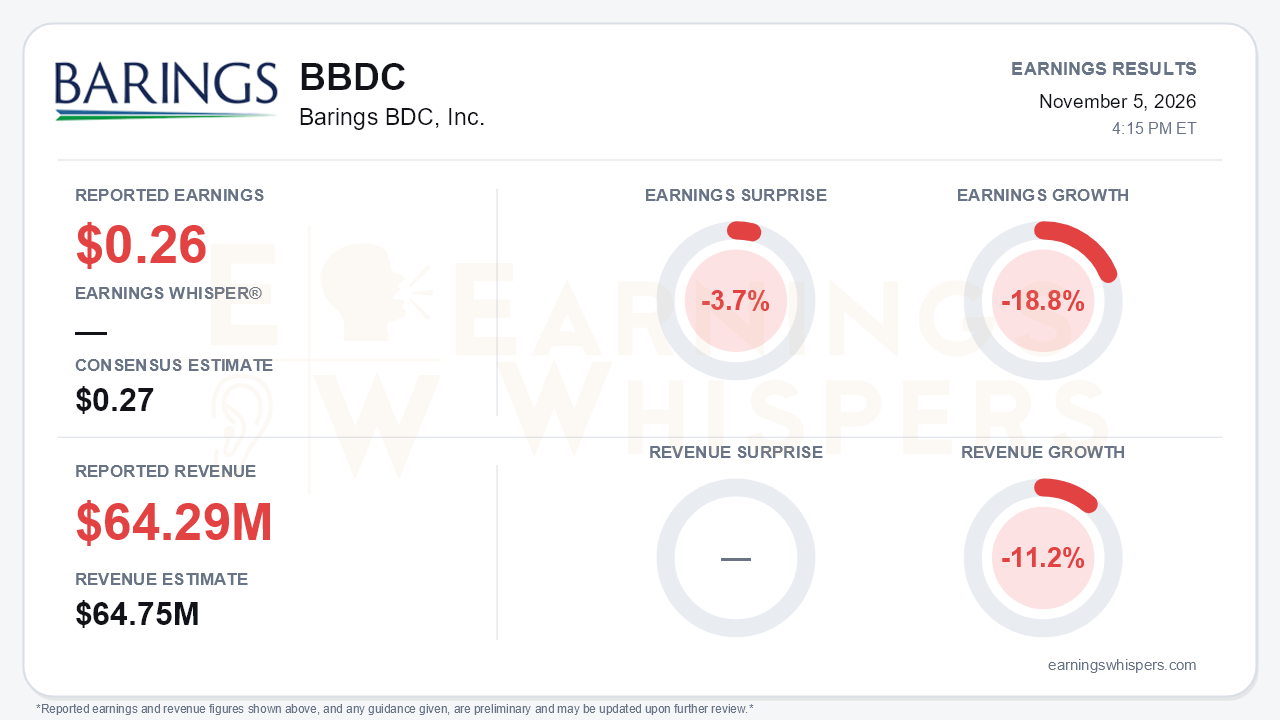
Barings BDC reported third-quarter net investment income of $0.26 per share, $0.01 below the $0.27 consensus. That is a 3.7% miss and an 18.8% decline from a year earlier. Total investment income was $64.29 million, 0.7% short of expectations and down 11.2% year over year. Management's framing was that NII 'fully covered' the unchanged $0.26 dividend. That is accurate, but it now means coverage at exactly 1.0x. The dividend has moved from comfortably covered to fully absorbed, and that is the central tension of the quarter. The cushion behind it is thinning just as credit metrics begin to soften.
The quality of the quarter deserves scrutiny. NII fell from $0.28 in the second quarter to $0.26, and from $0.32 in the year-ago period, when Barings was also paying a $0.05 special. Interest income fell to $42.6 million from $48.8 million a year ago, and dividend income slipped to $11.4 million from $14.2 million. The call attributed the sequential drop to lower equity dividend income and a higher incentive fee, which rose to $6.3 million from $5.6 million a year earlier. Payment-in-kind income rose to $6.4 million from $5.2 million. On the GAAP side, the net increase in net assets was $0.24 per share. Net realized losses of $4.8 million were only partly offset by $2.2 million of unrealized appreciation. NAV per share edged down to $10.92 from $10.94. That is small in isolation, but it is the fourth straight decline from $11.09 at the end of 2025.
The conference call made the credit picture look softer than the stable-NAV headline suggests. Non-accruals rose to 11 companies and 1.1% of fair value, or 0.7% excluding credit-support-agreement assets. In the second quarter they were 0.6% in total and 0.2% excluding those assets. Assets rated 4 or 5 on the company's risk scale climbed to 7% from 6%. PIK income rose to roughly 10% of revenue from about 7%. Management tied much of the increase to Policy Services, a Florida non-standard auto insurer that shifted to PIK, and said about 40% of PIK is amendment-driven. Origination also slowed: gross fundings fell to $196 million from $262 million, and net portfolio growth roughly halved to about $50 million. New-deal spreads of 541 basis points were essentially flat with repayments. Management signaled that the spread widening seen earlier in the year is normalizing, with possible compression ahead as buyout activity returns.
The constructive development is on the liability side. Barings priced a CLO on October 30 to refinance its $350 million of 3.3% notes due November 23. The release sizes the CLO at about $396.3 million; the call characterized it as roughly $400 million. The refinancing removes the most visible near-term maturity and pushes the next one to November 2027. The trade-off is cost. Fixed 3.3% debt is being replaced with floating SOFR+164 paper, which raises funding expense. Pro forma, unsecured debt falls to about 53% of the mix from roughly 77-80%. Leverage is another constraint. Net debt-to-equity rose to 1.24x from 1.18x, near the top of the 0.9x-1.25x target range. Management expects fourth-quarter loan sales to the Jocassee joint venture to bring leverage back to about 1.15x-1.16x. A planned exit from the non-income-producing Security Holdings equity stake, likely in the first quarter of 2027, is a credible lever for lifting earnings by redeploying that capital. Post-quarter activity is described inconsistently across the sources. The release cites $36.2 million of new first-lien funding at 11.1%, plus $35.0 million of previously committed draws. The call references $73.6 million at 9.1%.
The most consequential remark may be management's explicit statement that it would cut the dividend rather than erode NAV if credit problems emerge. Spillover income stood at about $0.80 per share, down from $0.84, and management guided it lower by year-end on book-tax differences. Bears have legitimate ammunition here: coverage is exactly 1.0x, non-accruals have roughly doubled, and the reserve behind the dividend is shrinking.
The market setup is more muted than the fundamentals might imply. Shares stood at $8.74 on the report date, up 2.7% from the $8.51 open after the August report and just 0.8% above the 200-day moving average of $8.67. That leaves them roughly 20% below NAV. Investor sentiment remains negative but improved marginally, to -0.15 from -0.17. That shift is too small to read as a real change in conviction, though it suggests expectations were already subdued heading into the print.
The bottom line is that Barings delivered a stable-looking quarter with deteriorating internals. The CLO deal credibly de-risks the balance sheet, and the Security Holdings exit offers a path to better returns on equity. Against that, NII has slipped to exactly the dividend level, NAV has declined four quarters in a row, and non-accruals, PIK and leverage all moved the wrong way. Management has openly put a dividend cut on the table if credit worsens. The stock's discount to NAV already reflects skepticism. The next few quarters of credit migration will decide whether that discount narrows or the payout resets.
Read our earnings preview for Barings BDC, Inc.: https://www.earningswhispers.com/article/BBDC/22246
This earnings review was originally published on Earnings Whispers.
This article is for informational purposes only and is not investment advice. Earnings Whispers and its staff may hold positions in the securities mentioned. It is AI-assisted, based on proprietary Earnings Whispers data and company reports, and edited by Earnings Whispers staff.
Mentioned In This Article
Latest News
| Nov-06 | |
| Nov-05 | |
| Nov-05 | |
| Oct-28 | |
| Oct-07 | |
| Aug-05 | |
| Jul-14 | |
| Jun-01 | |
| May-07 | |
| May-07 | |
| Apr-09 | |
| Feb-20 | |
| Feb-20 | |
| Feb-19 | |
| Feb-19 |
