Kayne Anderson BDC's Income Beat Is Undercut By A Fourth Straight NAV Decline And Rising Non-Accruals
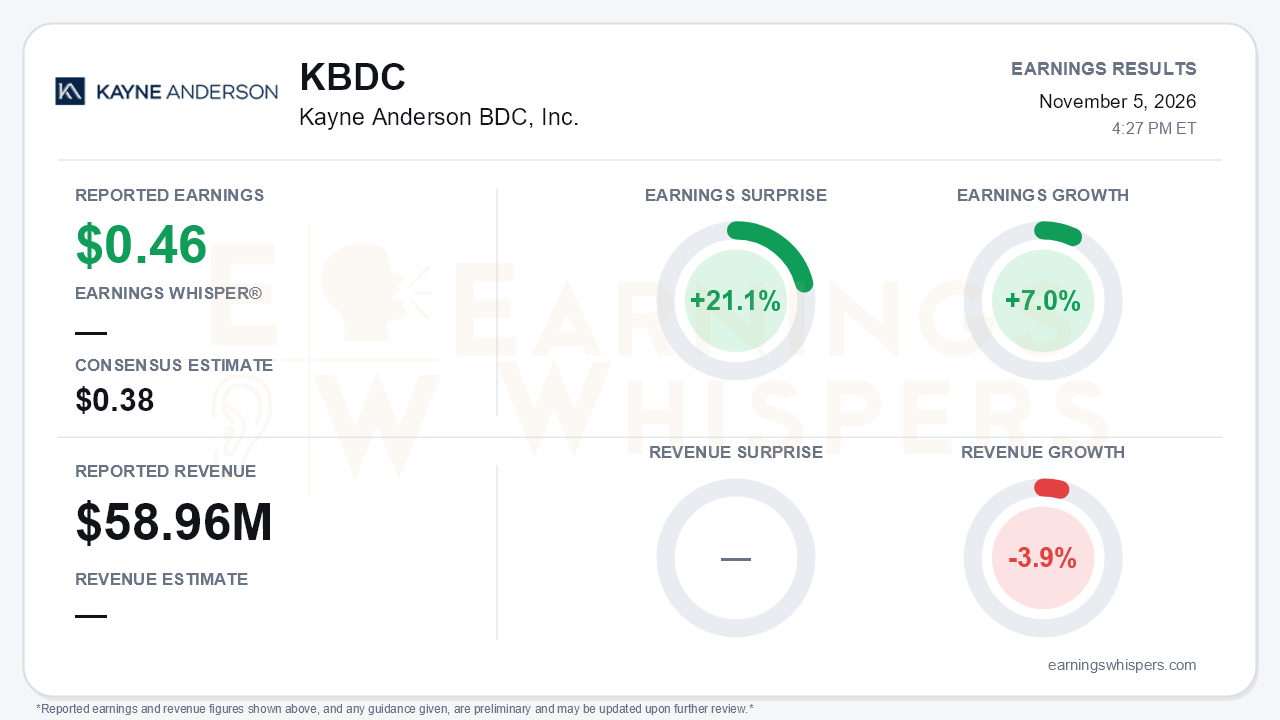
Kayne Anderson BDC delivered its strongest income quarter in five years, but its credit picture deteriorated again. Net investment income of $0.46 per share beat the $0.38 consensus by 21.1% and grew 7.0% year over year. It was also up from $0.42 in the second quarter. Revenue, measured as total investment income, was $58.96 million, down 3.9% from a year earlier, though it rose from $55.7 million sequentially. The problem is that the income statement and the balance sheet tell different stories. NAV per share fell to $15.71 from $16.00, its fourth consecutive decline from $16.32 at year-end 2025. Non-accruals climbed to 3.6% of debt investments at fair value from 2.7%. This is a BDC out-earning its dividend while gradually losing book value, and that is the central tension.
The quality of the beat deserves scrutiny. About $1.7 million of the sequential increase in investment income came from non-recurring prepayment and accelerated amortization tied to realizations. Expense dynamics also flattered the per-share result. Incentive fees fell to $1.2 million from $4.4 million a year ago, and buybacks cut the weighted average share count to about 66.0 million from 70.4 million. Below the NII line, the picture was much weaker. Net realized and unrealized losses of $0.36 per share left GAAP earnings, measured as the net increase in net assets, at just $0.10 per share, versus $0.35 a year ago. The largest hit was a $14.9 million realized loss from restructuring American Soccer Company (Score), which remains on non-accrual. Watch-list markdowns added further unrealized losses.
The call showed credit stress broadening rather than stabilizing. Non-accruals have risen every quarter this year: 1.4% at the end of 2025, then 2.5%, 2.7%, and now 3.6% at fair value. At cost, the figure is 5.4%, and the problem now spans eight borrowers. Centerline Communications, with roughly $28 million of fair value, was the latest addition. PIK income rose to 4.9% of interest income from 4.5%, and management described the watch list as slightly elevated at under 6%. Co-CEO Doug Goodwillie called the non-accrual increase "momentary" and said he expects the issues to be resolved soon. Two developments give that claim some support:
- Regiment was sold after quarter end at about 10 points above its 75.5% second-quarter mark.
- A Centerline restructuring expected in the fourth quarter could return a sizable portion of that loan to accrual status, which could bring non-accruals back toward second-quarter levels.
The forward income picture has improved even as deployment has slowed. SOFR is now above 4.1%, and management expects it to exceed 4.5%, compared with earlier expectations near 3%. That turns what had been a rate-cut headwind into a tailwind for a portfolio that is 95% floating-rate and earns an average spread of 587 basis points. On that basis, management extended its dividend confidence from "through 2026" to maintaining the $0.40 base dividend "going forward." The supporting numbers are solid:
- Dividend coverage reached 115%.
- Spillover income rose to $0.32 per share from $0.21 at year-end.
- Liquidity exceeds $500 million.
Origination, however, is fading. New commitments fell to $76.3 million from $138.7 million. Repayments of $114.9 million outpaced fundings of $91.9 million, and the portfolio shrank to 100 companies from 104. New-deal spreads narrowed to 538 basis points from 566. The post-quarter pipeline of about $50 million compares with $69 million after the second quarter and $150 million after the first, and management expects fourth-quarter originations to fall below prior years. A shrinking book at tighter spreads limits how much of the rate tailwind reaches NII.
Investors have priced in the credit concerns more than the income strength. Earnings Whispers sentiment improved from -0.85 to -0.71 but remains deeply negative. Shares at $12.74 are down 4.9% since the open after the August report and sit 7.5% below the 200-day moving average of $13.77. That leaves the stock at roughly 81% of NAV. At that discount, the company's buybacks, recently executed at an average of $12.60, are accretive. The modest $3.6 million pace of repurchases, however, suggests management is not leaning aggressively into that discount.
The bottom line is that KBDC's dividend looks better covered than at any point this year, and the higher-rate environment strengthens that case. Bears still have legitimate ammunition in four straight NAV declines, rising non-accruals, and a shrinking portfolio. The next two quarters hinge on whether the Centerline and Regiment resolutions actually halt the erosion in book value, and whether the slowing origination pipeline lets the earnings tailwind show up in results.
Read our earnings preview for Kayne Anderson BDC, Inc.: https://www.earningswhispers.com/article/KBDC/22319
This earnings review was originally published on Earnings Whispers.
This article is for informational purposes only and is not investment advice. Earnings Whispers and its staff may hold positions in the securities mentioned. It is AI-assisted, based on proprietary Earnings Whispers data and company reports, and edited by Earnings Whispers staff.
Mentioned In This Article
Latest News
| Nov-06 | |
| Nov-05 | |
| Oct-28 | |
| Oct-09 | |
| Aug-11 | |
| Aug-10 | |
| Aug-10 | |
| Aug-07 | |
| Jul-09 | |
| May-12 | |
| May-11 | |
| May-11 | |
| May-08 | |
| Apr-09 | |
| Mar-03 |
