Vivid Seats Misses On EPS As GOV Returns To Growth, But A Dilutive Recapitalization Now Defines The Equity Story
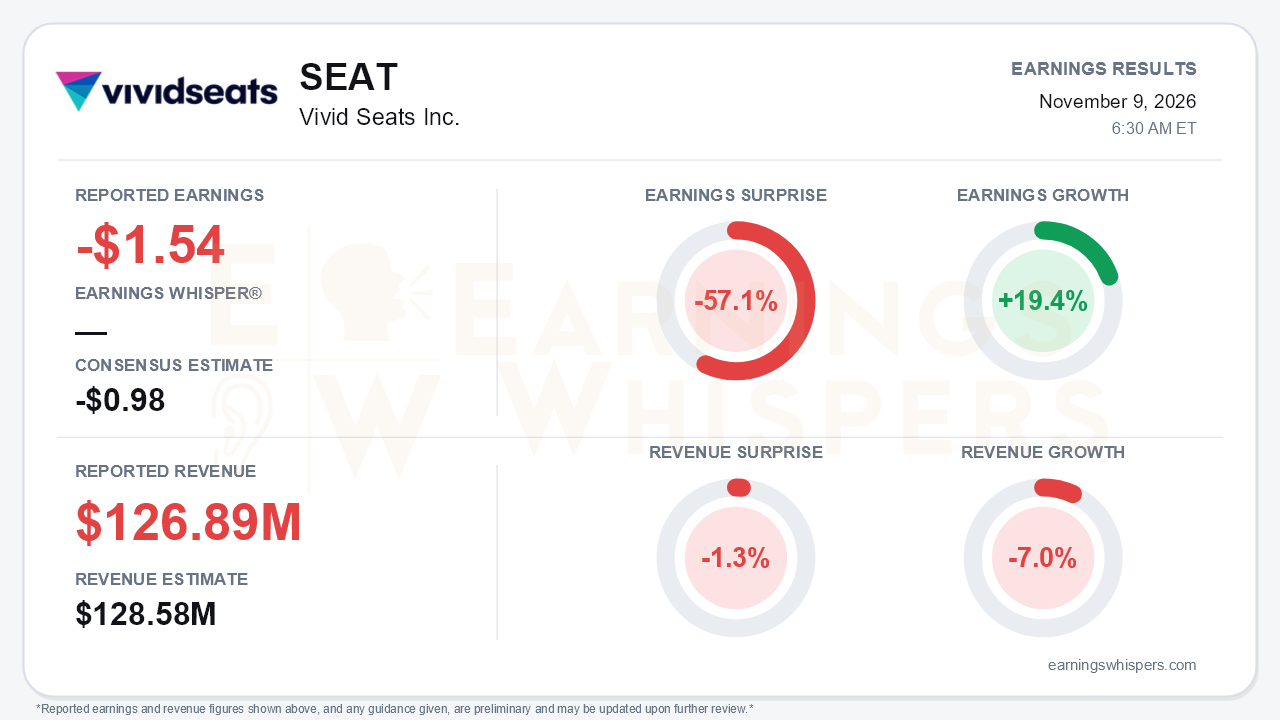
Vivid Seats (NASDAQ: SEAT) reported a third-quarter loss of $1.54 per share, missing the -$0.98 consensus by 57.1%. Revenue of $126.89 million fell 7.0% year over year and came in 1.3% below the $128.58 million estimate. Earnings Whispers measures earnings growth of 19.4% year over year, so the per-share loss did narrow from last year's third quarter. Management delivered the second-half return to growth it had promised for three straight calls: Marketplace GOV rose to $624.0 million from $618.1 million, and adjusted EBITDA climbed 81% to $8.9 million from $4.9 million. The release also disclosed an agreement in principle with a substantial majority of term lenders on a debt-for-equity recapitalization. That is the central tension. The operating business is stabilizing just as existing shareholders face the prospect of being substantially diluted.
The quality of the growth deserves scrutiny. GOV grew less than 1%, while Marketplace orders fell to 1.876 million from 2.101 million. Resale orders fell to 97,000 from 115,000. Revenue declined 7% even as GOV ticked higher, so the platform monetized each dollar of gross order value less effectively than a year ago. The EBITDA improvement came mostly from cost discipline rather than top-line leverage. General and administrative expense dropped to $34.4 million from $45.2 million, and marketing and selling fell to $50.0 million from $56.0 million, both reflecting the $60 million cost program completed by late 2025. On a GAAP basis, the company still lost $17.4 million. The sequential picture is weaker than the year-over-year comparison suggests. GOV slid from $659 million in the second quarter, and adjusted EBITDA fell from $12.6 million, as the World Cup boost faded.
The call preserved some credible product momentum. The Skybox broker-to-broker marketplace is now fully launched, and app share of GOV continues to rise. Private label returned to growth after lapping a July 2025 customer loss, and funnel upgrades are rolling out ahead of an end-to-end product rebuild targeted for around the first quarter of 2027. The demand commentary, however, turned more cautious. Management called the concert on-sale calendar "fairly muted" since September, with late October and early November unusually quiet. It now frames 2027 industry volume as flat to slightly down including the World Cup comparison, a step back from earlier talk of modest industry growth. Las Vegas softness among lower-end consumers persists, and weakness in Japan is new. Paid-search competition from the largest rival and a newer entrant also explains why order volume declined as marketing spend was pulled back.
Full-year guidance was reaffirmed at $2.3 billion to $2.6 billion of GOV and $34 million to $40 million of adjusted EBITDA, with no raise after the second-quarter lift to the low ends. Through nine months, the company has generated $1.896 billion of GOV and $30.9 million of adjusted EBITDA. That leaves an unusually wide implied fourth-quarter range, especially with a weak World Series matchup weighing on event mix. Looking further out, an expiring MLB labor agreement adds a quantified risk: management sized a full lost season at roughly a 5% to 6% GOV headwind.
The recapitalization is the most consequential development, and bears have legitimate ammunition. The proposal includes $60 million of new-money term loans and extended maturities. The release cites roughly $200 million of funded debt reduction, while call commentary framed it as more than $200 million net of new money. Final terms still require definitive documentation. The need for the deal is evident on the balance sheet. Cash fell to $44.8 million from $102.7 million at year-end. Nine-month operating cash burn was $32.0 million, plus $10.6 million of financing-related payments. Long-term debt stands near $381 million against a shareholders' deficit of $118 million. Converting a significant portion of that debt into equity strengthens the company but likely leaves current holders owning far less of it.
The market had largely braced for this outcome. Shares closed at $2.09 heading into the report, down 74.9% from the $8.34 open after the August release. The stock sits 66.8% below its 200-day moving average and only 3% above the 52-week low of $2.03 set on October 27, after peaking at $9.59 in early August. Investor sentiment improved sharply, from -0.53 to roughly neutral at -0.05, likely reflecting a view that much of the damage is priced in. The Earnings Whispers trend signals remain mostly negative, with price, sequential growth, and AVWAP readings all pointing lower.
The bottom line is that Vivid Seats delivered the operational stabilization it promised, but the headline EPS miss, falling revenue, and shrinking order volumes show a business still being held together by cost cuts. The recapitalization should remove the existential balance-sheet overhang. However, it shifts the question for shareholders from whether the company survives to how much of it they will still own, all against a cooling demand backdrop for 2027.
Read our earnings preview for Vivid Seats Inc.: https://www.earningswhispers.com/article/SEAT/22588
This earnings review was originally published on Earnings Whispers.
This article is for informational purposes only and is not investment advice. Earnings Whispers and its staff may hold positions in the securities mentioned. It is AI-assisted, based on proprietary Earnings Whispers data and company reports, and edited by Earnings Whispers staff.
Mentioned In This Article
Latest News
| 6 hours | |
| 9 hours | |
| Nov-02 | |
| Oct-28 | |
| Oct-08 | |
| Sep-09 | |
| Aug-19 | |
| Aug-04 | |
| Aug-03 | |
| Jul-21 | |
| May-05 | |
| May-04 | |
| Apr-22 | |
| Apr-16 | |
| Mar-13 |
