Compugen Beats On Gilead-Driven Revenue, But The Quarter Matters Mainly As A Bridge To A Binary MAIA-Ovarian Readout
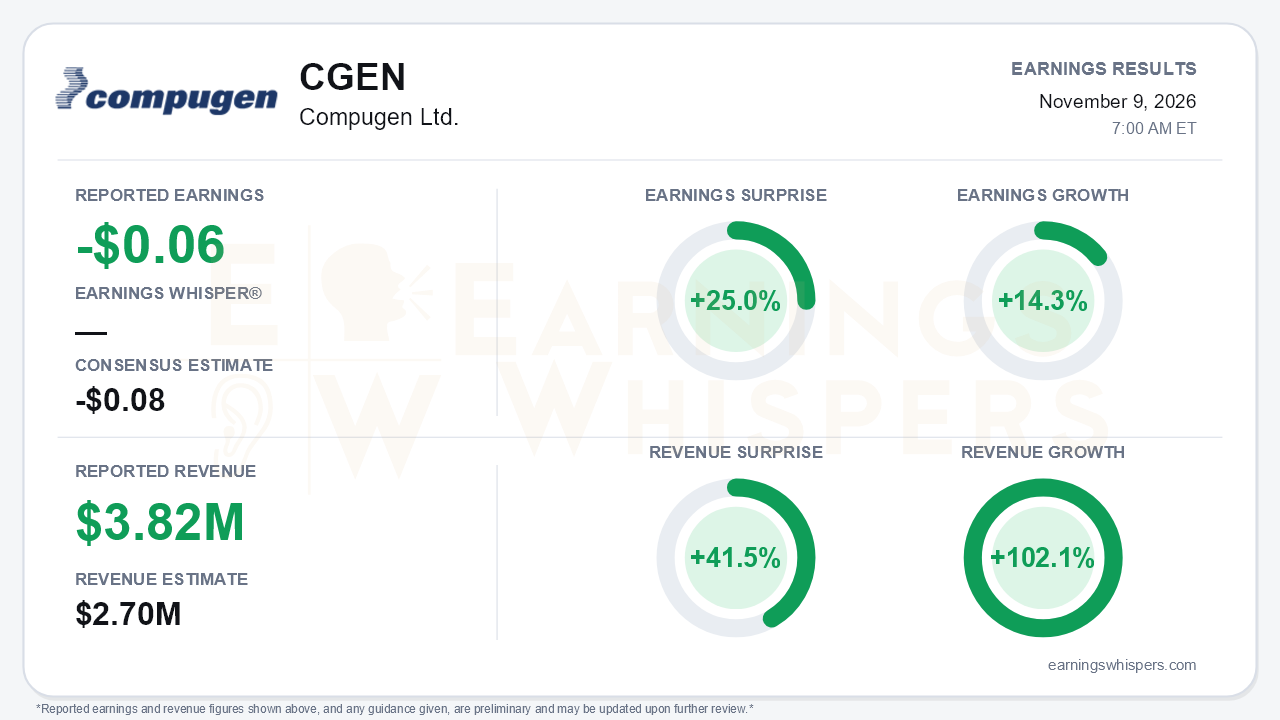
Compugen (NASDAQ: CGEN) delivered a clean beat on both lines for the third quarter. It posted a loss of $0.06 per share against a consensus estimate of -$0.08, a 25.0% earnings surprise. Revenue of $3.82 million topped the $2.7 million consensus by 41.5%. Revenue grew 102.1% year over year and earnings improved 14.3%, as the net loss narrowed to $5.8 million from $7.0 million a year earlier. The sequential picture is equally tidy: revenue climbed from $2.2 million in Q1 to $2.6 million in Q2 to $3.8 million in Q3, while the net loss shrank from $7.7 million to $7.0 million to $5.8 million. For a clinical-stage company, however, these numbers are not the story. The real question is whether COM701 can show a credible signal in a small, unpowered trial reading out by the end of Q1 2027. That is the central tension: improving financial optics against an investment case that now rests on a near-term binary event.
The quality of the revenue beat deserves scrutiny. The release attributes Q3 revenue entirely to recognizing portions of Gilead's upfront payment and IND milestone, both cash Compugen already holds. Long-term deferred revenue fell to $15.2 million from $24.9 million at year-end, and short-term deferred revenue rose to $12.8 million. That is accounting recognition, not new demand or new cash. Cost of revenues also rose to $2.4 million, so gross profit was $1.4 million. Below that line, the improvement was modest. R&D was flat year over year at $5.8 million, although it eased sequentially from $6.9 million in Q1 and $6.3 million in Q2. Financial income of about $1.1 million also cushioned the loss. Cash, deposits and securities fell to $117.5 million from $125.3 million in Q2 and $145.6 million at year-end. That works out to roughly $8 million of burn this quarter, and management reaffirmed runway into 2029 excluding any new inflows.
Operationally, this was an execution quarter. MAIA-ovarian is fully enrolled with 62 patients randomized 2:1 against placebo, after having been described only as "progressing" on the Q2 call. The more important partner development was timing. AstraZeneca's Phase 3 ARTEMIDE-Biliary01 trial of rilvegostomig in adjuvant biliary tract cancer (n=760) is now expected to deliver high-level results in the second half of 2027. On the Q2 call, management had cited AstraZeneca guidance of Phase 3 results only after 2027. AstraZeneca also presented first overall-survival data from the Phase 2 ARTEMIDE-01 trial in first-line PD-L1-positive lung cancer, which compared favorably with historical controls and showed no Grade 4+ treatment-related adverse events. Rilvegostomig now sits in 12 Phase 3 trials, keeping alive up to $195 million in milestones plus mid-single-digit royalties. Management also introduced UnigenX, an extension of its discovery engine into tumor-associated antigens for T cell engagers, and framed 2027 as a "data-rich year."
Bears have legitimate ammunition, though, and much of it centers on COM701. The trial is exploratory and not powered for statistical significance. The placebo PFS assumption remains near four months, down from about 5.5 months cited in Q1. Management's language for success has also drifted. In Q1 it hypothesized a PFS improvement of at least three months; it now emphasizes the "totality of the data" and the share of patients progression-free at six months. That shift may simply be prudent, but it gives investors more room for an ambiguous result. Emerging ADC competition in ovarian maintenance was flagged at the October KOL event. On the partner side, the next AstraZeneca milestone requires BLA acceptance, so even a positive biliary readout would not trigger a payment on its own. Meanwhile, GS-0321's Phase 1 dose escalation has run for more than 18 months without disclosed data, and Gilead's terms limit what Compugen can say.
The market has not rewarded the operational progress. Investor sentiment weakened meaningfully into the report, falling from -0.11 to -0.29. Shares closed at $1.96 on November 6, down 16.2% from the $2.34 open after the August report. That leaves the stock about 14% below its $2.29 200-day moving average and just 5% above the inter-earnings low of $1.87, set on November 5. It is also a third below the late-August high of $2.94, so the summer rally has been entirely given back. Price and AVWAP trend readings are negative, while sequential growth is the lone positive, which mirrors the split between improving reported financials and a deteriorating tape.
The bottom line is that Compugen beat estimates and cleaned up its trajectory, but the beat reflects non-cash recognition of Gilead money rather than a change in fundamentals. What did change is timeline visibility. The COM701 readout is now a fully enrolled, near-term catalyst, and AstraZeneca's first Phase 3 rilvegostomig data moved into 2027. Runway into 2029 lets the company reach both events without immediate financing pressure. Still, a softened success bar, a small trial and fading investor sentiment mean the stock enters 2027 priced with clear skepticism. The MAIA-ovarian data, not quarterly earnings, will determine whether that skepticism was warranted.
Read our earnings preview for Compugen Ltd.: https://www.earningswhispers.com/article/CGEN/22557
This earnings review was originally published on Earnings Whispers.
This article is for informational purposes only and is not investment advice. Earnings Whispers and its staff may hold positions in the securities mentioned. It is AI-assisted, based on proprietary Earnings Whispers data and company reports, and edited by Earnings Whispers staff.
Mentioned In This Article
Latest News
| Nov-09 | |
| Nov-09 | |
| Nov-09 | |
| Nov-03 | |
| Nov-02 | |
| Oct-26 | |
| Oct-06 | |
| Sep-22 | |
| Sep-08 | |
| Aug-26 | |
| Aug-05 | |
| Aug-03 | |
| Aug-03 | |
| Jul-31 | |
| Jul-21 |
