Evolution Petroleum Misses As Hedge Losses Mask A Minerals Ramp, While A Thinner Balance Sheet Forces A Shift To Debt Reduction
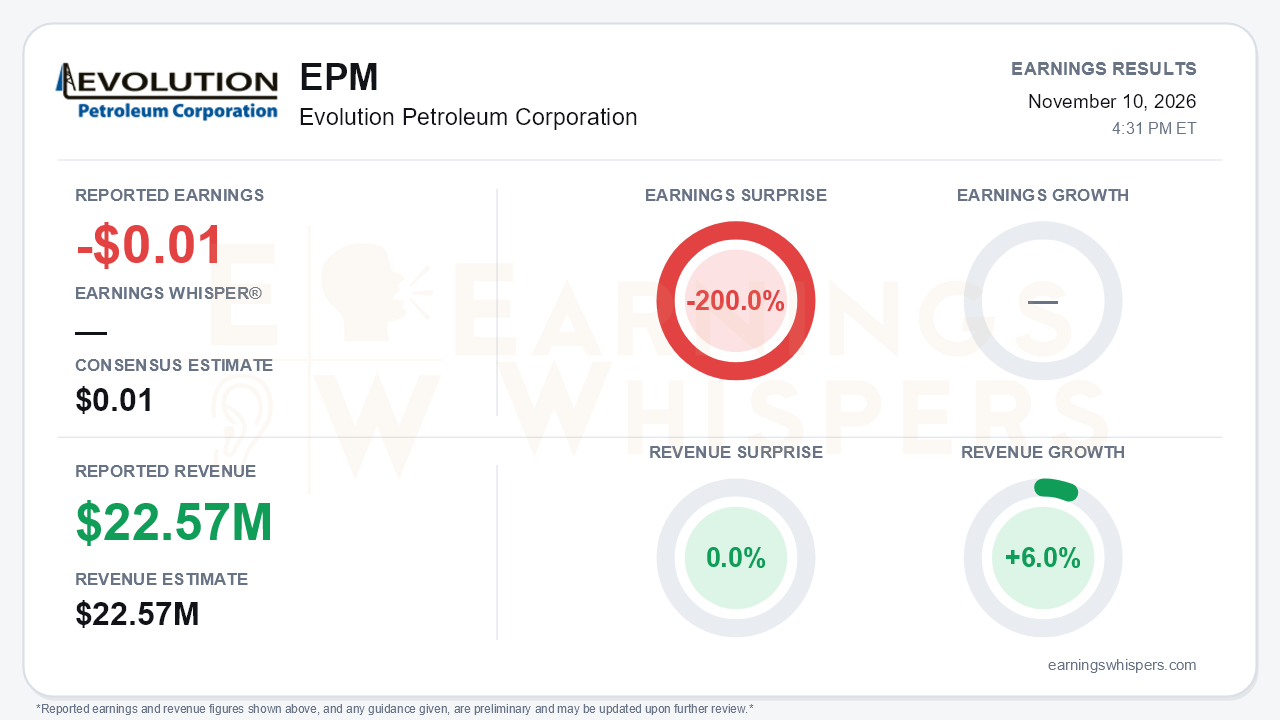
Evolution Petroleum (NYSE American: EPM) reported an adjusted loss of $0.01 per share for its fiscal first quarter, missing the consensus estimate for a $0.01 profit by 200.0%. Revenue of $22.57 million matched consensus exactly and grew 6.0% year over year. On a GAAP basis, the company swung to a net loss of $3.0 million, or $0.08 per share, from net income of $0.8 million a year earlier and $4.6 million in the June quarter. The miss is real, but it is largely a commodity and hedging story. Underneath it, the capex-free minerals strategy management has been promising is starting to show up in volumes and unit costs. The central tension is that this operating progress arrived just as the balance sheet tightened and the company pivoted from buying growth to paying down debt.
The quality of the quarter deserves careful reading. Most of the GAAP loss came from a $4.1 million unrealized derivative loss. The adjusted miss stems more from realized hedges, which cost $1.3 million against $0.9 million of gains a year ago. That roughly $2.2 million swing explains why adjusted EBITDA fell to $6.8 million from $7.3 million year over year even though the realized equivalent price rose 11% to $35.13 per BOE. Sequentially, the top line decelerated. Revenue fell 7% from $24.2 million as oil realizations slipped to $81.74 from $90.74, after a quarter in which revenue had jumped roughly 20%. The hedge book also cuts both ways going forward. Calendar 2027 oil swaps sit at $68.43 and collars cap at $74.57, well below recent realizations. Gas swaps around $3.38 to $4.01 provide meaningful support against a realized price of just $2.51.
The operating trends are better than the headline. Adjusted EBITDA rose from $6.5 million in the June quarter and $3.1 million in the March quarter. Cash flow from operations before working capital climbed to $8.4 million from $6.5 million. LOE per BOE improved to $19.25 from $20.35 last quarter and $21.49 the quarter before. Management expects further declines as royalty volumes, which carry LOE of only $2 to $3 per BOE, become a larger share of the mix. Production edged up 1% sequentially to 6,978 BOEPD. The newly acquired Permian minerals averaged about 218 BOE/d, ahead of the 200 to 210 BOE/d expectation, with roughly six new wells not yet counted. Eight rigs are running and 30 to 40 new permits have been filed since quarter end. Haynesville and Bossier royalty volumes rose about 92% sequentially, delivering the ramp management flagged over the past two quarters.
Bears still have legitimate ammunition. Production remains down 5% year over year. Delhi is again the problem child: the compressor issue was first flagged two quarters ago and described as resolved last quarter, but production is now shut in with no restart timeline from the operator. Delhi volumes fell to 576 BOEPD from 648 sequentially. The Permian deal was funded partly with about $12.5 million of net equity, which lifted the share count to 40.6 million from 35.9 million. Borrowings also rose to $60 million while cash fell to $3.1 million. The borrowing base was redetermined at $70 million, above the $65 million spring level but below the $73 million interim increase. That leaves availability of only $9.2 million as of October 20. Reported operating cash flow after working capital was $3.3 million, short of the $4.9 million dividend. The $0.12 payout is covered on a pre-working-capital basis, but the cushion is thin.
Management's response is a new monetization lever. It completed a Williston farm-out of 636 net acres for about $2.5 million plus a 0.25% overriding royalty with a drilling commitment, and it is negotiating more farm-outs across the portfolio. It also floated a buyback as a possible use of asset-sale proceeds. The tone shifted noticeably from acquisition-led growth to debt reduction, with a high bar for new deals. That is prudent, but it implies slower external growth. Fiscal 2027 capex guidance of $4 to $6 million was not updated, and Chaveroo drilling timing remains unresolved.
The market has not been rewarding the story. Shares are down 7.3% since the open after the prior report, at $3.57, and sit 11.8% below the $4.05 200-day moving average. Management acknowledged on the call that the stock had weakened following the equity raise, and the AVWAP trend reading remains negative. Investor sentiment improved only marginally, moving from -0.043 to -0.028. That is still slightly negative and essentially neutral, with no sign of a meaningful shift in expectations.
The bottom line is that Evolution delivered a headline miss driven by hedge losses and softer sequential pricing, alongside genuine operating improvement in EBITDA, unit costs and mineral volumes. The next two quarters must show a full period of Permian contribution, a Delhi restart, and farm-out proceeds actually reducing debt. Until then, the dividend and the balance sheet will remain the market's focus rather than the minerals ramp.
Read our earnings preview for Evolution Petroleum Corporation: https://www.earningswhispers.com/article/EPM/22734
This earnings review was originally published on Earnings Whispers.
This article is for informational purposes only and is not investment advice. Earnings Whispers and its staff may hold positions in the securities mentioned. It is AI-assisted, based on proprietary Earnings Whispers data and company reports, and edited by Earnings Whispers staff.
Mentioned In This Article
Latest News
| 1 hour | |
| Nov-10 | |
| Nov-10 | |
| Nov-03 | |
| Oct-29 | |
| Sep-22 | |
| Sep-21 | |
| Sep-21 | |
| Sep-17 | |
| Sep-15 | |
| Sep-15 | |
| Sep-10 | |
| Sep-08 | |
| Aug-28 | |
| Aug-20 |
