Pixelworks Misses On EPS, But Meta Deal And 92% Gross Margin Give The Licensing Story Its First Real Proof Point
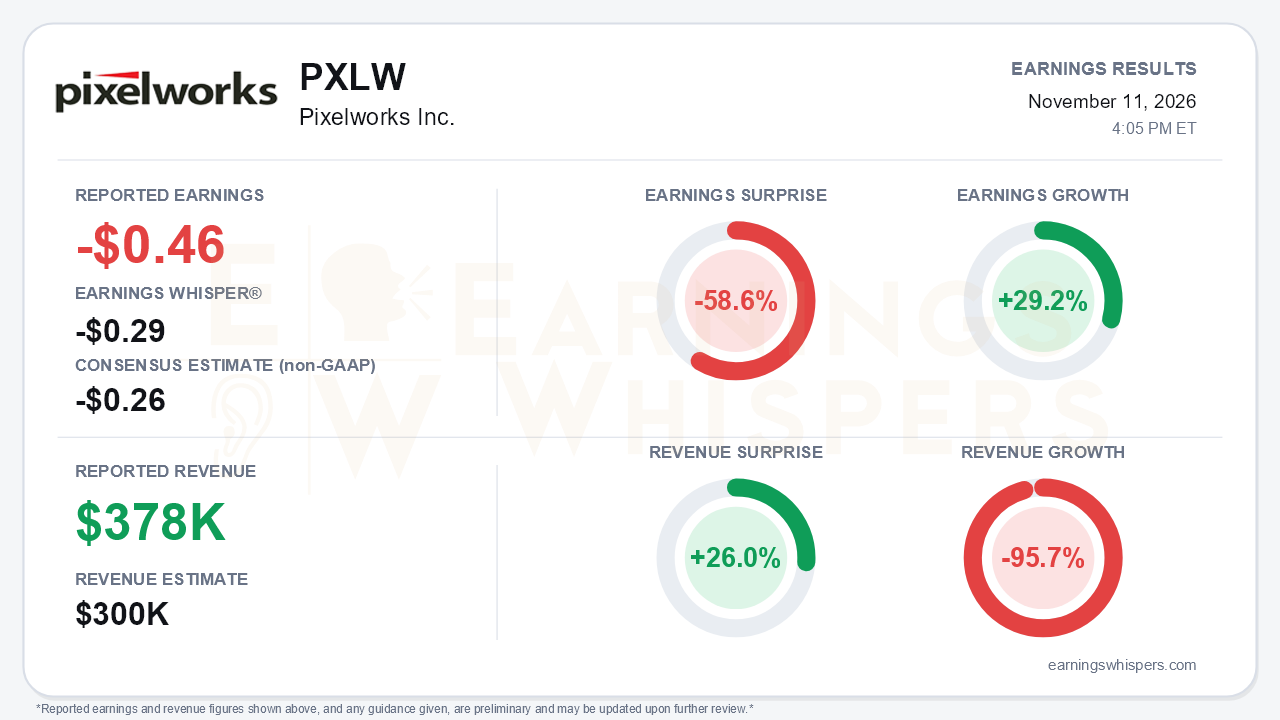
Pixelworks reported a third-quarter loss of $0.46 per share, missing the -$0.26 consensus by 58.6% and falling well short of the -$0.29 Earnings Whisper number. The miss needs context. The $0.46 figure is a GAAP loss from continuing operations, while consensus was framed on a non-GAAP basis, so part of the gap reflects accounting rather than a collapse in the business. Revenue of $0.38 million beat the $0.3 million consensus by 26.0%, and earnings improved 29.2% year over year as the per-share loss narrowed. The more important development is strategic. Meta is now Pixelworks' first major TrueCut Motion device licensee, and the first device licensing revenue arrived ahead of plan. That is the central tension: the licensing thesis finally showed up in the numbers, but the numbers remain very small relative to the cost base.
The headline revenue comparisons conflict, and investors should understand why. Earnings Whispers shows revenue down 95.7% year over year. That figure reflects the comparison against a prior-year base that included the semiconductor operations sold to a VeriSilicon-led entity in January. On the continuing-operations basis in the press release, revenue rose to $378,000 from $241,000 a year ago and from just $64,000 in the second quarter. Nine-month revenue of $888,000 already exceeds the roughly $690,000 of TrueCut revenue for all of fiscal 2025. Gross margin rose to 92.1%, up from 60.9% in Q2 and 56.7% in Q1, as licensing entered the mix. That is the margin profile a pure-play licensing model is supposed to produce.
Below the gross line, the quality of the quarter deserves scrutiny. GAAP operating expenses rose to $3.8 million from $3.4 million in Q2 and $2.8 million a year earlier. R&D climbed to $1.47 million from $0.93 million, and stock-based compensation nearly doubled year over year to about $1.1 million. The operating loss widened to $3.4 million from $2.6 million. The net loss looked better only because $648,000 of interest and other income, earned on the cash from the divestiture, offset much of the increase.
Management's non-GAAP opex framework has also drifted upward with each update:
- "$2 million or less" in Q4 FY25
- about $2 million in Q1
- under $2.5 million in Q2
- $2 to $2.5 million per quarter now
The new target of quarterly cash burn below $1 million arrives only "exiting 2027." That implies at least another year of meaningful burn.
On the call, management's tone moved from the earlier "greasing the skids" language to describing a "major turning point." Management expects Meta to accelerate studio demand for new TrueCut-graded releases and library conversions, and it called 2027 a "breakthrough year" for theatrical titles, with numerous releases targeted over the next four quarters. DreamWorks Animation's Forgotten Island, graded in 2D and 3D, extended the content slate. A strong domestic box office provides a supportive backdrop for premium large-format screens: roughly $8.5 billion year to date, up 20%. Bears still have legitimate ammunition:
- Meta's financial terms are undisclosed, and revenue timing depends on Meta's product launches.
- Management continues to describe revenue as lumpy.
- No new exhibitor partners were added beyond Marcus, Odeon, Vue, Kinepolis and CineD.
The balance sheet buys time, but the cash is steadily declining. Cash and short-term securities of about $50 million compare with $53 million in Q2 and $58 million in Q1. Operating cash use ticked up to $1.8 million. The company repurchased $1.2 million of stock below book value, down from $3.2 million in Q2, and only about $0.6 million of the $5 million authorization remains.
The market has started to reward the story. Investor sentiment improved sharply from -1.0 to -0.37, a meaningful shift, though it remains on the negative side of the scale. The stock price moved even more abruptly. Shares hit a 52-week low of $4.80 on November 5 and then rallied to a quarter high of $7.43 on November 10, the day before the report. Shares entered earnings at $7.29, just 1.9% below that high, 18.9% above the 200-day moving average and up 21.1% since the open after the August report. The Earnings Whispers trend readings are mixed: momentum and AVWAP trends are positive, while price and sequential-growth trends remain negative. Because the stock went into the print near the top of its range, much of the Meta optimism may already be reflected in the price ahead of the numbers.
The bottom line is that Pixelworks delivered the first tangible evidence that its licensing pivot can produce high-margin revenue, and the Meta agreement is a credible catalyst that arrived ahead of schedule. Still, quarterly revenue under $400,000 is set against roughly $3.8 million of operating expenses, the opex framework keeps creeping higher, and the burn target is more than a year away. Investors are now underwriting Meta's undisclosed economics and a 2027 content ramp, so upcoming quarters must show revenue scaling rather than just milestones accumulating.
Read our earnings preview for Pixelworks Inc.: https://www.earningswhispers.com/article/PXLW/22963
This earnings review was originally published on Earnings Whispers.
This article is for informational purposes only and is not investment advice. Earnings Whispers and its staff may hold positions in the securities mentioned. It is AI-assisted, based on proprietary Earnings Whispers data and company reports, and edited by Earnings Whispers staff.
Mentioned In This Article
Latest News
| Nov-11 | |
| Nov-11 | |
| Nov-11 | |
| Nov-10 | |
| Nov-10 | |
| Nov-10 | |
| Nov-05 | |
| Oct-28 | |
| Oct-15 | |
| Oct-12 | |
| Oct-06 | |
| Oct-01 | |
| Sep-30 | |
| Sep-29 | |
| Sep-23 |
