Lithium Americas Reports Third Quarter 2026 Results
(All amounts in US$ unless otherwise indicated)
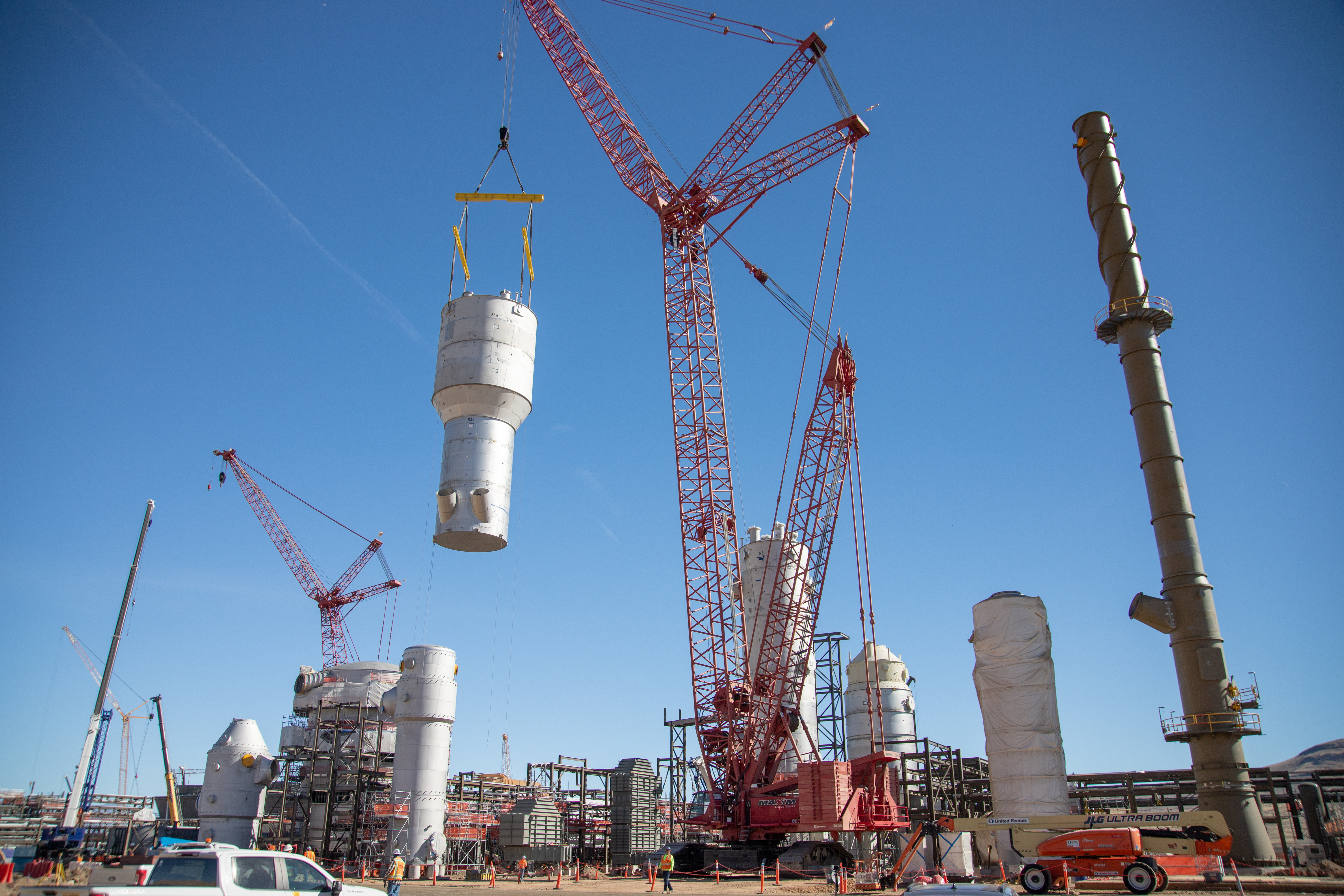
VANCOUVER, British Columbia--(BUSINESS WIRE)--$LAC #Nevada--Lithium Americas Corp. (TSX: LAC) (NYSE: LAC) (“Lithium Americas,” “LAC” or the “Company”) announced that it has filed its Quarterly Report on Form 10-Q, which includes the Company’s unaudited condensed consolidated interim financial statements for the three and nine months ended September 30, 2026 (“Q3 2026”). The Company continues to progress major construction at its Thacker Pass lithium project in Humboldt County, Nevada (“Thacker Pass” or the “Project”), with Phase 11 targeting mechanical completion in late 2027, with ramp-up through 2028.

Jonathan Evans, President and Chief Executive Officer of Lithium Americas, said, “Thacker Pass is one of the largest construction projects in Nevada and is on track to deliver America's largest fully integrated source of domestic battery-quality lithium carbonate. Thacker Pass represents more than a strategic supply chain asset, it is an investment in Nevada workers and local communities, creating meaningful, family-supporting jobs. We are proud to build a lithium operation expected to help secure America’s critical mineral independence, which is key for national security.”
Q3 2026 AND SUBSEQUENT TO Q3 2026 HIGHLIGHTS
-
As of September 30, 2026, the Company had approximately $1.3 billion total cash and restricted cash, including $359.5 million at the Thacker Pass joint venture (“JV”) level.
- The Company issued and sold 1.1 million common shares during Q3 2026 at an average price of $3.87 per share for aggregate net proceeds of $4.1 million after sales agent's commission and other expenses, pursuant to its March 19, 2026 at-the-market (“ATM”) equity program (the “March 2026 ATM Program”).
- On August 21, 2026, the Company received its fourth advance of $239.0 million on the U.S. Department of Energy (“DOE”) loan (“DOE Loan”). Cumulative advances total $1.448 billion.
- On August 5, 2026, the Company entered into a securities purchase agreement (the “Purchase Agreement”) with YA II PN, Ltd., an affiliate of Yorkville Advisors Global, LP (“Yorkville”), for up to $175 million in aggregate principal amount of subordinated convertible debentures (the “Yorkville Debentures”). On August 13, 2026, the Company issued $150 million in Yorkville Debentures to Yorkville. The Company retains the right to, subject to certain conditions, issue up to an additional $25 million in Yorkville Debentures in one or more subsequent closings at its discretion. During Q3 2026, Yorkville converted $40.5 million of principal and accrued interest and the Company issued 14.3 million common shares to Yorkville.
- On October 7, 2026, the Company contributed the additional $120 million in reserve account funding required pursuant to the October 7, 2025 omnibus waiver, consent and amendment (as amended, the “OWCA”) to the DOE Loan.
- As of November 11, 2026, the Company had 377,334,749 shares issued and outstanding.
- The Company continues to progress major construction at Thacker Pass Phase 1, targeting mechanical completion in late 2027, with ramp-up through 2028.
-
On November 11, 2026, the Company announced a definitive capital cost estimate (“Capex Estimate”) for Thacker Pass Phase 1 of $3.83 billion (including contingency) (see below Capital Expenditure and 2026 Capex Guidance section for more information), that included the following Project update as of September 30, 2026 (unless otherwise indicated):
- 4.7 million workhours were completed at Thacker Pass without a serious injury or lost-time incident.
- Approximately 1,900 personnel on site, including over 1,600 craft workers, increasing to approximately 2,200 total personnel by year end 2026 as construction ramps up to peak labor and peak activity.
- Both detailed engineering design and procurement of equipment and materials are well advanced, with detailed engineering completed and procurement at over 90% completed. Outstanding procurement consists mainly of finishing final deliveries of equipment and bulk materials to site, which are expected by year end 2026.
- Over 80% of the value for third-party contracts has been committed with over 50% incurred.
- The Company commenced awarding equipment contracts in late 2024 and early 2025, which has supported the de-risking of the construction schedule. Proximate to September 30, 2026, approximately 60 truckloads of equipment and materials were arriving to site each day as major long-lead equipment, along with other key equipment and materials, were being delivered to Thacker Pass. Deliveries have included certain key equipment with long lead times, such as the 115 kV main transformer, the steam turbine generator and major process vessels.
- All major structural steel was delivered to the site by the end of August 2026. Structural steel for key facilities in the processing plant area, including the Filter Building, the Magnesium Sulfate Building and the Lithium Carbonate Building, continue to advance with steel installations enabling mechanical and piping activity.
- Both above-ground and underground piping installations are progressing across multiple work fronts throughout the site. At the end of October 2026, 80% of the required fabricated piping material was either in transit or delivered to site.
- Major concrete work required throughout the site continues to progress, with concrete finishing being a priority to ensure quality and readiness for follow-on work.
-
The following Project development milestones are targeted for the remainder of 2026:
- Delivery of all packaged equipment and all remaining miscellaneous structural steel.
- Structural completion of the main field erected tanks.
- All structural concrete foundations required at the site are expected to be completed.
- Early commissioning of utilities in the individual plants is expected to commence.
- Connecting the electrical utility grid to the site substation and the subsequent energization of certain key components in the process plant.
- Construction at the Company’s Transload Terminal (“TLT”) west of Winnemucca continues. In Q3 2026, installation of rail stabilization (geo-membrane) and sub-ballast achieved 95% completion, the first concrete was poured, powerline relocation work commenced and construction of the main line railroad turnout was completed and is now ready for installation. Completion of the TLT is targeted in 2027 to align with startup at Thacker Pass to support operations by serving as a critical logistics hub for the operation’s reagents.
- The Company’s contributions on October 7, 2026, of $120 million in reserve account funding required pursuant to the OWCA, as noted above, and $650 million in contributions toward the incremental funding requirement as a result of the Capex Estimate, will result in an increase to the Company’s ownership percentage in the JV. The Company is working with the DOE and General Motors Holdings LLC (“GM”) to finalize the related implications on JV interest holdings.
| ______________ | ||
1 | See the Company's NI 43-101 technical report dated effective December 31, 2024, "National Instrument 43-101 Technical Report - Thacker Pass Project, Humboldt County, Nevada, USA" for full details. | |
CAPITAL EXPENDITURE AND 2026 CAPEX GUIDANCE
The Company has completed an updated Capex Estimate for Thacker Pass Phase 1 that reflects achieving advanced levels of construction, detailed engineering and procurement and further incorporates external factors, which have arisen following declaration of the final investment decision (“FID”) in April 2025. The updated Capex Estimate of $3.83 billion (including contingency) represents an increase from the prior Capex Estimate of $2.93 billion and reflects:
- Tariff and logistics – total impact of approximately $100 million. The tariff exposure estimate is now reduced to approximately $60 million (from the previously disclosed estimate of between $80 million and $100 million), now that most of the equipment and materials have been received. Logistics costs have been heavily impacted by increases in fuel prices, reductions in the availability of U.S. fabrication capacity and challenging global and national shipping conditions (i.e., requirements to reroute shipments due to regional constraints to protect the construction schedule, constraints in U.S. logistics and reduced open sea lane availability).
- Craft labor wage rates and compensation package inflation – total impact of approximately $150 million. Higher than anticipated escalation in union labor craft wage rates and incentives, due to higher than anticipated levels of regional competition for skilled union labor.
- Labor install rates for piping, steel and equipment – total impact of approximately $245 million. Labor hour costs related to install rates have been updated to reflect anticipated hours based on the current availability of quality labor. Regional competition is stretching the availability of union labor beyond what was anticipated. Actual install rates for the steel, piping and mechanical disciplines are now better known based on early installation quantities, allowing the Company to develop estimates with a higher level of accuracy and confidence.
- Engineering, procurement and construction management (“EPCM”) and contractor staffing levels – total impact of approximately $100 million. The Project’s EPCM contractor, Bechtel, and its contractors required more engineers and construction staff to complete the Project. Given the advanced levels of detailed engineering, the required number of personnel can now be estimated with higher confidence.
- EPCM and contractor staff wage rates – total impact of approximately $150 million. The Project’s EPCM and various contractors have also been exposed to inflationary and competitive wages, as well as increased incentives, to be able to continue to attract quality craft professionals.
- Additional contingency – impact of approximately $150 million. Allocating an additional 10% contingency on estimated capital costs that have not yet been committed or spent.
The Capex Estimate risk profile has been lowered with advanced levels of engineering and procurement completed, all earthworks and geotechnical risks have passed, and all remaining key long-lead equipment is expected to mobilize to site during November 2026. Further, the number of craft workers already on site lowers the risk associated with being able to achieve peak labor requirements by the end of 2026. For the remainder of construction, primary risks include costs associated with attraction and retention of quality craft labor and sustaining planned installation rates.
The Company estimates the incremental funding requirement arising from the Capex Estimate and other assumption changes to be approximately $995 million, summarized as follows:
- Incremental capital expenditure of $895 million;
- An additional $58 million from net increases to Sustaining Capex Reserve Account requirements under the DOE Loan through March 2028, driven by increased levels of sustaining capital in 2028 and 2029; and
- A further net increase of $42 million across all other areas, including increases to other pre-completion expenditures, partially offset by improved estimated operating cash flow during the 2028 ramp-up period, largely resulting from changes in the pricing forecast for lithium carbonate.
Pursuant to (a) an omnibus waiver, consent, and amendment to the DOE Loan (the “OWCA 3”) signed on November 10, 2026 and related loan documents, and (b) agreements among DOE, the Company, and GM, it is anticipated the incremental funding requirement will be fully met through, collectively, $650 million in contributions from the Company to the Thacker Pass JV level and, as and when required, $315 million currently credited to certain reserve accounts established and funded under the DOE Loan. In addition, amendments to the DOE Loan documents pursuant to the OWCA 3 will decrease the funding requirement of the Sustaining Capex Reserve Account by approximately $30 million during and after the ramp-up period of the Project. These contributions will result in an increase to the Company’s ownership percentage in the JV.
Peak capital expenditure is expected to be in fiscal year 2026, with the balance of capital expenditure spent throughout 2027 and into 2028 during ramp-up.
As of September 30, 2026, a total of $2.4 billion of construction capital costs and other project-related costs had been capitalized, of which $2.3 billion is part of the total Capex Estimate. The Company is now targeting a total Capex Estimate range of $1.7 billion to $2.0 billion for Thacker Pass Phase 1 for fiscal year 2026.
The table below summarizes capital expenditure in the three and nine months ended September 30, 2026, cumulative capital expenditure to September 30, 2026, as well as the Company’s 2026 capital expenditure guidance (“Capex Guidance”).
(in US$ millions, except as noted) |
| For the Three Months Ended September 30, 2026 |
|
| For the Nine Months Ended September 30, 2026 |
| Fiscal Year 2026 Capex Guidance |
| Cumulative to September 30, 2026 | |||
Thacker Pass Phase 1 construction costs included in the total Capex Estimate 1, 2 |
| $ | 639.6 |
|
| $ | 1,398.7 |
| $1.6 - $1.9 billion |
| $ | 2,261.3 |
Other capitalized development costs for Thacker Pass 3 |
|
| 5.7 |
|
|
| 21.1 |
| 30.0 - 40.0 |
|
| 114.2 |
Capitalized interest, including the Orion Notes 4 and DOE Loan |
|
| 17.2 |
|
|
| 45.1 |
| 55.0 - 65.0 |
|
| 72.1 |
Total |
| $ | 662.5 |
|
| $ | 1,464.9 |
| $1.7 - $2.0 billion |
| $ | 2,447.6 |
| 1 | Thacker Pass Phase 1 construction costs cumulative to September 30, 2026 and those estimated for fiscal year 2026, do not include $19.5 million and $8.0 million, respectively, of community contributions that are required to be expensed under U.S. GAAP, though these were included in the Capex Estimate. | |
| 2 | Thacker Pass Phase 1 construction costs cumulative to September 30, 2026, and those estimated for fiscal year 2026, includes actual tariffs incurred through September 30, 2026. Thacker Pass Phase 1 construction costs estimate for fiscal year 2026 also includes estimated tariff exposure, primarily for equipment and construction materials sourced from Canada, China, India, UAE, Turkey and the European Union. The Company continues to closely monitor potential tariff exposure; however, changes in tariffs and trade restrictions can be announced with little or no advance notice. Thacker Pass Phase 1 construction costs estimate for fiscal year 2026 also include an estimate for the movement in the balance of prepaid construction costs and deposits on long-lead equipment during 2026, both of which are excluded from cumulative construction costs until the goods and services have been received at Thacker Pass. | |
3 | Other capitalized development costs are required to be capitalized under U.S. GAAP, though these were not included in the Capex Estimate. | |
4 | Fund entities managed by Orion Resource Partners LP (collectively “Orion”) purchased $195.0 million in aggregate principal amount of senior unsecured convertible notes (the “Orion Notes”). |
RESULTS OF OPERATIONS
The selected consolidated financial information set out below has been derived from the Company's audited consolidated annual financial statements for the year ended December 31, 2025 (“FY 2025”) and unaudited condensed consolidated interim financial statements for the three and nine months ended September 30, 2026 (“Q3 2026”) and should be read in conjunction with those consolidated financial statements and the related notes thereto.
The Nine Months Ended September 30, 2026 Compared with the Nine Months Ended September 30, 2025
The following table provides a summary of the Company’s unaudited Condensed Consolidated Interim Statements of Income (Loss) for the nine months ended September 30, 2026 (“YTD Q3 2026”) compared with the nine months ended September 30, 2025 (“YTD Q3 2025”).
|
|
For the Nine Months
|
|
|
|
| ||||||
(in US$ millions except for per share amounts) |
| 2026 |
|
| 2025 |
|
| Change |
| |||
Net income (loss) |
| $ | 96.4 |
|
| $ | (223.9 | ) |
| $ | 320.3 |
|
Net income (loss) attributable to LAC stockholders |
|
| 76.4 |
|
|
| (220.8 | ) |
|
| 297.2 |
|
Net income (loss) per share – basic - attributable to common stockholders |
|
| 0.21 |
|
|
| (0.98 | ) |
|
| 1.19 |
|
Net loss per share - diluted - attributable to common stockholders |
|
| (0.13 | ) |
|
| (0.98 | ) |
|
| 0.85 |
|
|
|
|
|
|
|
|
|
|
| |||
Net income (loss) comprised of: |
|
|
|
|
|
|
|
|
| |||
General and administrative expenses |
| $ | (35.5 | ) |
| $ | (24.1 | ) |
| $ | (11.4 | ) |
Transaction costs |
|
| (8.3 | ) |
|
| (18.3 | ) |
|
| 10.0 |
|
Gain (loss) on financial instruments measured at fair value: |
|
|
|
|
|
|
|
|
| |||
Gain on LAC Warrant and JV Warrant obligations |
|
| 58.5 |
|
|
| - |
|
|
| 58.5 |
|
Gain (loss) on convertible debt and conversion feature |
|
| 59.3 |
|
|
| (187.1 | ) |
|
| 246.4 |
|
Gain on convertible debt measured at fair value |
|
| 5.2 |
|
|
| - |
|
|
| 5.2 |
|
Gain (loss) on financial instruments measured at fair value |
|
| (4.8 | ) |
|
| 1.2 |
|
|
| (6.0 | ) |
Other income |
|
| 21.9 |
|
|
| 4.3 |
|
|
| 17.6 |
|
General and administrative expenses increased to $35.5 million in YTD Q3 2026 (YTD Q3 2025 - $24.1 million) due to increased hiring, share-based compensation, community investment, and regulatory and professional fees supporting expanded operations.
Transaction costs decreased to $8.3 million in YTD Q3 2026 (YTD Q3 2025 - $18.3 million). YTD Q3 2026 costs primarily related to advisory and professional fees for the Yorkville Debentures issuance in August 2026 and for the warrants the Company issued to the DOE to purchase up to 18,268,687 common shares (“LAC Warrant”) and the warrants the JV issued to the DOE to purchase 8,656,509,695 non-voting units of the JV (“JV Warrant”) on January 30, 2026 (the “Issuance Date”), while YTD Q3 2025 costs primarily related to the Orion Investment (“Orion Investment”) and advisory fees due upon achieving FID for Thacker Pass Phase 1.
The LAC Warrant and the JV Warrant were initially recognized as financial liabilities on October 7, 2025. A $5.0 million loss on change in fair value of the LAC Warrant was recognized in YTD Q3 2026 (YTD Q3 2025 - $nil), primarily reflecting the increase in the Company’s share price from $4.36 on December 31, 2025 to $4.87 on January 30, 2026, when the LAC Warrant was issued and reclassified to equity. A $63.5 million gain on change in fair value of the JV Warrant, including obligations under the Put, Call and Exchange Agreement, was recognized in YTD Q3 2026 (YTD Q3 2025 - $nil), primarily reflecting the decrease in share price from $4.36 on December 31, 2025 to $2.63 on September 30, 2026.
A $59.3 million gain on change in fair value of the embedded derivative associated with the Orion Notes (the “Embedded Derivative”) was recognized in YTD Q3 2026, primarily reflecting the decrease in the Company’s share price from $4.36 at December 31, 2025 to $2.63 at September 30, 2026. A $187.1 million loss on change in fair value of the Embedded Derivative was recognized in YTD Q3 2025, primarily reflecting the increase in the Company’s share price from $2.76 at April 1, 2025 to $5.71 at September 30, 2025.
A $5.2 million gain on change in fair value of the Yorkville Debentures was recognized in YTD Q3 2026 (YTD Q3 2025 - $nil), primarily reflecting the decrease in the Company’s share price from $3.43 at issuance on August 13, 2026 to $2.63 at September 30, 2026.
A $4.8 million loss on financial instruments measured at fair value was recognized in YTD Q3 2026 (YTD Q3 2025 - $1.2 million gain), primarily consisting of a $4.5 million loss on change in fair value of the Company’s investment in Ascend Elements, Inc. (“Ascend Elements”) (YTD Q3 2025 - $1.4 million gain). During YTD Q3 2026, the Company determined the fair value of the Ascend Elements investment was $nil based on public disclosures indicating significant uncertainty regarding recovery.
Other income for YTD Q3 2026 increased to $21.9 million (YTD Q3 2025 - $4.3 million), primarily due to higher interest income from increased balances in interest-generating bank accounts, driven largely by proceeds from the Company’s ATM programs.
The Three Months Ended September 30, 2026 compared with the Three Months Ended September 30, 2025
The following table provides a summary of the Company’s Condensed Consolidated Interim Statements of Income (Loss) for Q3 2026 compared with the three months ended September 30, 2025 (“Q3 2025”).
|
|
For the Three Months
|
|
|
|
| ||||||
(in US$ millions except for per share amounts) |
| 2026 |
|
| 2025 |
|
| Change |
| |||
Net income (loss) |
| $ | 90.1 |
|
| $ | (199.2 | ) |
| $ | 289.3 |
|
Net income (loss) attributable to LAC stockholders |
|
| 74.7 |
|
|
| (197.7 | ) |
|
| 272.4 |
|
Net income (loss) per share – basic - attributable to common stockholders |
|
| 0.19 |
|
|
| (0.83 | ) |
|
| 1.02 |
|
Net loss per share – diluted - attributable to common stockholders |
|
| (0.05 | ) |
|
| (0.83 | ) |
|
| 0.78 |
|
|
|
|
|
|
|
|
|
|
| |||
Net income (loss) comprised of: |
|
|
|
|
|
|
|
|
| |||
General and administrative expenses |
| $ | (9.3 | ) |
| $ | (9.7 | ) |
| $ | 0.4 |
|
Transaction costs |
|
| (7.3 | ) |
|
| (0.6 | ) |
|
| (6.7 | ) |
Gain (loss) on financial instruments measured at fair value: |
|
|
|
|
|
|
|
|
| |||
Gain on JV Warrant obligation |
|
| 53.6 |
|
|
| - |
|
|
| 53.6 |
|
Gain (loss) on convertible debt and conversion feature |
|
| 39.3 |
|
|
| (193.8 | ) |
|
| 233.1 |
|
Gain on convertible debt measured at fair value |
|
| 5.2 |
|
|
| - |
|
|
| 5.2 |
|
Gain (loss) on financial instruments measured at fair value |
|
| (0.1 | ) |
|
| 3.4 |
|
|
| (3.5 | ) |
Other income |
|
| 8.5 |
|
|
| 1.6 |
|
|
| 6.9 |
|
Transaction costs increased to $7.3 million in Q3 2026 (Q3 2025 - $0.6 million). Q3 2026 costs primarily related to advisory and professional fees for the issuance of the Yorkville Debentures.
The JV Warrant was initially recognized as a financial liability on October 7, 2025. A $53.6 million gain on change in fair value of the JV Warrant, including obligations under the Put, Call and Exchange Agreement, was recognized in Q3 2026 (Q3 2025 - $nil), primarily reflecting the decrease in the Company’s share price from $3.85 on June 30, 2026 to $2.63 on September 30, 2026.
A $39.3 million gain on change in fair value of the Embedded Derivative was recognized in Q3 2026, primarily reflecting the decrease in the Company’s share price from $3.85 at June 30, 2026 to $2.63 at September 30, 2026. A $193.8 million loss on change in fair value of the Embedded Derivative was recognized in Q3 2025, primarily reflecting the increase in the Company’s share price from $2.68 at June 30, 2025 to $5.71 at September 30, 2025.
A $5.2 million gain on change in fair value of the Yorkville Debentures was recognized in Q3 2026 (Q3 2025 - $nil), primarily reflecting the decrease in the Company’s share price from $3.43 at issuance on August 13, 2026 to $2.63 at September 30, 2026.
Other income increased to $8.5 million in Q3 2026 (Q3 2025 - $1.6 million), primarily due to higher interest income from increased balances in interest-generating bank accounts, driven largely by proceeds from the Company’s ATM programs.
Selected financial position information
(in US$ millions) |
|
September 30,
|
|
|
December 31,
|
|
| Change |
| |||
Cash and restricted cash |
| $ | 1,258.7 |
|
| $ | 905.6 |
|
| $ | 353.1 |
|
Mineral properties, plant and equipment, net |
|
| 2,569.9 |
|
|
| 1,344.0 |
|
|
| 1,225.9 |
|
Total assets |
|
| 3,945.8 |
|
|
| 2,579.0 |
|
|
| 1,366.8 |
|
Total liabilities |
|
| 1,853.2 |
|
|
| 992.4 |
|
|
| 860.8 |
|
At September 30, 2026, total assets increased by $1.4 billion from December 31, 2025, driven primarily by a $353.1 million increase in cash and restricted cash and a $1.226 billion net increase in mineral properties, plant and equipment, partially offset by a $205.8 million decrease in deferred financing costs.
- Cash and restricted cash increased primarily from DOE Loan advances, proceeds from the issuance of the Yorkville Debentures, and proceeds from the Company’s ATM programs, partially offset by cash outflows related to Thacker Pass construction costs, general and administrative expenses, and transaction costs.
Contacts
INVESTOR CONTACT
Virginia Morgan
Vice President, Investor Relations and ESG
+1-778-726-4070
ir@lithiumamericas.com
Read full story here
Mentioned In This Article
Latest News
| 7 hours | |
| 7 hours | |
| 8 hours | |
| Nov-11 | |
| Nov-11 | |
| Nov-11 | |
| Nov-10 | |
| Sep-14 | |
| Aug-13 | |
| Aug-13 | |
| Aug-11 | |
| Aug-06 | |
| Jul-16 | |
| Jul-13 | |
| Jun-29 |
