Seanergy Beats Big On Capesize Rates, But Plateauing Sequential Earnings And An $855 Million Build-Out Complicate The Setup
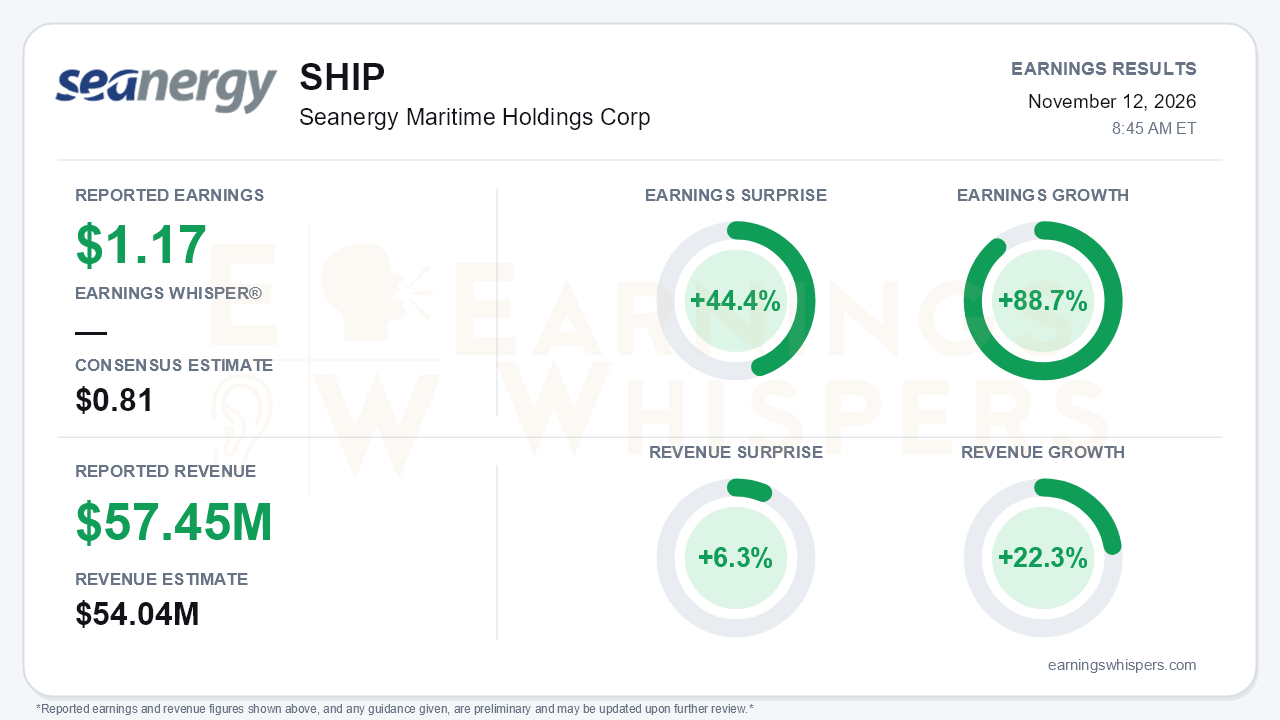
Seanergy Maritime (NASDAQ: SHIP) delivered a decisive third-quarter beat. It reported earnings of $1.17 per share against a $0.81 consensus, a 44.4% surprise. Revenue of $57.45 million topped the $54.04 million estimate by 6.3%. Earnings grew 88.7% year over year and revenue rose 22.3%, carried by a fleet time-charter equivalent of $34,266 per day, up 46% from a year ago. The headline is unambiguous: the pure-play Capesize model is converting a strong freight market into profits, record nine-month net income of $61.9 million, and a rising dividend. The central tension is that the quarter looks more like a plateau than an acceleration, and it arrived while the company is sharply expanding its capital commitments.
The quality of the beat holds up on most measures, though some details deserve scrutiny. Revenue growth came entirely from rates. Ownership days fell to 1,656 from 1,911 as older tonnage left the fleet, so the top line rose despite a smaller operating base. Costs helped. Daily vessel operating expenses fell to $6,699 from $7,376, utilization improved to 98.7%, and net interest expense declined. Against that, G&A climbed to $6.2 million from $4.6 million, with stock-based compensation rising. The company's own figures were GAAP EPS of $1.20 and adjusted EPS of $1.25, both modestly above the normalized $1.17. The bigger issue is sequential. Adjusted EBITDA of $40.8 million and adjusted EPS of $1.25 both slipped from the second quarter's $41.5 million and $1.32, even though revenue rose from $55.7 million and TCE improved from roughly $32,400. The flattening has a clear cause. Hedges and fixed-rate conversions left realized TCE well below the Baltic Capesize Index, which averaged about $41,400 in the quarter and peaked near $50,000.
That same hedging trade-off shapes the outlook. With roughly 86% of fourth-quarter days fixed, management guided Q4 TCE to about $33,284. That is slightly below the third quarter but well above the roughly $30,800 coverage the company cited for the second half on its Q2 call. Full-year 2026 TCE is expected near $31,000, up about 48%. Management framed 2027 at $32,000 to $35,000 per day. The supports it cited were:
- four existing vessels converted to fixed 2027 rates near $35,000;
- only about 100 off-hire days expected next year;
- lower operating costs as the fleet gets younger.
On demand, the CEO pointed to record bauxite volumes, iron-ore ton-mile growth, a faster-than-expected Simandou ramp, and effective fleet growth below 1%. This is a company deliberately trading peak upside for visibility, and the call preserved a credible earnings floor for 2027.
The forward story is now dominated by the fleet program. This quarter Seanergy added four vessels for about $264 million, bringing the program to 12 vessels, roughly $855 million, and 2.3 million dwt, more than 50% capacity growth. The first Hengli newbuilding arrives in January 2027, about four months early. The related-party sale of the 2009-built Friendship for $33 million should free about $19.6 million in net liquidity and book a gain of roughly $12.4 million in the first quarter. Four of the six vessels delivering in 2027–2028 have secured, or are close to securing, multi-year charters with floor rates and index-linked upside. Management also estimates the newbuildings are worth about $85 million above contract price.
Bears have legitimate ammunition, however. Remaining commitments total about $727.6 million. Roughly $354 million falls due in 2027, and only about $177 million of that is covered by secured financing. Two vessels still lack vessel-specific debt. Long-term debt net of deferred charges rose to $409.7 million from $290.2 million at year-end; the call cited total debt of $419 million, including a €100 million bond. Cash of $167.9 million provides a cushion. Management itself flagged several 2027 risks:
- possible volatility tied to Chinese commodity demand;
- about 99 Capesize-class newbuild deliveries next year;
- a likely slowdown in bauxite growth.
The market has already been discounting some of that. Shares at $14.64 are down 11.7% from the open after the prior report. They sit 3.2% below the 200-day moving average and 23.8% below the 52-week high of $19.22 set in early September. The stock touched a quarterly low of $13.79 on November 5, days before the release. Investor sentiment fell from 0.31 to 0.01, a substantial retreat to roughly neutral. Expectations had cooled meaningfully heading into a quarter that ultimately beat comfortably.
The bottom line is that Seanergy's operations are performing well. Rates, costs, guidance and shareholder returns all moved in the right direction, and the surprise was large. The investment setup has changed in two ways. Sequential earnings appear to be leveling off as hedges cap upside, and the balance sheet is taking on a far larger, partly unfunded growth program aimed at a 2027 market that management concedes could be volatile. A depressed share price and deflated sentiment leave room for the beat to matter. Execution on financing and chartering the new tonnage is now the variable investors will watch.
Read our earnings preview for Seanergy Maritime Holdings Corp: https://www.earningswhispers.com/article/SHIP/23002
This earnings review was originally published on Earnings Whispers.
This article is for informational purposes only and is not investment advice. Earnings Whispers and its staff may hold positions in the securities mentioned. It is AI-assisted, based on proprietary Earnings Whispers data and company reports, and edited by Earnings Whispers staff.
Mentioned In This Article
Latest News
| Nov-12 | |
| Nov-12 | |
| Nov-06 | |
| Nov-06 | |
| Sep-25 | |
| Sep-02 | |
| Jul-30 | |
| Jul-30 | |
| Jul-27 | |
| Jul-08 | |
| May-28 | |
| May-28 | |
| May-26 | |
| Apr-14 | |
| Apr-01 |
