Eagle Point Credit Beats On A One-Off Payoff While NAV Erosion And A Bleaker CLO Outlook Dominate
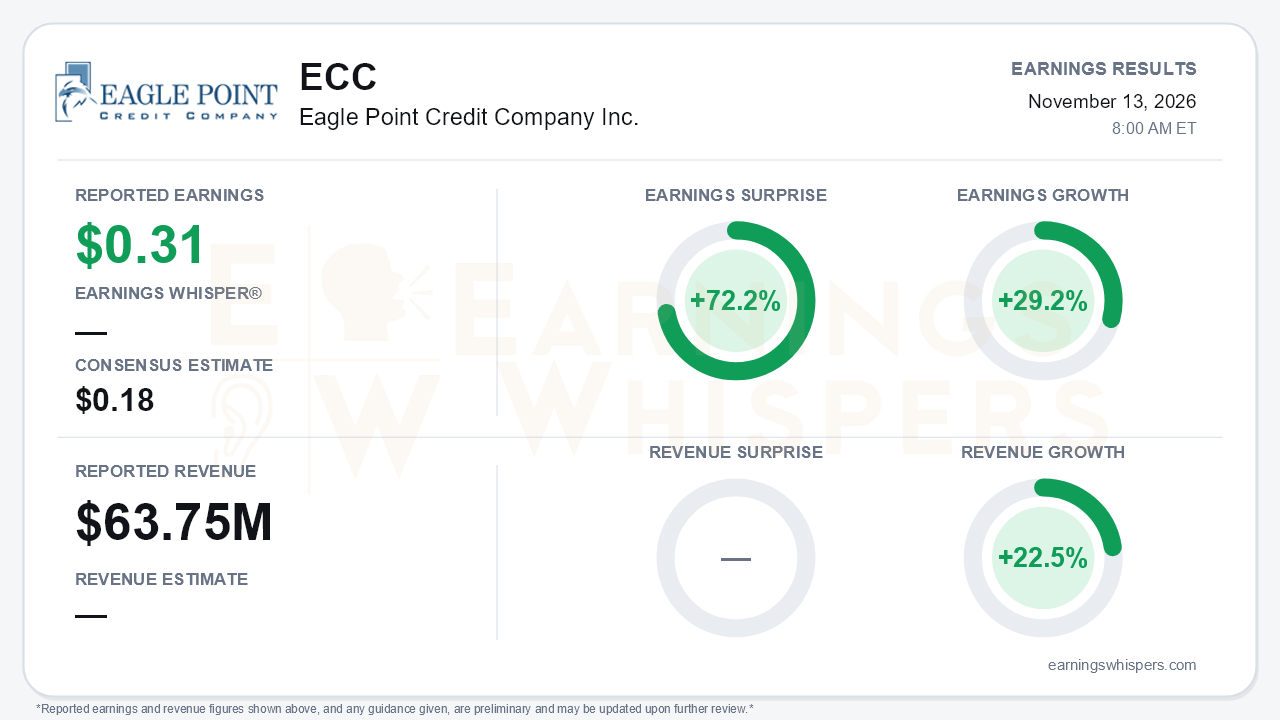
Eagle Point Credit Company (NYSE: ECC) posted net investment income of $0.31 per share for the September quarter, beating the $0.18 consensus by 72.2% and rising 29.2% from a year earlier on revenue of $63.75 million, up 22.5%. The headline beat is real but narrow in quality. About $0.11 per share came from the early payoff of the Nexus infrastructure credit investment, which returned $94 million on a $72 million cost. Excluding that, normalized NII of roughly $0.18 matched the $0.18 quarterly common distribution exactly, leaving no cushion. That is the central tension: a large reported beat sitting on top of a balance sheet and cash-flow profile that continued to deteriorate.
The release shows the gap clearly. NII less realized losses rebounded to $0.29 per share from negative $0.62 in the June quarter, when CLO manager rotation losses hit results, and from $0.16 a year ago. But unrealized markdowns of $55.8 million pushed ECC to a GAAP net loss of $16.4 million, or $0.12 per share, versus GAAP earnings of $0.53 in Q2. NAV per share fell to $4.17 from $4.51. Management's October estimate of $3.73 to $3.83 implies another decline of about 9%, more than erasing the second-quarter recovery. Recurring cash flow from the portfolio slid to $46.2 million, or $0.35 per share, from $62 million in Q2 and $80 million in the fourth quarter of 2025. The weighted average effective yield on the CLO equity book, measured at amortized cost, fell to 8.4% from 9.0% last quarter and 12.4% a year ago. That is the slow income erosion beneath the payoff-driven headline.
The call marked a notable shift in tone. In earlier quarters management described itself as constructive on CLO equity. CEO Thomas Majewski now calls the arbitrage decline, driven by captive CLO funds that account for more than 75% of new issuance, "at a minimum a medium-term shift." He expects CLOs to shrink as a share of the portfolio and said the 50% cap on non-CLO assets may be amended. He also voiced frustration with both NAV and the share price. Non-CLO assets held at 38% of the portfolio, up from 26% at the end of 2025. Management backed the pivot with new track-record disclosure: more than $800 million invested since 2020 at an 18%-plus gross IRR, including roughly $350 million realized at about a 28% IRR.
Other operating metrics were mixed:
- **Positives:** Reset and refinancing activity stayed brisk at 7 resets and 9 refinancings, and the reinvestment period lengthened to 3.6 years. Loan spread compression appears to have paused.
- **Weakening economics:** Deployment slowed to $62.3 million from $111 million in Q2. New-investment yields dropped to 19.6% from 24.6%, and reset debt savings narrowed to 20 basis points from 43 in Q1.
Leverage is the most pressing risk. Debt and preferred equity reached 49.1% of total assets, up from 47% and well above the 27.5% to 37.5% long-term target. Management emphasized the 200% asset coverage test. The full redemption of the Series C term preferred and the 25% redemption of the 2029 notes (about $20.9 million) on December 22 should reduce leverage. The cost is reinvestment: only $5.6 million was deployed in October as cash was reserved for the redemptions. The monthly $0.06 common distribution was extended through the first quarter of 2027. With normalized NII only matching the payout and cash flow trending lower, its durability will be the key question in coming quarters.
The market had largely judged the quarter before the release. Shares closed at $2.13 on November 12, down 43.9% from the $3.80 open after the August report. That leaves the stock 43.6% below its 200-day moving average and just 3.1% above a fresh 52-week low of $2.07 set the same day. The price also sits at roughly a 44% discount to the midpoint of the October NAV estimate, so the market is effectively discounting further NAV erosion. Investor sentiment fell sharply, from roughly neutral at -0.06 after the prior report to -0.53, one of the larger negative swings on the scale. Price and AVWAP trend readings remain negative, consistent with persistent selling pressure rather than a stabilizing chart.
The bottom line is that ECC's 72% beat was produced mostly by a single successful exit, while recurring earnings, cash flow, NAV and leverage all moved the wrong way. Management's own outlook on its core CLO equity franchise grew notably more cautious. The private credit pivot has a credible track record, and the deleveraging redemptions are prudent. However, until recurring income clearly exceeds the distribution and NAV stops falling, bears have legitimate ammunition, and the deep discount to NAV reflects real uncertainty rather than an obvious mispricing.
Read our earnings preview for Eagle Point Credit Company Inc.: https://www.earningswhispers.com/article/ECC/22977
This earnings review was originally published on Earnings Whispers.
This article is for informational purposes only and is not investment advice. Earnings Whispers and its staff may hold positions in the securities mentioned. It is AI-assisted, based on proprietary Earnings Whispers data and company reports, and edited by Earnings Whispers staff.
Mentioned In This Article
Latest News
| Nov-13 | |
| Nov-13 | |
| Nov-05 | |
| Oct-29 | |
| Oct-14 | |
| Aug-13 | |
| Aug-12 | |
| Jul-30 | |
| May-19 | |
| May-19 | |
| May-18 | |
| May-12 | |
| May-05 | |
| Apr-06 | |
| Mar-01 |
