Montauk Renewables Misses Badly As Turkey Stall Turns Into A Covenant And Liquidity Problem
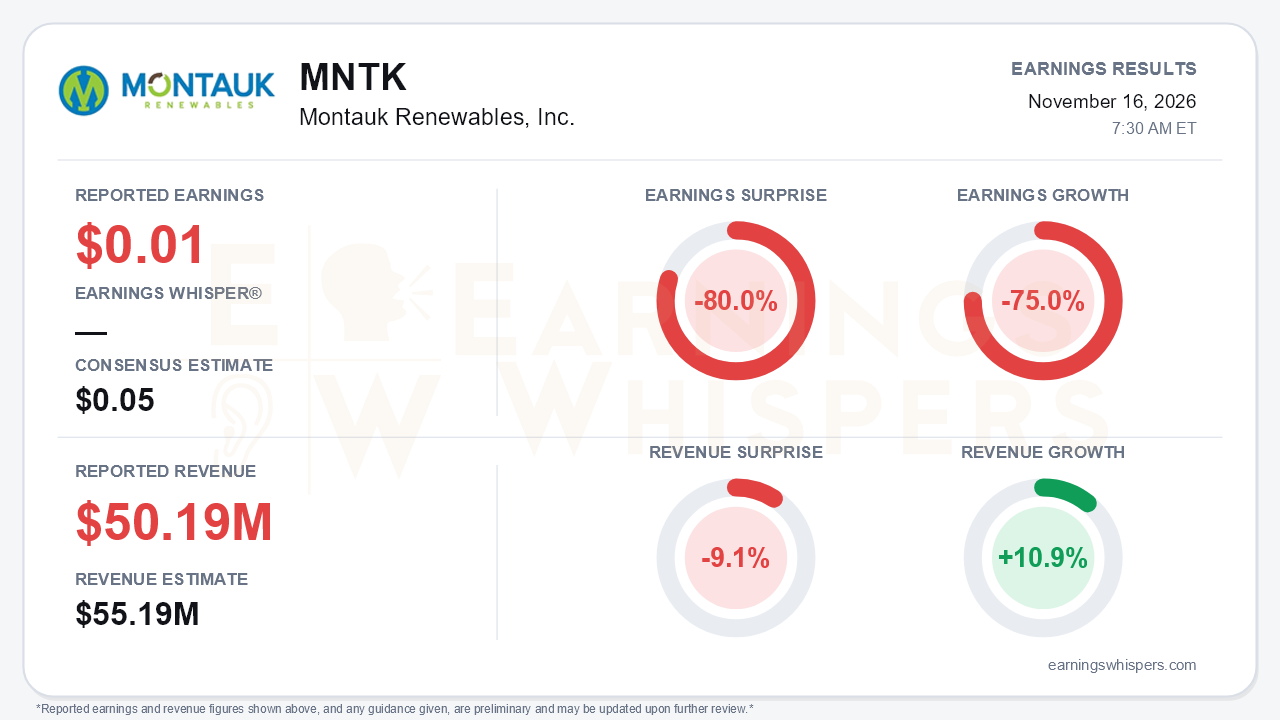
Montauk Renewables (NASDAQ: MNTK) reported third-quarter earnings of $0.01 per share, missing the $0.05 consensus by 80.0%, with earnings down 75.0% from a year ago. Revenue rose 10.9% to $50.19 million but fell 9.1% short of the $55.19 million consensus, and the company lowered full-year guidance. The miss is not the main story. Montauk has gone from a growth company with a delayed flagship project to a company negotiating with its lender to avoid a covenant default. That shift in the setup outweighs the quarter's numbers.
The quality of the quarter deserves scrutiny.
- **Revenue growth leaned on GreenWave.** Roughly $4.0 million of revenue came from RINs distributed and sold from the GreenWave joint venture, up from $1.1 million a year earlier. The company also recorded about $4.1 million of expenses tied to those RINs and to pathway dispensing.
- **The core commodity business shrank.** RNG volumes sold under fixed or floor-price contracts fell about 73.9% as pathway contracts expired. RNG commodity revenue dropped about 52.2%.
- **Operating profit turned to a loss.** Montauk posted an operating loss of $1.0 million, versus operating income of $4.4 million a year ago.
- **GAAP net income was propped up below the operating line.** The $2.1 million profit depended on $2.6 million of equity income from GreenWave and a $1.5 million tax benefit.
- **Adjusted EBITDA reversed.** It fell 20.6% to $10.2 million, after a 144.5% gain in the second quarter.
- **Costs rose.** RNG operating and maintenance costs climbed 15.4%. Renewable electricity O&M jumped 126%, driven largely by non-capitalizable costs at the Montauk Ag Renewables project in Turkey, North Carolina.
The core RNG operation was the one area that held up.
- Production rose 6.7% to 1.5 million MMBtu, faster than the 3% gain in Q2 and flat Q1.
- The realized RIN price improved to $2.58, from $2.29 a year earlier.
- RINs sold rose 12.2%.
- RNG production guidance of 5.8 to 6.0 million MMBtu was reaffirmed.
But the RNG revenue outlook was narrowed to $175 to $180 million from $175 to $190 million, citing lower D3 RIN pricing.
The Turkey facility remains the problem.
- **What happened this quarter.** The project reached its utility commercial operation date in August, which lets it generate swine and enhanced RECs. Output, however, stayed at nominal levels.
- **The new fix.** Management identified moisture-control and syngas-temperature problems that limit how much feedstock reaches the reactors and force frequent maintenance. Fixing them will take roughly three months and about $15 million, which falls outside the $200 million phase-one budget. Work will not start until the lender amendment is executed.
- **A pattern of slippage.** Revenue was expected in April, then May, then July power with switchgear fixes by mid-August. Each date has passed without commercial volumes.
- **Guidance keeps falling.** Renewable electricity revenue guidance has now been cut three straight times, from $35 to $41 million to $17 to $19 million. Production guidance fell to 170,000 to 175,000 MWh.
- **The one offsetting positive.** Hog feedstock agreements expanded to more than 80 farms and 400,000 spaces. That matters only if the plant can actually process the feedstock.
Liquidity is where the investment case changed most.
- **Cash is draining.** Cash fell to $12.4 million, from $15.8 million in Q2 and $25.9 million in Q1.
- **Payables have swelled.** Accounts payable roughly doubled since year-end to $32.8 million.
- **The credit line is effectively closed.** Montauk cannot draw further on its $200 million HASI facility, where $155 million is drawn, because engineering and operational requirements have not been met.
- **Default risk is explicit.** The company has a non-binding term sheet for additional borrowing and a 12-month covenant forbearance. Without relief, it expects to be in default as of December 31.
- **The going-concern question is mixed.** The 10-Q dropped the going-concern qualification previewed in the late-filing notice. Yet management still says a covenant breach is probable absent an amendment, and that sits uneasily with the softer formal disclosure.
- **Growth is being pulled back.** Montauk is deferring $100 to $120 million of development capex and cutting maintenance capex by $10 to $15 million, mainly from 2027.
- **Restructuring is on the table.** Management is weighing asset sales and vendor payment arrangements, and up to $15 million of shareholder financing is possible.
- **Tone turned defensive.** The call took no questions, and its framing has moved from commissioning confidence to protecting liquidity.
The market moved ahead of the release. Shares ran to a 52-week high of $3.28 on October 5, then collapsed to $0.94 on November 13, a 52-week low and the last trading day before the report. They closed that day at $0.95, down 43.5% since the open after the prior report and 45.9% below the 200-day moving average. A sub-$1 price also brings the company's own listed Nasdaq continued-listing risk closer. Investor sentiment improved to -0.055 from -0.198, but it remains slightly negative. That reads more like the worst-case fears easing as the going-concern label was avoided than like renewed confidence.
The bottom line is that Montauk's modestly improving RNG business is now secondary to whether it can secure lender relief and fund a $15 million fix at a plant that has repeatedly missed its timelines. A forbearance agreement would buy time. It would not resolve the core problem: the growth engine is stalled, cash is thin, and expansion plans are being deferred. Until Turkey produces commercial volumes, bears hold the stronger hand.
Read our earnings preview for Montauk Renewables, Inc.: https://www.earningswhispers.com/article/MNTK/22786
This earnings review was originally published on Earnings Whispers.
This article is for informational purposes only and is not investment advice. Earnings Whispers and its staff may hold positions in the securities mentioned. It is AI-assisted, based on proprietary Earnings Whispers data and company reports, and edited by Earnings Whispers staff.
Mentioned In This Article
Latest News
| Nov-16 | |
| Nov-16 | |
| Nov-16 | |
| Nov-12 | |
| Nov-09 | |
| Nov-03 | |
| Nov-02 | |
| Oct-27 | |
| Sep-15 | |
| Aug-06 | |
| Aug-05 | |
| Aug-05 | |
| Jul-27 | |
| May-06 | |
| May-06 |
