Spire Edges Past A Seasonal-Loss Estimate, But A Lower FY2027 Outlook Shifts The Story To 2028 And Beyond
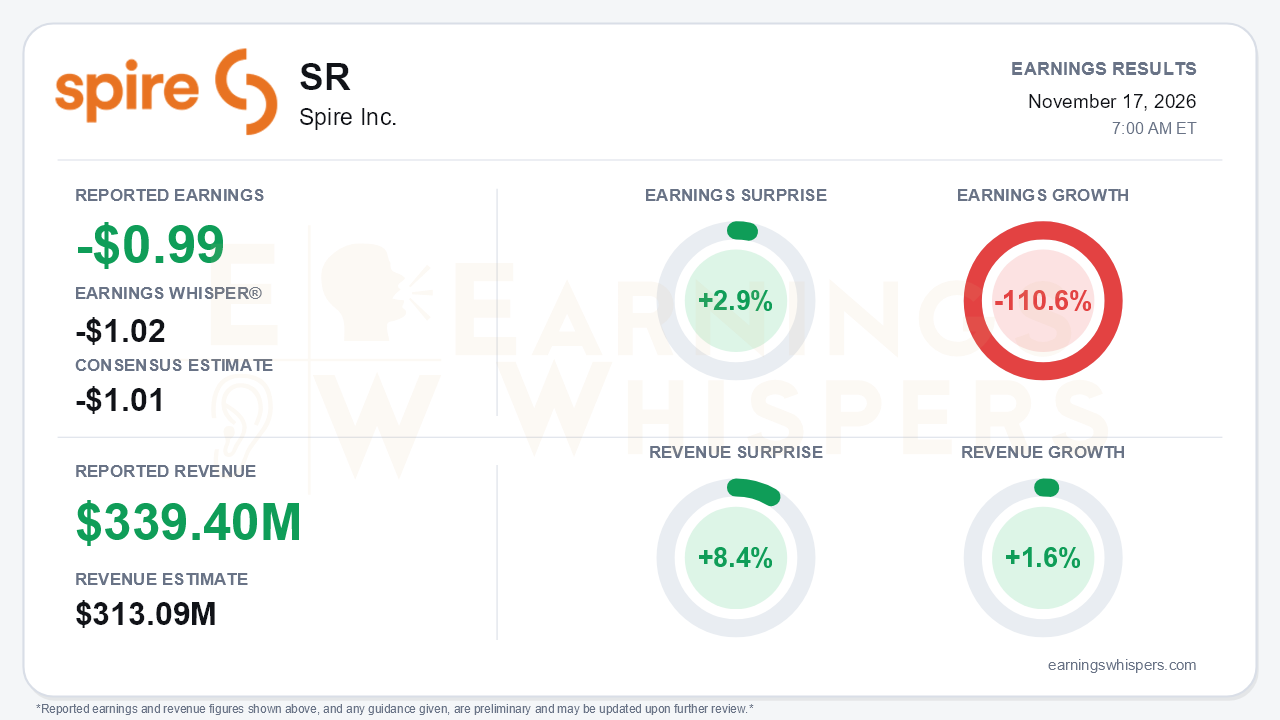
Spire's fiscal fourth quarter cleared a low bar, but the guidance reset defined the report. The company posted an adjusted loss of $0.99 per share, slightly better than the $1.01 consensus and the $1.02 Earnings Whisper number, a 2.9% positive surprise. Revenue of $339.4 million beat the $313.09 million consensus by 8.4%. Earnings Whispers puts year-over-year earnings growth at -110.6% and revenue growth at +1.6%. The release's restated continuing-operations tables frame it differently: the adjusted loss widened from $0.69 to $0.99, and reported revenue rose from $281.4 million, largely because of the Piedmont Tennessee acquisition. Either way, the seasonal loss deepened. The more consequential news was management cutting fiscal 2027 adjusted EPS guidance to $5.05–$5.25 from $5.40–$5.60. That earlier range had been reaffirmed in both the second and third quarters. Management paired the cut with a new fiscal 2028 range of $6.10–$6.30 and a faster long-term growth target. That is the central tension: a weaker near-term outlook in exchange for a bigger and more visible out-year.
The quality of the quarter deserves scrutiny. On a GAAP basis, Spire lost $1.60 per share from continuing operations versus $0.89 a year ago, with $0.61 of adjustments tied mostly to Tennessee transaction and financing costs. Inside the utility, new Missouri and Alabama rates were more than offset by four pressures:
- lower Alabama CCM benefits;
- higher O&M;
- higher depreciation;
- higher property taxes.
For the full year, adjusted EPS of $4.02 rose 20% and landed at the midpoint of the $3.90–$4.10 range. Contribution margin climbed $159 million, and run-rate O&M was nearly flat. GAAP continuing-operations EPS, however, fell to $2.62 from $3.14. The cost of the transformation shows up below the operating line:
- Full-year interest expense jumped to $288.9 million from $195.9 million.
- Long-term debt rose to $5.7 billion from $3.4 billion.
- The corporate segment's adjusted loss more than doubled to $42.9 million.
- Operating cash flow slipped to $511.8 million from $578.0 million.
The call explained why fiscal 2027 broke, and it was mostly regulatory rather than operational. Tennessee regulators applied the ARM's 4% cap to margin and approved a $9 million increase against $14 million requested. Management called that impact significantly larger than Alabama's and is accelerating a Tennessee rate case into the first half of calendar 2027. In Alabama, the RSE renewal came at a 9.4% ROE, versus 10.5% requested and 9.9% previously allowed, which management sized at roughly 3 to 4 cents. Missouri weather-normalized margin ran about $24 million below plan in fiscal 2026, and management built further negative variance into fiscal 2027. Demand was essentially flat, so the earnings path depends on rate outcomes and capital deployment rather than volume.
The forward story is genuinely stronger, which explains why management sounded more confident despite the cut. The long-term EPS growth target rose to 6%–8% through fiscal 2031, off the $6.20 fiscal 2028 midpoint, from a prior 5%–7% path off $5.75. The 10-year capital plan grew to $11.8 billion, and the dividend rose 4.8% to $3.46. The standout catalyst is the MoGas expansion for Ameren Missouri's West Alton Energy Center. It is a 20-year, 100% customer-funded project expected to add about $15 million in annual earnings once in service in fiscal 2030, with tax gross-up earnings during construction. Spire also filed its first Missouri future-test-year case, seeking a $228 million revenue requirement, a 10.5% ROE and a usage-alignment mechanism aimed at its weather problem. Bears have legitimate ammunition, though. The fiscal 2028 step-up leans heavily on that Missouri case, which management expects to be fully litigated as a case of first impression. Spire has just absorbed below-request outcomes in two other states. Near-term capex through 2030 is also modestly lower than the prior plan, and roughly $500 million of holdco commercial paper keeps rate exposure elevated.
Investors appeared less comfortable heading into the print. Earnings Whispers sentiment slipped from slightly positive (0.04) to modestly negative (-0.13), a meaningful but not dramatic shift. Price action told a stronger story. Shares closed at $88.88 before the report, up 12.4% since the open after the August release. That put them 4.8% above the 200-day moving average and about 3.9% below the inter-earnings high of $92.52 set on November 5. The stock had also rebounded 18.8% from a 52-week low of $74.84 on October 1. Price and AVWAP trend readings are positive, but the stock entered the report near the top of its range carrying a guidance cut the market had not yet seen.
The bottom line is that Spire traded a credibility hit on fiscal 2027 for a more ambitious fiscal 2028-2031 framework. The quarterly beat is incidental. What matters is whether Missouri regulators deliver on the future-test-year case and whether Tennessee's upcoming filing repairs the ARM shortfall. Until those outcomes are clearer, a stock trading near its recent highs leaves little cushion if regulators again disappoint.
Read our earnings preview for Spire Inc.: https://www.earningswhispers.com/article/SR/23107
This earnings review was originally published on Earnings Whispers.
This article is for informational purposes only and is not investment advice. Earnings Whispers and its staff may hold positions in the securities mentioned. It is AI-assisted, based on proprietary Earnings Whispers data and company reports, and edited by Earnings Whispers staff.
Mentioned In This Article
Latest News
| 8 hours | |
| 9 hours | |
| 11 hours | |
| 12 hours | |
| 12 hours | |
| Nov-12 | |
| Nov-10 | |
| Nov-02 | |
| Oct-19 | |
| Sep-11 | |
| Aug-05 | |
| Aug-05 | |
| Aug-05 | |
| Jul-30 | |
| Jul-15 |
