Maximus Tops Q4 Estimates, But FY27 Guidance Resets Earnings Lower As VA Incentives Disappear
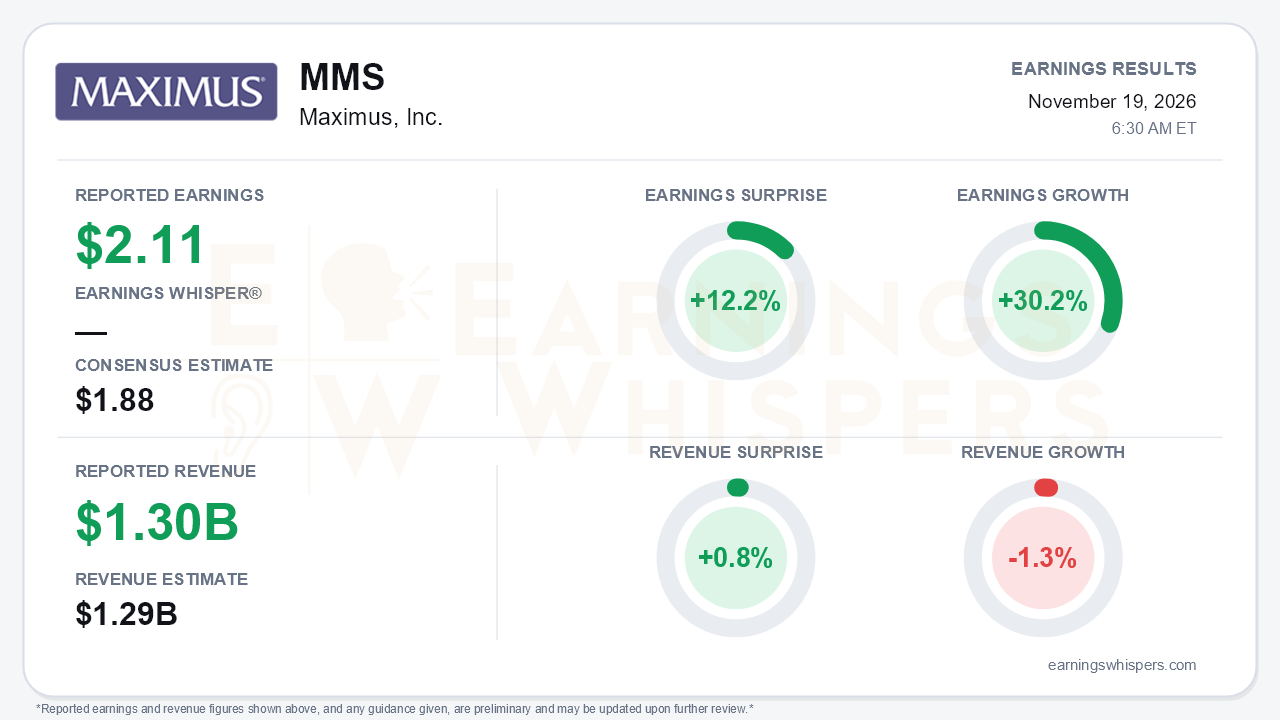
Maximus closed fiscal 2026 with a strong fourth quarter. The forward picture it set up is weaker, and that is the central tension in the report. Adjusted EPS of $2.11 beat the $1.88 consensus by 12.2% and grew 30.2% year over year, well above the 12.0% full-year adjusted EPS growth rate. Revenue of $1.301 billion edged past the $1.29 billion estimate by 0.8% but fell 1.3% from a year ago. Full-year adjusted EPS of $8.24 cleared the top of guidance. Fiscal 2027 guidance of $7.50 to $8.00, however, puts the midpoint of $7.75 below what the company just earned and below the $8.25 to $8.55 range it was guiding to for fiscal 2026 as recently as the second quarter.
The quality of the fourth-quarter beat is better than a typical margin story, but it carries an expiration date. Q4 adjusted EBITDA margin reached 14.6%, up from 12.2% a year earlier. U.S. Federal Services margin jumped to 19.8% from 15.1%. That happened even though the quarter already reflected the customer-directed removal of VA Medical Disability Examination performance incentives. The lift came from strong clinical performance that management expects to moderate. GAAP diluted EPS rose to $1.83 from $1.32, so the improvement was not an adjustment artifact. Share count also helped: diluted shares fell roughly 7% year over year after about $192 million of fiscal 2026 buybacks.
The guidance shows how much of fiscal 2026 was non-recurring. The VA MDE incentives contributed about $75 million of revenue and an estimated $1.05 of adjusted EPS across the first three quarters. Fiscal 2027 assumes none of it. Excluding that benefit, the midpoint implies roughly 8% growth. Even so, consolidated adjusted EBITDA margin is guided down to about 12.8% from 14.2%, and federal segment margin to 14-15% from 18.1%. Revenue guidance of $5.45 to $5.65 billion looks like growth, but it includes about ten months of Agile Defense. Call commentary put implied organic growth at only about 1% at the midpoint on a pro forma basis. The core business is essentially flat, with Agile carrying the top line.
Cash flow was the quarter's other conflict. Fiscal 2026 free cash flow of just $69 million fell roughly $380 million short of the $450 to $500 million guide. Receivables swelled to $1.34 billion from $898 million a year earlier. Management attributes the shortfall to timing. It has collected more than $330 million from a major customer since year-end, and fiscal 2027 free cash flow guidance of $700 to $800 million assumes DSO returns to 60-70 days from 93. If those collections continue, the cash miss becomes a cash windfall. Investors should still watch whether that normalization arrives on schedule.
The forward catalysts are real but uneven:
- **Bookings:** Q4 book-to-bill improved to 1.0x, the best of the year, after 0.2x in Q1. Awarded-but-unsigned contracts rose to $1.86 billion from $322 million in Q2, helped by an $800 million-plus, ten-year state Medicaid re-win at higher pricing. The recompete win rate was about 89%.
- **U.S. Services:** The segment returned to organic growth in Q4 and is guided to mid-single-digit growth. Five states are now contracted for Medicaid community engagement work. A CMS option letting states suspend adverse actions for six months could slow that ramp.
- **Pipeline:** The trailing book-to-bill remains 0.5x. The pipeline shrank to $44.8 billion from $56.8 billion in Q2, mainly because the VA MDE recompete carries a five-year term rather than the assumed ten, with no incentives.
- **Agile Defense:** The deal brings about $450 million of calendar 2027 revenue and double-digit growth. It also lifts pro forma leverage to about 2.3x and interest expense to about $110 million.
- **Outside the U.S.:** The segment posted a loss in fiscal 2026 and expects another in Q1.
Investor sentiment entered the report negative but improving, rising from -0.57 to -0.39. The stock has traded the same way. Shares sat at $65.26 before the release, up 12.7% from the post-August open of $57.90 and about 28% above the September 28 52-week low of $51.04. They had pulled back about 8% from the November 5 high of $70.98 and sat only 3.6% above the 200-day moving average of $62.98. The market had already priced in a good part of a recovery, so a guide below fiscal 2026 actuals leaves less room for error than the headline beat suggests.
The bottom line is that Maximus delivered a clean, high-quality fourth quarter and a credible cash-flow rebound story, but fiscal 2027 is a reset year. Earnings step down, margins compress, and organic growth is close to zero once Agile Defense is excluded. Bulls can point to improving bookings, state Medicaid momentum and a $700-800 million cash inflow funding buybacks. Bears have legitimate ammunition in the lost VA incentives, a shrinking pipeline and higher leverage. Execution on collections and the Agile integration will matter more than this quarter's beat.
Read our earnings preview for Maximus, Inc.: https://www.earningswhispers.com/article/MMS/23164
This earnings review was originally published on Earnings Whispers.
This article is for informational purposes only and is not investment advice. Earnings Whispers and its staff may hold positions in the securities mentioned. It is AI-assisted, based on proprietary Earnings Whispers data and company reports, and edited by Earnings Whispers staff.
Mentioned In This Article
Latest News
| Nov-19 | |
| Nov-19 | |
| Nov-19 | |
| Nov-19 | |
| Nov-11 | |
| Oct-19 | |
| Oct-08 | |
| Oct-05 | |
| Aug-06 | |
| Aug-06 | |
| Jul-09 | |
| Jul-06 | |
| May-07 | |
| May-07 | |
| May-07 |
