Dycom Beats And Raises Again, But An Earlier Fiber-To-The-Home Slowdown Rewrites The FY28 Story
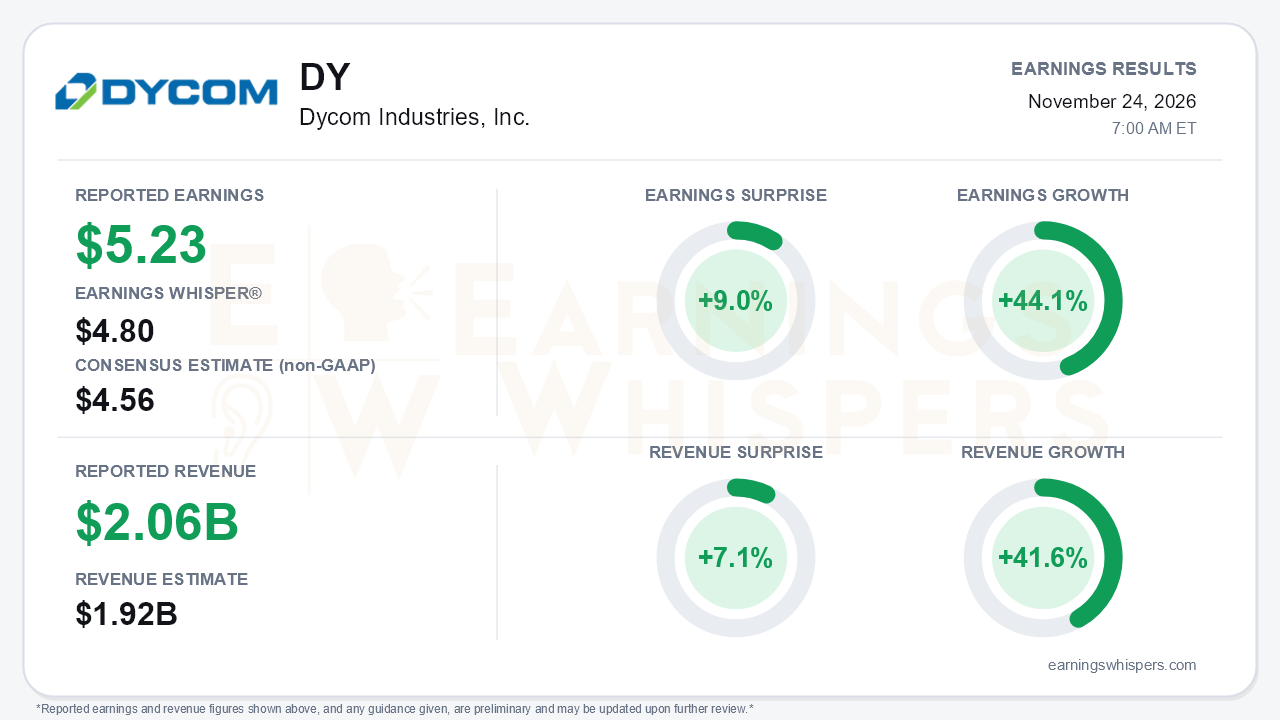
Dycom Industries delivered another clean beat-and-raise on the headline numbers. Fiscal third-quarter adjusted earnings of $5.23 per share topped the $4.56 consensus by 9.0% and cleared the $4.80 Earnings Whisper number. Revenue of $2.056 billion beat the $1.92 billion consensus by 7.1%. Earnings grew 44.1% year over year and revenue rose 41.6%, and the company exceeded the high end of its own outlook on every metric. The more important development, however, came from the call rather than the scorecard. Several large fiber-to-the-home customers are moderating their fiscal 2028 build pace, and management now expects FTTH revenue to decline next year. That is roughly a year earlier than management had anticipated. That is the central tension: Dycom is executing exceptionally well in the present while the engine that powered its communications growth story is stalling sooner than expected.
The quality of the beat deserves scrutiny. Most of the 41.6% revenue growth came from acquired Building Systems revenue of $441.7 million. Organic growth was 11.2%, which is solid but well below the 17.2% organic pace for the first nine months, so the core business is decelerating. On the growth figures, the company's own release shows adjusted EPS up 33.1%, lower than the 44.1% Earnings Whispers figure, because Dycom recast the prior-year quarter to exclude intangible amortization. GAAP results tell a weaker story. Diluted EPS fell 12.1% to $3.19, weighed down by $59.5 million of amortization, sharply higher interest expense from acquisition debt, and a $22.7 million reserve ($0.57 per share after tax) after a rural customer filed for Chapter 11 and another smaller customer ran into financial trouble. The adjusted figures add back that charge, so the beat holds up, but the credit event is a reminder that the customer base includes financially stretched builders.
The segment mix explains the margin picture. Building Systems was outstanding, posting a 23.8% adjusted EBITDA margin, far above the mid-teens framework the company first gave investors. Communications went the other way. Segment margin slipped to 12.8% from 13.6% in the second quarter and 15.1% a year ago, as costs to scale operations and fuel pressure took their toll. The fuel headwind widened to about 50 basis points from roughly 35, and management offered no near-term relief beyond gradual contract repricing. Consolidated margin of 15.2% was essentially flat year over year only because the acquisition is masking erosion in the legacy business.
The forward story was reshaped rather than broken. Management guided fiscal 2028 communications growth to only mid-single digits, below its 10-12% organic framework, and pushed reacceleration out to fiscal 2029. Several developments are meant to fill the gap:
- Long-haul and data center interconnect backlog more than doubled sequentially to over $2 billion, including post-quarter awards, some of it taken from underperforming competitors.
- Copper reclamation is ramping as a multi-year program.
- Building Systems is framed for high-teens-plus growth.
- BEAD verbal awards have grown, though they remain largely outside backlog.
Record backlog of $12.9 billion, up 57%, and a third consecutive full-year revenue raise to $7.66-$7.73 billion support the near term. The fourth-quarter guide of $2.48-$2.78 in adjusted EPS was viewed as in line rather than a step up.
The balance sheet adds to the bear case. Days sales outstanding climbed to 112 from 101 in the second quarter and 96 in the first, which management attributed to customer consolidation. Cash fell to $202.8 million from $340.1 million, while long-term debt sits near $2.8 billion. Management still spent $100.5 million on buybacks and lifted the authorization to $200 million. That signals confidence, but it is a more aggressive use of cash while working capital is absorbing liquidity.
The market had largely anticipated a softer outlook. Shares entered the report at $218.37, down 33.2% since the open after the August report. That leaves them about 40.5% below the 200-day moving average and 34% under the inter-earnings high. The stock set a 52-week low of $186.25 on November 5 and has since recovered about 17%. Investor sentiment weakened substantially, from 0.20 to 0.04, and now sits barely on the positive side of neutral. The trend signals are split: sequential growth and momentum readings remain positive, while price and AVWAP trends are negative, a gap between operating results and stock behavior.
The bottom line is that Dycom's quarter was operationally strong but strategically sobering. The beat, raise and record backlog are real, and long-haul, data center and Building Systems give management a credible bridge. Still, the earlier-than-expected FTTH downturn, compressing communications margins, a customer bankruptcy and swelling receivables give bears legitimate ammunition. With the stock already down a third and sentiment near neutral, much of that disappointment appears priced in. The next leg depends on whether long-haul and data center backlog converts quickly enough to offset fiber's retreat.
Read our earnings preview for Dycom Industries, Inc.: https://www.earningswhispers.com/article/DY/23224
This earnings review was originally published on Earnings Whispers.
This article is for informational purposes only and is not investment advice. Earnings Whispers and its staff may hold positions in the securities mentioned. It is AI-assisted, based on proprietary Earnings Whispers data and company reports, and edited by Earnings Whispers staff.
Mentioned In This Article
Latest News
| 2 hours | |
| 5 hours | |
| 6 hours | |
| 6 hours | |
| Nov-23 | |
| Nov-16 | |
| Nov-16 | |
| Nov-13 | |
| Sep-10 | |
| Aug-26 | |
| Aug-26 | |
| Aug-26 | |
| Aug-26 | |
| Aug-26 | |
| Aug-26 |
