CleanSpark's Bitcoin-Driven Profit Beat Masks A Shrinking Mining Base And A Lost Texas Exclusivity
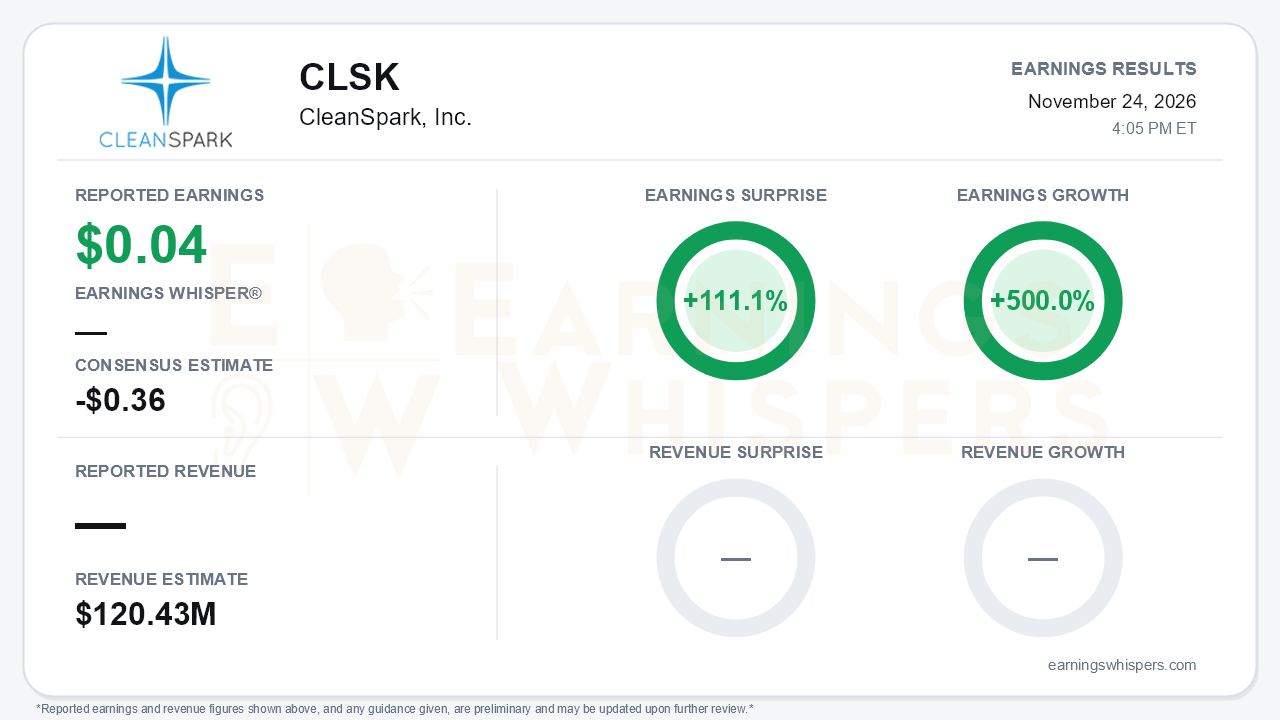
CleanSpark (NASDAQ: CLSK) reported fiscal fourth-quarter earnings of $0.04 per share. Consensus expected a loss of $0.36, so the result beat by 111.1%, and earnings grew 500.0% year over year as the company swung from a small net loss in the prior-year quarter to $9.8 million of net income. Revenue of $120.9 million was roughly in line with the $120.43 million consensus but fell 46% from a year ago. The beat says more about the bitcoin price at quarter-end than about the business. The quarter's real story is a trade-off: CleanSpark de-risked its flagship AI data center project while its legacy mining engine kept shrinking and its Texas commercialization story lost ground.
The quality of the beat deserves scrutiny. Operating income of $11.2 million depended on a $305.6 million fair-value gain on bitcoin holdings. That gain more than offset a $171.7 million impairment tied to the Sandersville conversion and $94.9 million of depreciation. Adjusted EBITDA of $345.4 million carries the same distortion, because the company does not strip out bitcoin mark-to-market gains. For the full year, CleanSpark posted a net loss of $987.1 million, or $3.74 per share, and negative adjusted EBITDA of $304.2 million. On the normalized basis discussed on the call, full-year adjusted EBITDA fell to roughly $96 million from $306 million, with margin compressing from about 40% to 17%.
Beneath the headline, the mining business is deteriorating quarter by quarter:
- Revenue slid from $181 million in Q1 to $136 million, $138 million, and now $121 million.
- Gross margin compressed from 47% to 40%, 38%, and 34%.
- Average hashrate dropped to 36 EH/s from 42.6 EH/s in Q3. In Q2, management had pointed toward roughly 55 EH/s by year-end.
- Bitcoin mined fell to about 1,700 from about 1,900.
Fleet efficiency did improve to 14.8 J/TH from 15.8 J/TH. Still, this is a business being deliberately run down to fund a pivot, and the revenue base it leaves behind is getting smaller.
The pivot itself made genuine progress. The $6.6 billion, 20-year triple-net lease at Sandersville with a high-investment-grade tenant is now fully funded through $2.276 billion of 7.875% senior secured notes due 2031. Per the call, the notes were more than 4x oversubscribed, at roughly 92% loan-to-cost and with under $100 million of equity required. The first data hall remains on schedule for November 2027. Extension options lift potential contracted revenue to about $12.2 billion from $11.6 billion. In Washington, Georgia, a preliminary load study supports expansion from 86 MW to as much as 500 MW, and CleanSpark acquired 500 adjacent acres. Management also introduced a modular opportunity spanning roughly 600 MW across about 30 smaller sites.
Bears have legitimate ammunition, however:
- **Lost exclusivity.** The exclusivity period with the Sandersville tenant on the up-to-885 MW Sealy and Brazoria assets expired without a lease, even though the Q3 call had characterized exclusivity as intact with no timing change.
- **Softer posture.** Management cited midterm-driven policy concerns in Texas and Georgia and higher sector credit costs. It is now open to non-investment-grade counterparties and alternative structures such as powered land leases, a notable retreat from its prior insistence on top-tier tenants.
- **Timeline slippage.** Sealy energization moved to mid-2027 from the first half of 2027.
- **Upcoming tests.** The ERCOT meeting on December 10 and the PUCT meeting on December 17 are the next gating items.
- **Balance sheet strain.** Long-term debt jumped to nearly $4.0 billion from $645 million, while stockholders' equity fell to $786 million from $2.18 billion. The decline reflects heavy buybacks as well as the annual loss.
- **Funding flexibility.** The undrawn bitcoin-backed credit line shrank to about $310 million. CleanSpark filed a new shelf registration, though management said it has no equity plans. Post-year-end bitcoin sales are building cash for expected acquisitions.
The market had already turned hard against the stock heading into the report. Shares closed at $5.53 on November 23, down 60.4% from the $13.97 open after the August report and 53.5% below the 200-day moving average of $11.88. The decline has been steep and recent. The stock peaked at $15.27 on September 22 and set a 52-week low of $4.84 on November 20, leaving it just 14.4% above that trough. Investor sentiment deteriorated meaningfully, from -0.15 to -0.45. Earnings Whispers trend signals are mostly negative, with only momentum reading positive.
The bottom line is that CleanSpark's earnings beat is largely an accounting artifact of bitcoin's quarter-end value, not evidence of operating improvement. The investment case now rests almost entirely on execution at Sandersville, which looks credibly funded and on schedule, and on whether the Texas and Georgia portfolios can still be commercialized after exclusivity lapsed and management loosened its tenant standards. With the stock sitting near its lows and sentiment sharply weaker, the December regulatory meetings and any new Texas lease announcement matter far more than this quarter's EPS.
Read our earnings preview for CleanSpark, Inc.: https://www.earningswhispers.com/article/CLSK/23259
This earnings review was originally published on Earnings Whispers.
This article is for informational purposes only and is not investment advice. Earnings Whispers and its staff may hold positions in the securities mentioned. It is AI-assisted, based on proprietary Earnings Whispers data and company reports, and edited by Earnings Whispers staff.
Mentioned In This Article
Latest News
| 2 hours | |
| 3 hours | |
| 4 hours | |
| Nov-23 | |
| Nov-22 | |
| Nov-19 | |
| Nov-09 | |
| Nov-06 | |
| Nov-05 | |
| Nov-04 | |
| Nov-04 | |
| Nov-04 | |
| Nov-03 |
Bitcoin Miners Pivoted to AI-Only to Find It's Just as Turbulent as Crypto
CLSK +13.99%
The Wall Street Journal
|
| Nov-02 | |
| Oct-17 |
