3 Reasons JJSF is Risky and 1 Stock to Buy Instead

What a brutal six months it’s been for J&J Snack Foods. The stock has dropped 32.1% and now trades at $118.23, rattling many shareholders. This was partly driven by its softer quarterly results and may have investors wondering how to approach the situation.
Is there a buying opportunity in J&J Snack Foods, or does it present a risk to your portfolio? Check out our in-depth research report to see what our analysts have to say, it’s free.
Why Is J&J Snack Foods Not Exciting?
Even though the stock has become cheaper, we're sitting this one out for now. Here are three reasons why JJSF doesn't excite us and a stock we'd rather own.
1. Fewer Distribution Channels Limit its Ceiling
With $1.59 billion in revenue over the past 12 months, J&J Snack Foods is a small consumer staples company, which sometimes brings disadvantages compared to larger competitors benefiting from economies of scale and negotiating leverage with retailers. On the bright side, it can grow faster because it has a longer list of untapped store chains to sell into.
2. Projected Revenue Growth Is Slim
Forecasted revenues by Wall Street analysts signal a company’s potential. Predictions may not always be accurate, but accelerating growth typically boosts valuation multiples and stock prices while slowing growth does the opposite.
Over the next 12 months, sell-side analysts expect J&J Snack Foods’s revenue to rise by 2.8%, a deceleration versus its 8.3% annualized growth for the past three years. This projection doesn't excite us and suggests its products will see some demand headwinds.
3. Previous Growth Initiatives Haven’t Impressed
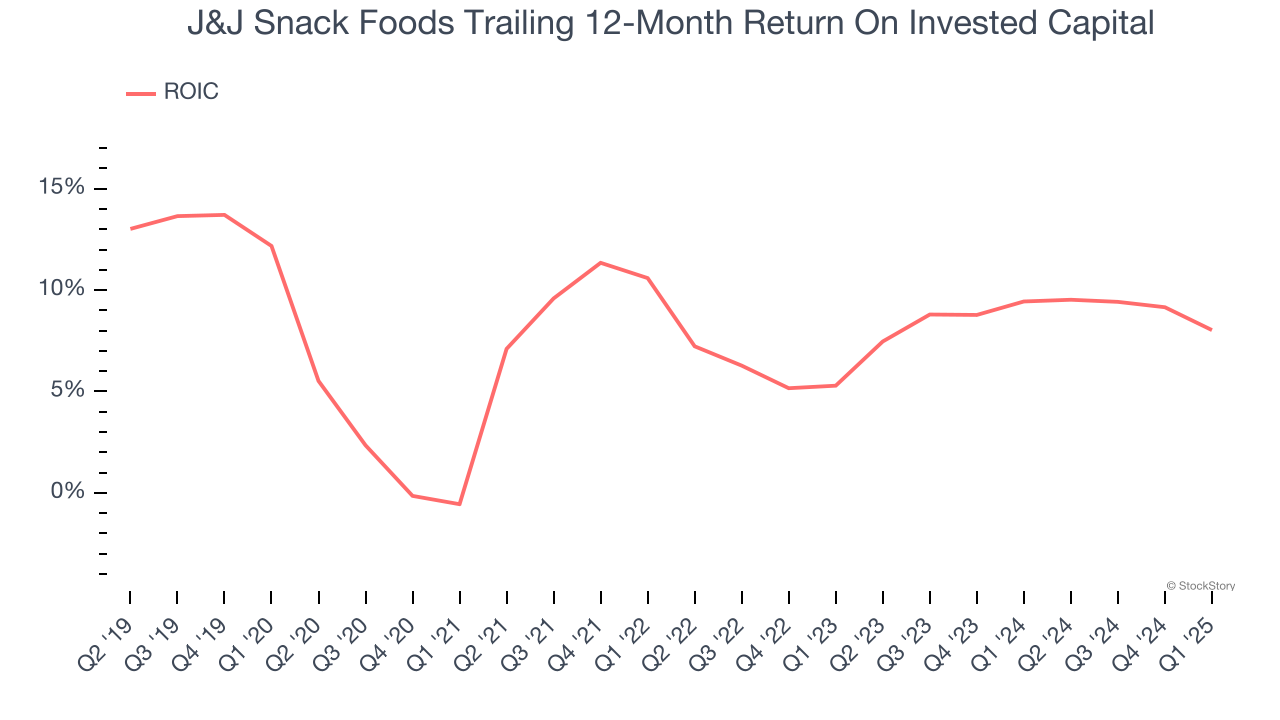
Growth gives us insight into a company’s long-term potential, but how capital-efficient was that growth? Enter ROIC, a metric showing how much operating profit a company generates relative to the money it has raised (debt and equity).
J&J Snack Foods historically did a mediocre job investing in profitable growth initiatives. Its five-year average ROIC was 6.6%, somewhat low compared to the best consumer staples companies that consistently pump out 20%+.
Final Judgment
J&J Snack Foods isn’t a terrible business, but it doesn’t pass our quality test. After the recent drawdown, the stock trades at 22.1× forward P/E (or $118.23 per share). This multiple tells us a lot of good news is priced in - you can find better investment opportunities elsewhere. We’d suggest looking at one of our all-time favorite software stocks.
Stocks We Would Buy Instead of J&J Snack Foods
Market indices reached historic highs following Donald Trump’s presidential victory in November 2024, but the outlook for 2025 is clouded by new trade policies that could impact business confidence and growth.
While this has caused many investors to adopt a "fearful" wait-and-see approach, we’re leaning into our best ideas that can grow regardless of the political or macroeconomic climate. Take advantage of Mr. Market by checking out our Top 5 Growth Stocks for this month. This is a curated list of our High Quality stocks that have generated a market-beating return of 176% over the last five years.
Stocks that made our list in 2020 include now familiar names such as Nvidia (+1,545% between March 2020 and March 2025) as well as under-the-radar businesses like the once-micro-cap company Kadant (+351% five-year return). Find your next big winner with StockStory today.
Mentioned In This Article
Latest News
| Oct-14 | |
| Sep-30 | |
| Sep-08 | |
| Sep-04 | |
| Aug-20 | |
| Aug-19 | |
| Aug-14 | |
| Aug-13 | |
| Aug-06 | |
| Aug-05 | |
| Aug-05 | |
| Aug-05 | |
| Jul-20 | |
| Jun-16 | |
| May-28 |
