What Dollar Tree's Surge and Home Depot's Slide Say About Consumer Health
As 2025 comes to an end, there continue to be signs that the post-April market recovery is bifurcated, not unlike the oft-referenced K-shaped economic recovery. And despite critical macro data that’s routinely provided by the government not being delivered during or in the wake of the shutdown earlier this fall, the way the economy is manifesting itself in the market is telling.
That’s particularly true of the consumer discretionary and consumer staples spaces, which are highly sensitive to consumer spending habits. But it’s even more true for a handful of mega-cap companies that are so impactful, they’ve come to serve as barometers of economic health.
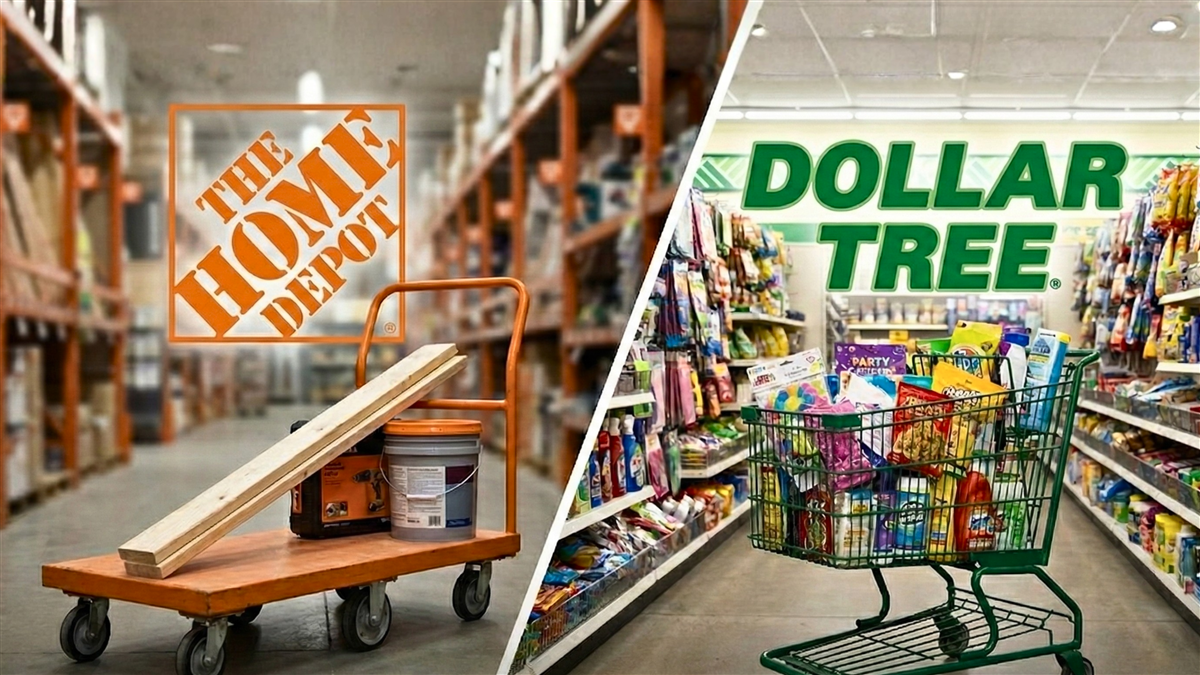
Specifically, when it comes to The Home Depot (NYSE: HD) and Dollar Tree (NASDAQ: DLTR), both have demonstrated their ability to function as leading economic indicators.
Shifting Consumer Sentiment Is Hurting Discretionary Stocks
With the exception of April’s tariff tantrum, the consumer discretionary sector has basically been flat on the year. On the surface, the sector’s middling 6.74% year-to-date (YTD) gain is good enough to place it eighth among the S&P 500’s 11 sectors.
However, upon closer inspection, the story is far different than what that YTD figure suggests. Since its post-tariff tantrum recovery on May 13, the consumer discretionary sector has been trading within a range, unable to achieve its next leg up as numerous headwinds have resulted in shoppers tightening their belts.
Since that date, the sector has been unable to break overhead resistance despite numerous attempts to do so. That also goes for the stocks that call consumer discretionary home—specifically, Home Depot.
Home Depot Has Stagnated as Consumers Buckle Down
The home improvement chain has dealt with the fallout from tariffs, the least affordable housing market in U.S. history, and subsequently a slowdown in same-store sales. Not even Mother Nature has been on Home Depot’s side this year. Without any hurricanes making U.S. landfall, CEO Ted Decker noted in the company’s Q3 earnings call that “the lack of storms in the third quarter…resulted in greater-than-expected pressure in certain categories.”
Between the administration’s trade policies, stubbornly high interest rates for 30-year mortgages, and a lack of natural disasters in 2025, shares of Home Depot have fallen nearly 17% since their YTD high on Jan. 27.
With little relief expected in the housing market or in the affordability crisis over the next year, consumers will likely continue to put off home renovation projects that often require debt financing, as discretionary purchases take a backseat to necessities.
In turn, that has ended an impressive streak for Home Depot. Following a run of 19 consecutive quarters of earnings beats, the company has posted three consecutive quarterly misses. After reporting Q3 results, the company lowered its full-year outlook.
Meanwhile, Home Depot has seen its net income decrease more than 13% from $17.1 billion in 2022 to $14.8 billion last year. On a trailing 12-month (TTM) basis, that figure stands at $14.5 billion, suggesting that when 2025 is in the books, the company—and its shareholders—will be facing a worse fiscal and earnings performance than they saw in 2024.
With consumer confidence—as measured by the University of Michigan's Index of Consumer Sentiment Survey—showing that sentiment in November was 29% lower than the year prior and year-ahead inflation expectations at 4.5%, more pain could be in store for the company.
Higher-Income Shoppers Flock to Dollar Tree
On the other side of the coin, Dollar Tree has seen its stock gain more than 60% YTD, including nearly 44% since its six-month low on Oct. 7.
The discount retailer has been enjoying outsized gains as budget-conscious shoppers flock to its locations in search of deals as household budgets continue to be stressed by runaway utility costs, sticky inflation, and rising food costs.
But while shareholders of consumer discretionary stocks like Home Depot are being punished, budget-conscious shoppers continue to drive top-line growth for discount retailers like Dollar Tree.
In his Q3 2026 earnings call comments, CEO Mike Creedon stated that the company now serves “an increasingly broad spectrum of shoppers, from core value-focused households to middle and higher-income shoppers who are making deliberate choices about how and where they spend.”
In fact, Dollar Tree had 3 million more households shop there during Q3 than it did the same quarter a year prior. However, even more impressively, shares of DLTR have benefited from a nearly 60% increase in higher-income shoppers (i.e., those earning more than $100,000 annually).
And while the company was in the red last year, much of that was attributed to Dollar Tree facing massive impairments and charges related to its struggling Family Dollar chain. But the company sold Family Dollar and closed nearly 1,000 underperforming stores.
That turnaround is already in the works. On a quarterly basis, the company has posted three consecutive quarters of net income gains during fiscal year 2026. The smart money is largely on board. Institutional ownership of DLTR stands at a staggering 97.40% of the float.
Where Should You Invest $1,000 Right Now?
Before you make your next trade, you'll want to hear this.
MarketBeat keeps track of Wall Street's top-rated and best performing research analysts and the stocks they recommend to their clients on a daily basis.
Our team has identified the five stocks that top analysts are quietly whispering to their clients to buy now before the broader market catches on... and none of the big name stocks were on the list.
They believe these five stocks are the five best companies for investors to buy now...
The article "What Dollar Tree’s Surge and Home Depot’s Slide Say About Consumer Health" first appeared on MarketBeat.
Mentioned In This Article
Latest News
| Oct-14 | |
| Oct-14 | |
| Oct-13 | |
| Oct-12 | |
| Oct-12 | |
| Oct-12 | |
| Oct-12 | |
| Oct-09 | |
| Oct-08 | |
| Oct-08 | |
| Oct-08 | |
| Oct-08 | |
| Oct-08 | |
| Oct-08 | |
| Oct-08 |
