|
|
|

|
|||||
|
|
|
AT&T Inc. T is preparing its network for upcoming winter storms to ensure customers stay connected no matter the weather. AT&T uses its Weather Operations Center, comprising meteorologists, to predict storms and guide network preparation. Since 1992, AT&T has invested over $1 billion in disaster recovery equipment. During emergencies, more than 750 specialized vehicles and tools are ready to be deployed at a quick notice.
AT&T has added snow-ready equipment like snowcats, bulldozers and winter UTVs to its arsenal. To prevent ice buildup, satellite dishes with heaters are implemented. Placing snow chains in disaster recovery vehicles and preparing generators for freezing weather are the key steps taken to face the various upcoming winter challenges.
To meet various winter storm threats, AT&T has improved its network capacity, testing backup batteries at cell sites and placing backup generators and recovery equipment in those areas where the chances of being hit by the storm are maximum. Its Response Operations Group, ROG, led by former responders and equipped with more than 190 deployable units, is always ready to provide reliable backup connectivity during contingencies.
Such initiatives are likely to improve wireless connectivity in extreme weather conditions and enable it to better serve its customers.
AT&T faces stiff competition from Verizon Communications, Inc. VZ and T-Mobile, US, Inc. TMUS. Verizon uses portable cell-sites, satellite-enabled equipment, and mobile generators to restore connectivity if storms or disasters damage fixed infrastructure. During emergencies, Verizon Frontline Crisis Response Team stays on call to assist first responders and communities so that communications remain available. After any natural disaster, customers regain services without too much delay as Verizon restores connectivity very fast using mobile cell sites, satellite backhaul, and temporary generators.
T-Mobile’s Self-Organizing Network uses real-time data and AI to detect service disruptions and can automatically adjust nearby antennas, reroute traffic, and manage spectrum to keep the connectivity stable during bad weather or power loss. T-Mobile uses satellite-enabled mobile cell sites (SatCOWs / SatCOLTs), portable generators, and Wi-Fi for seamless connectivity when fixed infrastructure is damaged. During freezing weather or power outages, T-Mobile reinforces critical infrastructure and deploys portable generators in advance to prevent service interruptions.
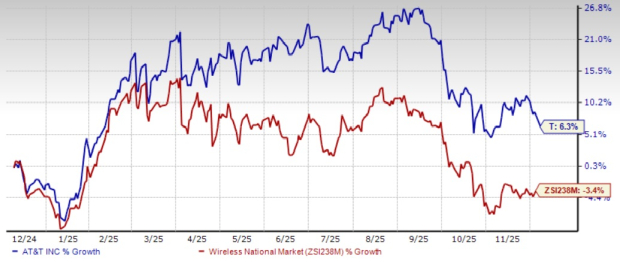
AT&T has gained 6.3% over the past year against the industry’s decline of 3.4%.
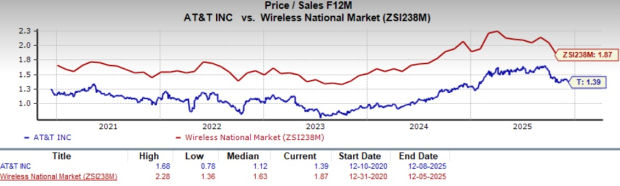
From a valuation standpoint, AT&T trades at a forward price-to-sales ratio of 1.39, below the industry tally of 1.87.
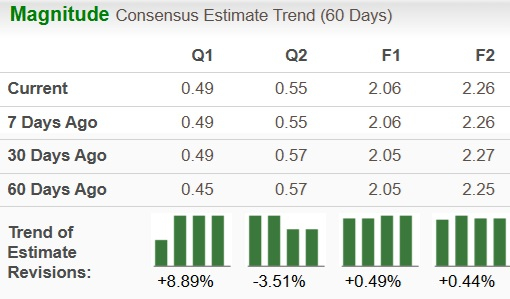
Earnings estimates for 2025 have increased 0.5% to $2.06 over the past 60 days, while the same for 2026 have also increased 0.4% to $2.26.
AT&T currently carries a Zacks Rank #3 (Hold). You can see the complete list of today’s Zacks #1 Rank (Strong Buy) stocks here.
Want the latest recommendations from Zacks Investment Research? Today, you can download 7 Best Stocks for the Next 30 Days. Click to get this free report
This article originally published on Zacks Investment Research (zacks.com).
| Apr-01 | |
| Mar-31 | |
| Mar-31 | |
| Mar-31 | |
| Mar-31 | |
| Mar-31 | |
| Mar-31 | |
| Mar-31 | |
| Mar-30 | |
| Mar-30 | |
| Mar-29 | |
| Mar-27 | |
| Mar-26 | |
| Mar-26 | |
| Mar-26 |

Join thousands of traders who make more informed decisions with our premium features. Real-time quotes, advanced visualizations, alerts, and much more.
Learn more about Finviz Elite