|
|
|

|
|||||
|
|
|
Microsoft's MSFT ambitious AI infrastructure expansion faces scrutiny as the company navigates unprecedented capital expenditure demands. The tech giant's latest announcement outlining seven AI trends for 2026 underscores its commitment to building what executives call "flexible, global AI systems" and next-generation linked AI superfactories designed to improve efficiency and reduce costs.
The company's infrastructure strategy centers on densely packed computing power distributed across global networks, moving beyond simply building larger datacenters. This approach aims to maximize every computing cycle while managing the substantial financial burden of AI development. According to Microsoft's first-quarter fiscal 2026 earnings, capital expenditures surged to $34.9 billion, representing a 74% year-over-year increase and significantly exceeding the $30 billion management had projected last quarter. Management now expects fiscal 2026 capital spending growth to surpass fiscal 2025 levels, with sequential increases anticipated throughout the year.
Microsoft reported cash and cash equivalents plus short-term investments totaling approximately $102 billion as of Sept. 30, 2025, against total debt of $97.6 billion. Operating cash flow for the quarter reached $45.1 billion, demonstrating robust cash generation capability. However, the company's aggressive infrastructure buildout raises questions about sustainable returns on these investments.
The announcement reveals multiple resource-intensive initiatives spanning healthcare diagnostics, where AI systems already handle more than 50 million daily health queries through Copilot and Bing, and quantum computing development through the Majorana 1 chip designed for millions of qubits. AI agent proliferation across enterprise environments demands enhanced security infrastructure and computational capacity. GitHub's repository intelligence, processing 43 million monthly pull requests and 1 billion annual commits, requires substantial backend support. While Microsoft frames these investments as competitive differentiators that will redefine computing capabilities, the simultaneous deployment across multiple fronts intensifies capital requirements. The company's debt-to-cash ratio exceeding 2:1 suggests a limited balance sheet cushion, making consistent cash flow generation essential for funding this expansion without increasing leverage or diluting shareholders through equity issuance.
Amazon AMZN and Alphabet GOOGL-owned Google reported similarly aggressive AI infrastructure investments in their third-quarter 2025 results, positioning all three cloud giants in a parallel spending race. Amazon reported third-quarter capital expenditures of $34.2 billion and raised its full-year 2025 outlook to $125 billion, with expectations for further increases in 2026. Amazon's AWS revenues grew 20% year over year to $33 billion, while the company reported operating cash flow supporting these investments despite total debt of $50.7 billion. Google parent Alphabet raised its 2025 capital expenditure guidance to $91-$93 billion from $85 billion, with management signaling significant increases expected in 2026. Google Cloud revenues surged 34% to $15.2 billion, with an $155 billion backlog demonstrating strong demand. Alphabet reported operating cash flow of approximately $112 billion for the trailing 12 months ending September 2025, supported by cash and marketable securities totaling $98.5 billion against minimal debt. The parallel escalation in infrastructure spending across Microsoft, Amazon and Google underscores the industry-wide conviction that AI infrastructure investments remain essential for maintaining competitive positioning, despite mounting investor scrutiny over near-term returns on these massive capital commitments.
MSFT shares have appreciated 4.3% in the past six-month period compared with the Zacks Computer – Software industry and the Zacks Computer and Technology sector’s growth of 2.5% and 26.1%, respectively.
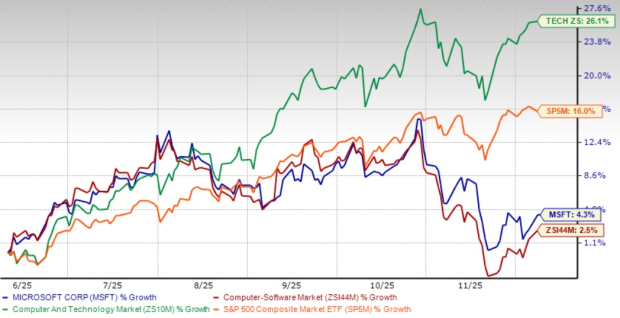
From a valuation standpoint, MSFT stock is currently trading at a forward 12-month Price/Sales ratio of 10.55X compared with the industry’s 7.69X. MSFT has a Value Score of D.

The Zacks Consensus Estimate for MSFT’s fiscal 2026 earnings is pegged at $15.59 per share, up 0.3% over the past 30 days. The estimate indicates 14.3% year-over-year growth.

Microsoft Corporation price-consensus-chart | Microsoft Corporation Quote
Microsoft currently carries a Zacks Rank #3 (Hold). You can see the complete list of today’s Zacks #1 Rank (Strong Buy) stocks here.
Want the latest recommendations from Zacks Investment Research? Today, you can download 7 Best Stocks for the Next 30 Days. Click to get this free report
This article originally published on Zacks Investment Research (zacks.com).
| 1 hour | |
| 1 hour | |
| 2 hours | |
| 3 hours | |
| 4 hours | |
| 6 hours | |
| 6 hours | |
| 6 hours | |
| 7 hours | |
| 8 hours | |
| 8 hours | |
| 8 hours | |
| 8 hours | |
| 9 hours | |
| 9 hours |

Join thousands of traders who make more informed decisions with our premium features. Real-time quotes, advanced visualizations, backtesting, and much more.
Learn more about Finviz Elite