Netflix's Acquisition of Warner Bros. Represents a Paradigm Shift in the Streaming Industry. Here Are 6 Things Investors Should Know About the Deal.
Key Points
Netflix's planned acquisition of Warner Bros.' assets, including HBO and HBO Max, marks the largest consolidation in the industry to date.
Regulators could still block the deal due to antitrust concerns or impose specific conditions. Competitors are also still lurking.
Netflix is betting a lot on HBO, but would also be acquiring some incredibly valuable franchises in the process.
Netflix (NASDAQ: NFLX) could change the streaming and media industries forever with its pending acquisition of Warner Bros. Discovery's (NASDAQ: WBD) film and television studios, which include HBO and HBO Max. It's one of the largest acquisitions ever announced in all media. The deal does not include Warner Bros' cable assets, which will be spun off into a separate company.
While the industry has already begun to consolidate, this signals a major shift, with many more streaming companies likely to be acquired in the future, leaving a few large competitors to dominate the space.
Where to invest $1,000 right now? Our analyst team just revealed what they believe are the 10 best stocks to buy right now. Continue »
Here are six things investors should know.
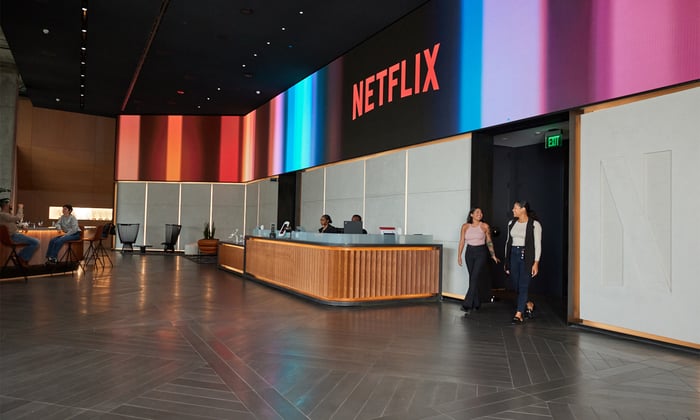
Image source: Getty Images.
1. Netflix is paying an enormous sum
Netflix will acquire Warner Bros.' assets for a total enterprise value of nearly $83 billion, which includes approximately $11 billion of net debt at Warner Bros. The deal values Warner Bros. at $27.75 per share. Netflix will fund 84% of the acquisition with cash and the remainder in stock.
To put this in perspective, Disney purchased Hulu in a deal that valued the company at $27.5 billion, although Disney didn't have to pay nearly that much because it already had a significant ownership stake. Amazon purchased MGM for roughly $8.45 billion. Netflix's deal is also slightly bigger than Disney's $71 billion acquisition of most of the assets of 21st Century Fox.
2. The company is draining the bank to fund the deal
Netflix is making a significant financial investment to secure this landmark deal. At the end of the third quarter, the company had approximately $9.3 billion in cash and equivalents, as well as an additional $3.6 billion in other current assets that can likely be quickly converted into cash. Netflix plans to use $10.3 billion of its cash in the deal. Then it will go out and reportedly raise another $59 billion in various eventual debt instruments for the remainder of the financing, although the company stated that it plans to use only $50 billion in acquisition debt for the deal.
Keep in mind that Netflix already had close to $14.5 billion of long-term debt of its own at the end of its most recent quarter. The company stated that it still intends to maintain an investment-grade credit rating by implementing a rapid debt reduction plan once the deal is closed.
3. It's far from a done deal
The proposed acquisition is far from a certainly and faces regulatory challenges, and now competing offers. As of this writing, Paramount Skydance (NASDAQ: PSKY) had just come in with a hostile bid of $30 per share in an all-cash tender offer, which consists of nearly $18 billion more in cash than Netflix's offer. However, Paramount is seeking to buy all of Warner Bros., including the cable assets, so it's not an apples-to-apples offer. Paramount has also contended that it is the only company in the space that could receive regulatory approval on such a massive deal.
On a conference call following the deal, Netflix management said they "are running full speed toward regulatory approval" and hope to close within 12 to 18 months. However, there's no guarantee, as the tie-up of two of the largest players in any industry has already drawn scrutiny from regulators on antitrust grounds.
Several politicians spoke out in opposition to the deal following the announcement.CNBC reported that the Trump administration views this acquisition with "heavy skepticism," citing anonymous sources.
However, other experts expect the deal to be approved eventually, although regulators may impose various conditions. "... We're highly confident in the regulatory process. This deal is pro-consumer, pro-innovation, pro-worker, it's pro-creator, it's pro-growth," Netflix co-CEO Ted Sarandos said.
4. Netflix is gaining some extremely valuable assets
Of course, there is a good reason Netflix is paying so much. The company is acquiring some of the most valuable movie and television franchises in the world, including Game of Thrones, the DC superhero universe, and Harry Potter. These are franchises that Netflix and HBO can produce numerous shows for, as well as generate tons of merchandise and even gaming products. Not only does HBO own all the Harry Potter movies and the Fantastic Beasts series, but it's also launching a revamped Harry Potter series expected to run for 10 seasons.
As some will recall, Disney purchased the Star Wars franchise for more than $4 billion in 2012. Last year, the company revealed in filings that Star Wars has brought in $12 billion of value to the company. While Star Wars is one of the biggest movie franchises, perhaps ever, this still shows the immense value that major movie and television franchises can bring to a business. Star Wars has generated strong returns for Disney, despite producing movies and shows that received substantial criticism.
5. The financial benefits to Netflix are substantial
Netflix expects the transaction to be accretive to earnings by its second full year once the deal closes. The company also expects to generate $2 billion to $3 billion of run-rate cost synergies by year three, a significant number. Sarandos said he expects most of the cost synergies to be in selling, general, and administrative expenses, but also sees opportunities through redundancies in the tech stack, as well as content production synergies over time.
A Reuters report, citing anonymous sources, raised concerns that the deal might not bring that much more market share to Netflix because there is significant overlap between the two subscriber bases. Netflix had more than 300 million global subscribers at the end of late 2024, while HBO Max had roughly 128 million, as reported in its most recent quarter.
Co-CEO Greg Peters also said that bundling Netflix and HBO could have numerous benefits, including higher retention and engagement, which could lead to increased revenue. He also noted that many Netflix subscribers are not currently HBO Max subscribers, so there's a real opportunity to bring enhanced value to these customers by introducing HBO titles in a prudent manner through a mix of different subscription plans and price tiering.
6. It could benefit the consumer
I think it's safe to say that consumers often feel overwhelmed by the numerous streaming options currently available. They can cost anywhere from a few dollars per month to Netflix's premium plan, which is roughly $25 per month. However, the cost starts to add up once you own several plans, and often, people are only interested in one or two movies or shows on a given streaming network, and still need to buy some type of cable option to receive their daily dose of sports and news.
That's why I believe consolidation will continue in the industry. The consumer may benefit in terms of pricing, as a bundled Netflix and HBO Max subscription is likely to be cheaper than purchasing both plans individually. I also think Netflix provides a much better tech platform and user experience than HBO, so the company will likely be able to leverage its tech prowess to enhance HBO's platform, or eventually bring all of HBO's content onto Netflix's platform.
The combination of these two content powerhouses should also provide the company with more resources and talent to deliver even more great content at an even quicker pace.
Should you invest $1,000 in Netflix right now?
Before you buy stock in Netflix, consider this:
The Motley Fool Stock Advisor analyst team just identified what they believe are the 10 best stocks for investors to buy now… and Netflix wasn’t one of them. The 10 stocks that made the cut could produce monster returns in the coming years.
Consider when Netflix made this list on December 17, 2004... if you invested $1,000 at the time of our recommendation, you’d have $521,550!* Or when Nvidia made this list on April 15, 2005... if you invested $1,000 at the time of our recommendation, you’d have $1,133,904!*
Now, it’s worth noting Stock Advisor’s total average return is 981% — a market-crushing outperformance compared to 194% for the S&P 500. Don’t miss out on the latest top 10 list, available when you join Stock Advisor.
*Stock Advisor returns as of December 8, 2025
Bram Berkowitz has no position in any of the stocks mentioned. The Motley Fool has positions in and recommends Amazon, Netflix, Walt Disney, and Warner Bros. Discovery. The Motley Fool has a disclosure policy.
Mentioned In This Article
Latest News
| 41 min | |
| 53 min | |
| 2 hours | |
| 8 hours | |
| Oct-08 | |
| Oct-08 | |
| Oct-08 | |
| Oct-07 | |
| Oct-07 | |
| Oct-06 | |
| Oct-06 | |
| Oct-06 | |
| Oct-06 | |
| Oct-06 | |
| Oct-06 |
