|
|
|

|
|||||
|
|
|
Oracle’s (NYSE: ORCL) stock price plunged following its fiscal year 2026 (FY2026) Q2 earnings release in mid-December because of its mixed results. However, weak as the revenue may be, the company is undergoing a strategic transformation supported by AI that will cement its position as a leader for decades to come. While the build-out of AI infrastructure drives results today, it is the long-term embedding and application of AI that will drive results in the long term. Oracle is positioned to embed AI throughout its stack, enabling à la carte AI services, including all major models, across sectors, industries, and verticals.
Highlights from its FY2026 Q2 results include a commitment to chip neutrality and the sale of its in-house chip design business, Ampere. This position provides for the exclusive use of third-party technologies, including NVIDIA (NASDAQ: NVDA), Advanced Micro Devices (NASDAQ: AMD) and Broadcom (NASDAQ: AVGO), both of which are expected to see accelerating demand as 2026 progresses. Oracle’s products are also embedded throughout Microsoft’s (NASDAQ: MSFT), Amazon’s (NASDAQ: AMZN), and Alphabet’s (NASDAQ: GOOGL) cloud networks, providing numerous growth opportunities.
Calendar Q3 2025 results from NVIDIA and GPU-as-a-Service providers such as Applied Digital (NASDAQ: APLD) indicate capacity is sold out, a tailwind for business throughout the AI complex. Regarding AI services, results from software companies such as Salesforce (NYSE: CRM), Snowflake(NYSE: SNOW), and Guidewire Software (NYSE: GWRE) indicate accelerating global adoption of cloud and AI services, a segment expected to be larger and grow faster than infrastructure.
Oracle produced a mixed FY 2026 Q2 report, but let’s be fair. The bar was set high, and the revenue miss is negligible given the remaining performance obligation (RPO) increase and the strength of margins. The company reported $16.06 billion in net revenue, up nearly 14% compared to the prior year. Revenue is 80 basis points below consensus, but underpinned by robust gains in the cloud and AI segments. Total cloud grew by 34% with IaaS up by 68% and SaaS up by 11%. Multicloud, Oracle’s true strength, led the way with an 817% gain. Multicloud is critical as all businesses must rely on numerous software vendors, which means they all use multiple clouds, including Oracle’s.
The margin news is mixed. The company’s operating income grew at a slower pace than revenue, as infrastructure investment cut into results. However, it is offset by the robust increase in RPO, which suggests massive revenue increases will be realized as the new data centers come online. RPO increased by 15% sequentially and 438% year-over-year to $523 billion, sufficient to sustain growth for many quarters to come, driven by new contracts with clients including Meta Platforms and NVIDIA. The bottom line is that the adjusted $2.26 EPS outpaced the consensus by 37%, including the sale of assets, providing ample cash flow to sustain the growth trajectory.
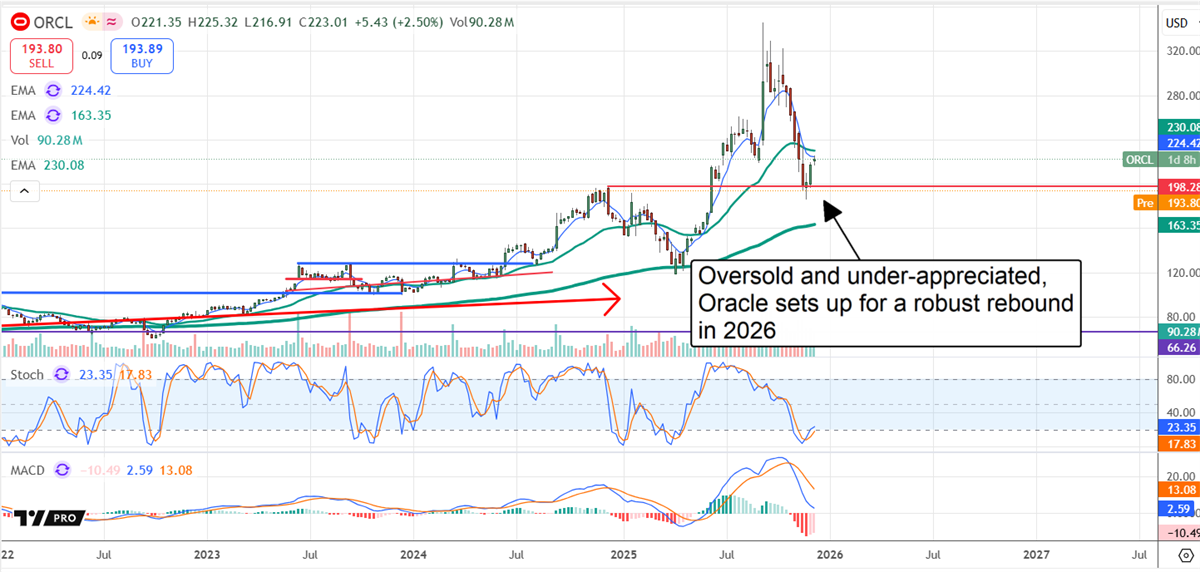
The analysts’ response isn’t positive. However, despite numerous commentaries expressing mixed (mostly unfavorable) sentiment, no ratings price target changes were made immediately following the release. The primary concern is Q2 shortfalls, but the RPO growth and longer-term outlook offset them. The critical detail is that Oracle’s coverage has swelled in recent months, numerous upgrades have been logged, and the price target trend leads to an above-consensus price point. As it stands, the price target implies approximately 50% upside from the critical support level, and it may be reached within weeks of the rebound starting.
The question is when the rebound may begin. The price action dropped more than 10% in after-hours trading and is likely to open weakly. The risk is that ORCL’s price will fall below $190, but that seems unlikely given the results, outlook, and market support. The more likely scenario is that the pre-market move will trigger another buy signal, leading to consolidation and the expected rebound in early to mid-2026.
Before you make your next trade, you'll want to hear this.
MarketBeat keeps track of Wall Street's top-rated and best performing research analysts and the stocks they recommend to their clients on a daily basis.
Our team has identified the five stocks that top analysts are quietly whispering to their clients to buy now before the broader market catches on... and none of the big name stocks were on the list.
They believe these five stocks are the five best companies for investors to buy now...
The article "Oracle Stock Hit Hard: Why Its AI Pipeline Could Drive a 2026 Rally" first appeared on MarketBeat.
| 1 hour | |
| 3 hours | |
| 3 hours | |
| 5 hours | |
| 5 hours | |
| 5 hours | |
| 5 hours | |
| 5 hours | |
| 5 hours | |
| 5 hours | |
| 5 hours | |
| 5 hours | |
| 6 hours | |
| 6 hours | |
| 6 hours |

Join thousands of traders who make more informed decisions with our premium features. Real-time quotes, advanced visualizations, alerts, and much more.
Learn more about Finviz Elite