Rivian Post Autonomy & AI Day: Is the Stock Worth Buying Now?
California-based electric vehicle (EV) company Rivian Automotive RIVN hosted its first Autonomy & AI Day yesterday. The focus was clear— stronger autonomy, better artificial intelligence (AI) and a more capable tech platform for upcoming models. With EV competition rising and software becoming a bigger differentiator, Rivian is pushing more technology in-house to boost performance and reduce long-term costs.
These developments come at a time when the company is navigating a slowdown in U.S. EV demand. Chinese automakers are also intensifying price pressure by flooding global markets with cheaper models, creating a tougher backdrop for premium EV brands like Rivian.
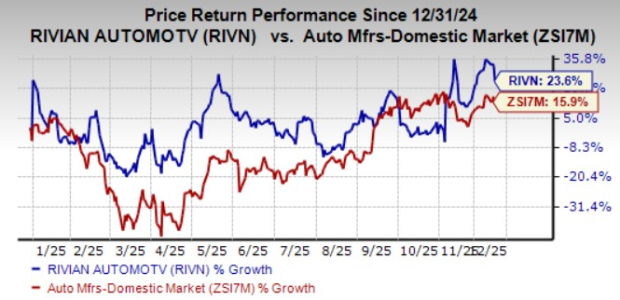
Year to date, RIVN shares have risen 24%, outperforming the industry. However, the stock still trades about 79% below its IPO price. So, is RIVN stock attractive enough to buy now? Or should you wait for clearer signs of progress?
Key Takeaways From RIVN’s Autonomy Event
The biggest announcement was Rivian’s new in-house silicon chip, which sits at the center of its autonomy push. Called the Rivian Autonomy Processor (RAP1), the chip will power the company’s Gen 3 Autonomy Computer and is designed specifically for heavy AI and vision workloads. The chip delivers faster processing and offers a bandwidth of 205 gigabytes per second. By designing its own chip, Rivian aims to reduce supply chain risks and dependence on outside vendors like NVIDIA and Qualcomm.
This new hardware will support Rivian’s next-generation AI platform. The company also introduced an AI-powered “Rivian Assistant,” a voice interface launching early next year for both first- and second-generation vehicles. Near-term software updates will bring “Universal Hands-Free,” which promises hands-free driving on more than 3.5 million miles of roads across North America.
Another major highlight was Rivian’s decision to integrate LiDAR into its future models—a key step toward advanced automated driving. With LiDAR, custom chips and a new autonomy computer, Rivian is targeting Level 4 self-driving capabilities over time. This places its long-term roadmap closer to companies like Alphabet’s GOOGL Waymo, which already operates at Level 4, and ahead of Tesla TSLA, whose cars remain at Level 2 and require hands-on supervision.
To support and monetize these capabilities, Rivian also announced an Autonomy+ subscription. It will be priced at $2,500 upfront or $49.99 per month, which compares better than Tesla’s $99 per month subscription.
Rivian Automotive, Inc. Price, Consensus and EPS Surprise

Rivian Automotive, Inc. price-consensus-eps-surprise-chart | Rivian Automotive, Inc. Quote
Upcoming R2 Model & VWAGY-Deal Are Key Catalysts
Rivian stands to gain from its upcoming affordable R2 model next year and partnership with German auto giant Volkswagen VWAGY.
Rivian aims to broaden its reach with the upcoming R2 and R3 models, targeting more budget-conscious consumers. The R2, a midsize SUV, is slated for launch in the first half of 2026 with a starting price around $45,000—significantly lower than the premium R1 lineup. Rivian views the R2 as a key growth driver, citing major cost efficiencies in both materials and manufacturing.
Rivian’s deal with Volkswagen is another booster. Volkswagen will invest up to $5.8 billion in Rivian and their joint venture (JV) by 2027. So far, it has received $3.3 billion and expects to receive another $2.5 billion. The partnership focuses on developing Rivian’s next-generation electrical architecture and software, starting with the R2 model.
Cash Burn & Muted Guidance Keep Optimism in Check
Rivian’s cash balance declined to $7.1 billion at the end of Q3 2025, down from $7.7 billion in 2024, as the company continues to burn cash while pursuing long-term growth. Additionally, the company's high capex forecast of $1.8–$1.9 billion is likely to further strain near-term financials and cash flows.
Discouragingly, Rivian has also trimmed its 2025 delivery guidance amid tariff woes. The company now expects 2025 deliveries in the range of 41,500-43,500 units, down from 51,579 units in 2024. The guidance is also narrower than the range of 40,000-46,000 units forecast earlier. It expects adjusted EBITDA loss to $2-$2.25 billion amid higher operating expenses, resulting from increased R&D spending on prototyping for the upcoming R2 launch and training for the autonomy platform.
What Do Estimates for RIVN Say?
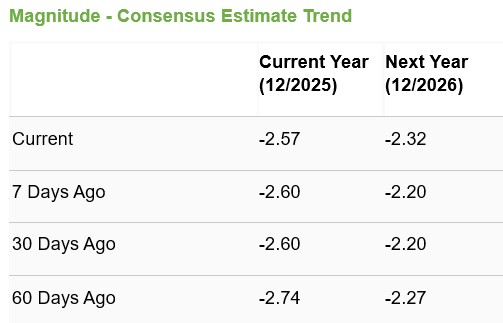
The Zacks Consensus Estimate for RIVN’s 2025 and 2026 revenues implies a year-over-year uptick of 8% and 36%, respectively. The consensus mark for 2025 and 2026 bottom line implies a year-over-year improvement of 25% and 10%, respectively.
While the 2025 loss estimates have narrowed over the past 60 days, the loss estimates for 2026 have widened over the same timeframe.
Conclusion
Rivian’s Autonomy & AI Day makes it clear that the company is thinking big, but the payoff won’t come overnight. The ideas are exciting, yet the business still has a lot to prove on the financial and execution side before investors get too confident.
With the stock well below its IPO price, it may tempt bargain hunters, but it’s still early for a strong call. Given the current scenario, Rivian carries a Zacks Rank #3 (Hold) and looks more like a “wait-and-see” story than a jump-in-now opportunity. You can see the complete list of today’s Zacks #1 Rank (Strong Buy) stocks here.
Want the latest recommendations from Zacks Investment Research? Today, you can download 7 Best Stocks for the Next 30 Days. Click to get this free report
Tesla, Inc. (TSLA): Free Stock Analysis Report
Alphabet Inc. (GOOGL): Free Stock Analysis Report
Volkswagen AG Unsponsored ADR (VWAGY): Free Stock Analysis Report
Rivian Automotive, Inc. (RIVN): Free Stock Analysis Report
This article originally published on Zacks Investment Research (zacks.com).
Mentioned In This Article
Latest News
| 2 hours | |
| 3 hours | |
| 3 hours | |
| Oct-09 | |
| Oct-09 | |
| Oct-09 | |
| Oct-09 | |
| Oct-09 | |
| Oct-09 | |
| Oct-09 | |
| Oct-09 | |
| Oct-09 | |
| Oct-09 |
Tesla's China Retail Sales Fall 9% Even as Shanghai Exports Surge 58%
TSLA
Benzinga Prediction Markets
|
| Oct-09 | |
| Oct-09 |
