Walmart & 2 More Blue Chip Retail Stocks to Watch Heading Into 2026
Heading into 2026, expectations of more stable economic growth and improving financial conditions are shaping investor strategy. Within this environment, blue-chip retail stocks such as Walmart Inc. WMT, Costco Wholesale Corporation COST and Lowe’s Companies, Inc. LOW continue to draw attention for their scale, operational resilience and steady earnings performance. Their strong market positions and diversified revenue streams enable them to benefit from long-term structural trends, including digitization, automation and consistent consumer demand.
The economic backdrop of 2025 provides important context for this outlook. Growth moderated as the economy shifted from post-pandemic momentum to a more cautious, sustainable expansion. Business investment softened, global trade remained uneven, and ongoing policy uncertainty around taxation, tariffs and fiscal priorities led many firms to postpone major capital expenditures.
Inflation and monetary policy were central themes throughout 2025. Although price pressures retreated from earlier highs, inflation remained above the Federal Reserve’s long-term target. In response, the Fed began cautiously cutting interest rates after an extended period of restrictive policy. This transition eased financial conditions and helped stabilize both housing activity and credit markets.
Equity markets reflected this improving sentiment. Year to date, the Dow Jones Industrial Average has gained roughly 14%, the S&P 500 has advanced about 16%, and the Nasdaq Composite has risen 19%.
Why Blue-Chip Retail Stocks Are a Safe Bet
These blue-chip giants are known for their financial strength and history of delivering reliable returns to shareholders. They tend to be less volatile than other stocks, making them dependable choices for seasoned investors and those newer to the market. They often provide steady dividend payouts, adding an extra layer of stability.
These retailers have strong market positions, excellent brand recognition, loyal customer bases and broad market reach, which provide them with a significant competitive edge and open up new growth opportunities. Their capacity to respond to shifting consumer behavior, leverage emerging technologies, and improve scalability and operational efficiency helps them maintain a competitive edge in a rapidly evolving retail landscape.
YTD Price Performance of WMT, COST & LOW
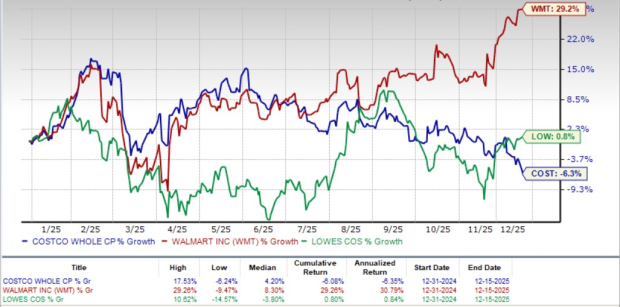
Image Source: Zacks Investment Research
3 Blue-Chip Retail Stocks to Watch
Walmart: Embracing Technology for Growth
Walmart continues to strengthen its position as a leading omnichannel retailer, leveraging a broad assortment, accelerated e-commerce momentum, and growing higher-margin profit streams like advertising and membership. Its commitment to everyday low prices, faster fulfillment and tech-powered innovation, particularly in automation and AI, enhances customer convenience and operational efficiency. Market share gains across grocery, general merchandise, and health & wellness reflect durable brand relevance and customer loyalty. The company is well-positioned to sustain long-term growth through scale, innovation and a diversified profit engine.
As of yesterday’s session, Walmart’s market capitalization stood at $931.1 billion. The company pays out a quarterly dividend of about 24 cents per share (96 cents annualized). WMT’s payout ratio is 37, with a five-year dividend growth rate of 4.9%. (Check WMT’s dividend history here)
The Zacks Consensus Estimate for Walmart’s current financial-year sales and earnings per share (EPS) suggests growth of 4.5% and 4.8%, respectively, from the year-ago reported numbers. This Zacks Rank #3 (Hold) company has a trailing four-quarter earnings surprise of 0.8%, on average. You can see the complete list of today’s Zacks #1 Rank (Strong Buy) stocks here.
Costco: Leveraging Membership Model for Success
Costco’s differentiated membership-driven model continues to fuel strong traffic, brand loyalty, and market share gains, supported by a curated value-oriented assortment and expanding global footprint. The company’s investments in digital capabilities, personalization and operational technology, such as AI-enhanced inventory systems, are improving efficiency and elevating the member experience. Robust membership renewal rates and rising Executive penetration reinforce the strength of its ecosystem and recurring revenue base. Costco's disciplined expansion strategy and focus on quality, value and newness underscore its competitive moat.
Costco has a market cap of $382 billion. The company pays out a quarterly dividend of $1.30 per share ($5.20 annualized). COST’s payout ratio is 28, with a five-year dividend growth rate of 13.7%.
The Zacks Consensus Estimate for Costco’s current financial-year sales and EPS implies growth of 7.5% and 11.3%, respectively, from the year-ago period’s actuals. This Zacks Rank #3 company has a trailing four-quarter earnings surprise of 0.5%, on average.
Lowe’s: Capitalizing on Home Improvement Trends
Lowe’s is advancing a multi-year Total Home Strategy that strengthens its competitive position through enhanced Pro capabilities, expanding service offerings and improved online experience. The company is driving higher engagement through loyalty programs, AI-enabled customer and associate tools, and more productive store layouts, which support better conversion and customer satisfaction. Strategic acquisitions like Foundation Building Materials (FBM) and Artisan Design Group (ADG) broaden its product portfolio and deepen its reach into commercial and Pro markets, creating new growth vectors. Innovation across merchandising, installation services and digital solutions positions Lowe’s to better capture both DIY and Pro demand.
Lowe’s has a market cap of $139.6 billion. The company pays out a quarterly dividend of $1.20 ($4.80 annualized) per share. LOW’s payout ratio is 39, with a five-year dividend growth rate of 15.6%.
The Zacks Consensus Estimate for Lowe’s current financial-year sales and EPS implies growth of 2.9% and 2.2%, respectively, from the year-ago period’s actuals. This Zacks Rank #3 company has a trailing four-quarter earnings surprise of 3.1%, on average.
Want the latest recommendations from Zacks Investment Research? Today, you can download 7 Best Stocks for the Next 30 Days. Click to get this free report
Walmart Inc. (WMT): Free Stock Analysis Report
Lowe's Companies, Inc. (LOW): Free Stock Analysis Report
Costco Wholesale Corporation (COST): Free Stock Analysis Report
This article originally published on Zacks Investment Research (zacks.com).
Mentioned In This Article
Latest News
| 4 hours | |
| 8 hours |
Richest Americans Gained 19% in Wealth as Poorest Lost 56% Since 2022
WMT
Benzinga Prediction Markets
|
| 11 hours | |
| 14 hours | |
| 16 hours | |
| 23 hours | |
| Oct-08 |
For Walmart, Replacing Humans With Robots Is a Multibillion-Dollar Struggle
WMT
The Wall Street Journal
|
| Oct-08 | |
| Oct-08 | |
| Oct-08 | |
| Oct-08 | |
| Oct-08 | |
| Oct-08 | |
| Oct-08 | |
| Oct-08 |
