|
|
|

|
|||||
|
|
|
Plug Power has disappointed many investors over the past 26 years.
But it has established an early mover’s advantage in the nascent hydrogen market.
Its vertically integrated business model gives it an edge against its competitors.
Plug Power (NASDAQ: PLUG), a developer of hydrogen charging technologies, was one of the hottest stocks of the dot-com bubble. It went public at a reverse-split-adjusted price of $150 in 1999 and skyrocketed nearly tenfold to a record high of $1,498 in early 2000.
Today, its stock trades at about $2. Like many of the hot IPOs of that era, it overpromised and underdelivered. The company initially planned to build hydrogen charging systems for homes to disrupt traditional power companies. Still, the plan fizzled out in the early 2000s due to high infrastructure costs, regulatory challenges, and soft consumer demand.
Where to invest $1,000 right now? Our analyst team just revealed what they believe are the 10 best stocks to buy right now, when you join Stock Advisor. See the stocks »
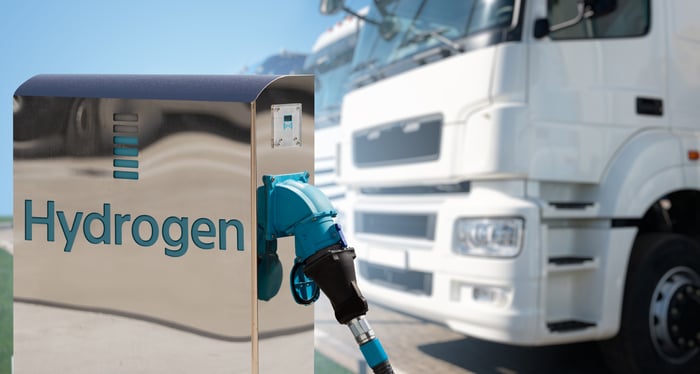
Image source: Getty Images.
Over the following two decades, Plug Power pivoted toward selling hydrogen fuel cells, charging systems, electrolyzers, and storage systems. It's already deployed 72,000 fuel cell systems and 275 fueling systems globally. It generates a significant portion of its revenue by selling fuel cells and charging systems for Amazon's (NASDAQ: AMZN) and Walmart's (NASDAQ: WMT) hydrogen-powered forklifts. Those two retail giants are also major investors in the company.
Over the past 12 months, Plug Power's stock declined by about 10% as it struggled with a cyclical slowdown. However, I believe its stock could be undervalued at these levels -- and it has the potential to generate at least a ten-bagger gain over the next decade.
Plug Power's revenue turned negative in 2020 because it subsidized its sales of fuel cells and charging systems to Amazon and Walmart with stock warrants. Those subsidies eclipsed its revenues from other customers, so it had to restate its financials.
After that restatement, its revenue turned positive again in 2021. It grew rapidly in 2022 and 2023, but much of that expansion was fueled by its acquisitions of two smaller cryogenic storage companies, rather than the organic growth of its fuel cell, charger, and electrolyzer segments. As it integrated those businesses, its operating and net losses widened.
|
Metric |
2022 |
2023 |
2024 |
9M 2025 |
|---|---|---|---|---|
|
Revenue |
$701 million |
$891 million |
$629 million |
$485 million |
|
Growth (YOY) |
40% |
27% |
(29%) |
11% |
|
Operating Margin |
(97%) |
(151%) |
(321%) |
(169%) |
|
Net Income (Loss) |
($724 million) |
($1.37 billion) |
($2.10 billion) |
($789 million) |
Data source: Plug Power. YOY = Year-over-year.
In 2024, its revenue declined as it absorbed those acquisitions, and macroeconomic headwinds limited the market's demand for new hydrogen charging projects.
Yet, in 2025, its revenue rose again as the hydrogen market gained momentum and its core businesses recovered. Most of that acceleration was driven by its electrolyzer sales, which offset its slower sales of fuel cells and charging systems. Over the past year, more companies have been installing those electrolyzers to earn government subsidies for new green hydrogen projects.
For the full year, analysts expect its revenue to rise 11% to $702 million as it narrows its net loss to $905 million. From 2025 to 2027, analysts expect its revenue to grow at a CAGR of 22% to $1.04 billion as it narrows its net loss to $272 million. That outlook suggests its cyclical downturn is ending, but it still needs to overcome some near-term and long-term challenges.
According to Grand View Research, the global green hydrogen market could expand at a CAGR of 38.5% from 2025 to 2030 as more countries ramp up their decarbonization initiatives.
However, the U.S. market -- which still accounted for over two-thirds of Plug's revenue in 2024 -- could lag behind Europe and Asia if the Trump Administration reins in the Department of Energy's (DOE) spending on new green hydrogen projects and subsidies.
Those unpredictable policy headwinds could continue to compress its valuations, even if it expands more aggressively overseas to reduce its dependence on American companies. That's probably why it still trades at less than four times next year's sales.
It's also burning a lot of cash. It ended its latest quarter with just $166 million in unrestricted cash and cash equivalents -- and it continues to raise money with more secondary stock and convertible debt offerings. That's why its number of outstanding shares more than tripled over the past five years, and it was still shouldering $1.6 billion in total liabilities in its latest quarter.
But if Plug Power overcomes those near-term challenges, it could generate massive gains for its patient investors. If it matches analysts' estimates through 2027, grows its revenue at a CAGR of 20% over the next eight years, and trades at a more generous ten times forward sales, its market cap could surge from $3.1 billion to $44.7 billion over the next decade.
That's not guaranteed to happen, but its early mover's advantage, vertically integrated business model, and support from Amazon and Walmart could help it hit those estimates. So if you're looking for a potential ten-bagger in the nascent hydrogen market, Plug Power deserves a closer look.
Before you buy stock in Plug Power, consider this:
The Motley Fool Stock Advisor analyst team just identified what they believe are the 10 best stocks for investors to buy now… and Plug Power wasn’t one of them. The 10 stocks that made the cut could produce monster returns in the coming years.
Consider when Netflix made this list on December 17, 2004... if you invested $1,000 at the time of our recommendation, you’d have $505,695!* Or when Nvidia made this list on April 15, 2005... if you invested $1,000 at the time of our recommendation, you’d have $1,080,694!*
Now, it’s worth noting Stock Advisor’s total average return is 962% — a market-crushing outperformance compared to 193% for the S&P 500. Don't miss the latest top 10 list, available with Stock Advisor, and join an investing community built by individual investors for individual investors.
*Stock Advisor returns as of December 16, 2025.
Leo Sun has positions in Amazon. The Motley Fool has positions in and recommends Amazon and Walmart. The Motley Fool has a disclosure policy.
| 36 min | |
| 1 hour | |
| 2 hours | |
| 3 hours | |
| Apr-01 | |
| Apr-01 | |
| Apr-01 | |
| Apr-01 | |
| Apr-01 | |
| Apr-01 | |
| Apr-01 | |
| Apr-01 | |
| Apr-01 | |
| Apr-01 | |
| Apr-01 |

Join thousands of traders who make more informed decisions with our premium features. Real-time quotes, advanced visualizations, alerts, and much more.
Learn more about Finviz Elite