Reflecting On Industrial Distributors Stocks' Q3 Earnings: Watsco (NYSE:WSO)

The end of an earnings season can be a great time to discover new stocks and assess how companies are handling the current business environment. Let’s take a look at how Watsco (NYSE:WSO) and the rest of the industrial distributors stocks fared in Q3.
Supply chain and inventory management are themes that grew in focus after COVID wreaked havoc on the global movement of raw materials and components. Distributors that boast a reliable selection of products–everything from hardhats and fasteners for jet engines to ceiling systems–and quickly deliver goods to customers can benefit from this theme. While e-commerce hasn’t disrupted industrial distribution as much as consumer retail, it is still a real threat, forcing investment in omnichannel capabilities to better interact with customers. Additionally, distributors are at the whim of economic cycles that impact the capital spending and construction projects that can juice demand.
The 24 industrial distributors stocks we track reported a mixed Q3. As a group, revenues beat analysts’ consensus estimates by 1.1% while next quarter’s revenue guidance was in line.
While some industrial distributors stocks have fared somewhat better than others, they have collectively declined. On average, share prices are down 3% since the latest earnings results.
Watsco (NYSE:WSO)
Originally a manufacturing company, Watsco (NYSE:WSO) today only distributes air conditioning, heating, and refrigeration equipment, as well as related parts and supplies.
Watsco reported revenues of $2.07 billion, down 4.3% year on year. This print fell short of analysts’ expectations by 2.6%. Overall, it was a disappointing quarter for the company with a significant miss of analysts’ revenue and adjusted operating income estimates.
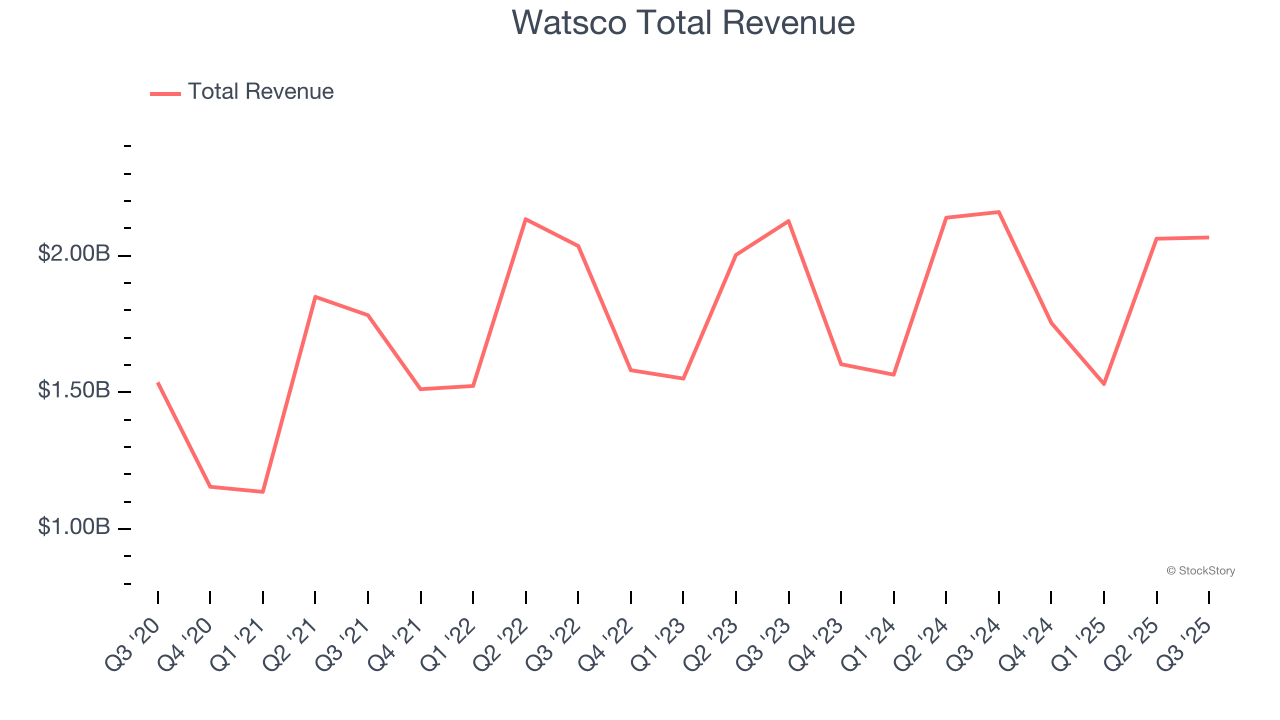
The stock is down 2.8% since reporting and currently trades at $348.30.
Read our full report on Watsco here, it’s free for active Edge members.
Best Q3: Richardson Electronics (NASDAQ:RELL)
Founded in 1947, Richardson Electronics (NASDAQ:RELL) is a distributor of power grid and microwave tubes as well as consumables related to those products.
Richardson Electronics reported revenues of $54.61 million, up 1.6% year on year, outperforming analysts’ expectations by 6%. The business had an incredible quarter with a beat of analysts’ EPS and EBITDA estimates.
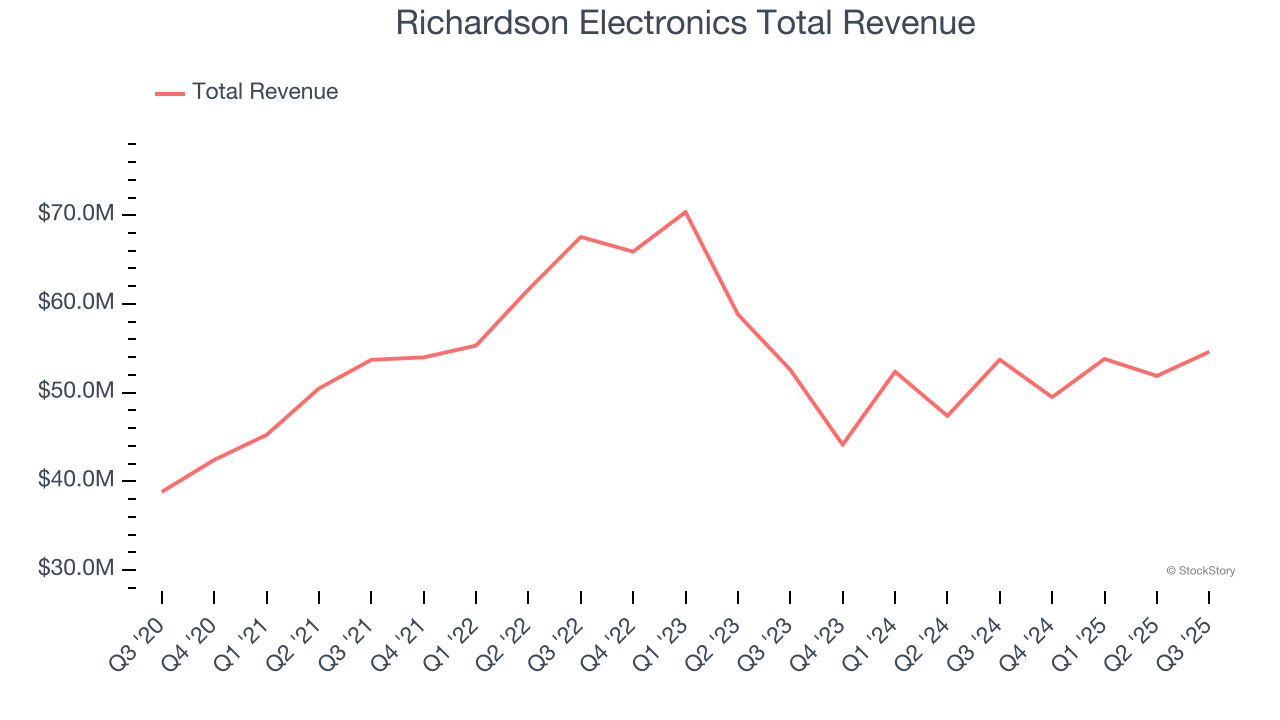
Richardson Electronics achieved the biggest analyst estimates beat among its peers. The market seems content with the results as the stock is up 1.8% since reporting. It currently trades at $10.80.
Is now the time to buy Richardson Electronics? Access our full analysis of the earnings results here, it’s free for active Edge members.
Weakest Q3: Alta (NYSE:ALTG)
Founded in 1984, Alta Equipment Group (NYSE:ALTG) is a provider of industrial and construction equipment and services across the Midwest and Northeast United States.
Alta reported revenues of $422.6 million, down 5.8% year on year, falling short of analysts’ expectations by 8.4%. It was a disappointing quarter as it posted a significant miss of analysts’ revenue and adjusted operating income estimates.
Alta delivered the weakest performance against analyst estimates and slowest revenue growth in the group. As expected, the stock is down 14.6% since the results and currently trades at $5.02.
Read our full analysis of Alta’s results here.
DXP (NASDAQ:DXPE)
Founded during the emergence of Big Oil in Texas, DXP (NASDAQ:DXPE) provides pumps, valves, and other industrial components.
DXP reported revenues of $513.7 million, up 8.6% year on year. This number topped analysts’ expectations by 3%. Zooming out, it was a mixed quarter as it also produced an impressive beat of analysts’ revenue estimates but a significant miss of analysts’ EPS estimates.
The stock is down 10.4% since reporting and currently trades at $109.37.
Read our full, actionable report on DXP here, it’s free for active Edge members.
VSE Corporation (NASDAQ:VSEC)
With roots dating back to 1959 and a strategic focus on extending the life of transportation assets, VSE Corporation (NASDAQ:VSEC) provides aftermarket parts distribution and maintenance, repair, and overhaul services for aircraft and vehicle fleets in commercial and government markets.
VSE Corporation reported revenues of $282.9 million, up 3.4% year on year. This result surpassed analysts’ expectations by 2.3%. It was a stunning quarter as it also put up an impressive beat of analysts’ EBITDA estimates and a solid beat of analysts’ adjusted operating income estimates.
The stock is down 6.5% since reporting and currently trades at $167.80.
Read our full, actionable report on VSE Corporation here, it’s free for active Edge members.
Market Update
Thanks to the Fed’s series of rate hikes in 2022 and 2023, inflation has cooled significantly from its post-pandemic highs, drawing closer to the 2% goal. This disinflation has occurred without severely impacting economic growth, suggesting the success of a soft landing. The stock market thrived in 2024, spurred by recent rate cuts (0.5% in September and 0.25% in November), and a notable surge followed Donald Trump’s presidential election win in November, propelling indices to historic highs. Nonetheless, the outlook for 2025 remains clouded by potential trade policy changes and corporate tax discussions, which could impact business confidence and growth. The path forward holds both optimism and caution as new policies take shape.
Want to invest in winners with rock-solid fundamentals? Check out our Hidden Gem Stocks and add them to your watchlist. These companies are poised for growth regardless of the political or macroeconomic climate.
StockStory’s analyst team — all seasoned professional investors — uses quantitative analysis and automation to deliver market-beating insights faster and with higher quality.
Mentioned In This Article
Latest News
| Oct-09 | |
| Oct-01 | |
| Sep-14 | |
| Sep-11 | |
| Aug-26 | |
| Jul-29 | |
| Jul-29 | |
| Jul-29 | |
| Jul-16 | |
| Jul-01 | |
| Jun-16 | |
| Jun-02 | |
| Apr-29 | |
| Apr-28 | |
| Apr-28 |
