Where Will UPS Stock Be in 1 Year?
Key Points
UPS is reducing Amazon deliveries, which will lower volume but potentially boost profits.
SMB market growth remains uncertain due to new tariffs and shifting supply chains.
Dividend sustainability is in question, with a possible need for cash reserves or debt.
The outlook for United Parcel Service (NYSE: UPS) is not straightforward. The company is set to see some major changes over the next year, but the real question for investors is how much it will change, what will happen to the share price, and what the dividend, now yielding 6.5%, will look like. Here are the main factors to keep an eye on.
Two key things to look out for with UPS in 2026
I will focus on the U.S. domestic package segment, as it accounts for over half of UPS's earnings and is typically the swing factor in those earnings. It's also the segment undergoing significant change in 2026. The two major factors to focus on in 2026:
Where to invest $1,000 right now? Our analyst team just revealed what they believe are the 10 best stocks to buy right now. Continue »
- The deliberate reduction in Amazon delivery volumes will contribute to a decrease in delivery volumes overall but should increase revenue per piece, hopefully leading to margin expansion and a profit increase
- The small- and medium-size business (SMB) market is a key end market for UPS, and it's unclear whether SMBs have yet felt the full weight of tariffs on their operations.
Volume, revenue, profits, and customer prospects are essential at all times, but particularly so when the company appears to be facing a significant challenge in supporting its $5 dividend payment. As a reminder, the Wall Street analyst consensus calls for just $5.3 billion and $5.4 billion in free cash flow (FCF) for UPS in 2026 and 2027, respectively. These figures indicate UPS would need to dip into cash reserves or issue debt to support the dividend.
While UPS could muddle through and sustain the dividend, there are significant questions about whether this is actually the best use of shareholder resources, and it doesn't leave the company much room for error.

Image source: Getty Images.
Lower delivery volumes, higher profit?
Management plans to reduce Amazon deliveries (focusing on low- or negative-margin deliveries) by 50% from the start of 2025 to the second half of 2026. The move makes perfect sense and aligns with management's strategy of tailoring its network for more productive deliveries rather than chasing volume growth in its own right.
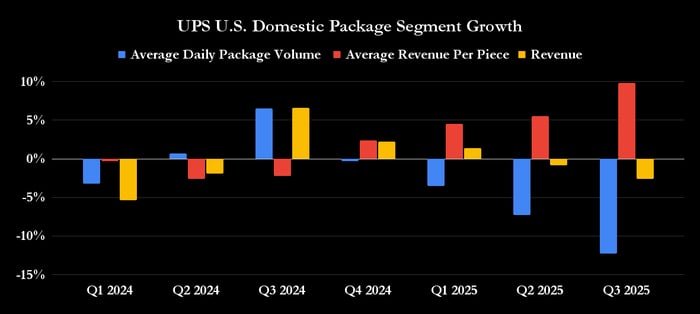
As UPS shifts to more productive deliveries, delivery volumes are dropping, while revenue per package is rising. In 2025, volumes are falling, but higher revenue per package helps offset the lower total volume.
For clarity, the segment's adjusted operating profit decreased by 1.4% and 1.5% year over year in the second and third quarters, respectively. The drop in volumes is not due only to fewer Amazon deliveries; the market has also been weaker than expected this year because tariffs have negatively affected trade.
Data source: UPS presentations.
Simply put, UPS investors hope that falling volumes (blue bars above) will be offset by higher revenue per package (red bars), which could lead to increased revenue (yellow bars) and improved profits in 2026.
The SMB market in 2026
Alongside healthcare, the SMB market is a focus for UPS, particularly through its Digital Access Program (DAP), which enables SMBs to access the pricing and shipping options of large enterprises.
Although SMB daily volume declined by 2.2% in the third quarter compared to the same period of last year, it rose as a share of total U.S. volume to 32.8% from 29.4% in the third quarter of 2024. Management's long-term aim is to get it to 40%.
The outlook for SMBs in 2026 is still uncertain. UPS CEO Carol Tomé is cautious, saying on a recent earnings call that "next year is when you're going to feel the full brunt of some of these tariffs hitting some of these SMBs."
This makes sense. Tariffs began in 2025, but SMBs will feel the full impact in 2026, since many have used up the inventory they purchased before the tariffs. Now tariffs also apply to countries like Vietnam and Thailand, where SMBs have turned for supplies instead of China. Moreover, SMBs attempted to pass on price increases in 2025, but it remains unclear whether this will be successful in 2026.

Image source: Getty Images.
UPS in one year?
The company will improve strategically by reducing Amazon volume. Still, the wild card of SMB volume creates uncertainty, and not least for a company struggling to generate the FCF to cover its dividend. One outcome is a dividend cut, followed by a recovery in the stock price once management resets expectations.
Alternatively, management has the financial resources to maintain the dividend. That will please income-focused investors, even if it's not necessarily what growth-oriented shareholders might want.
Should you buy stock in United Parcel Service right now?
Before you buy stock in United Parcel Service, consider this:
The Motley Fool Stock Advisor analyst team just identified what they believe are the 10 best stocks for investors to buy now… and United Parcel Service wasn’t one of them. The 10 stocks that made the cut could produce monster returns in the coming years.
Consider when Netflix made this list on December 17, 2004... if you invested $1,000 at the time of our recommendation, you’d have $509,039!* Or when Nvidia made this list on April 15, 2005... if you invested $1,000 at the time of our recommendation, you’d have $1,109,506!*
Now, it’s worth noting Stock Advisor’s total average return is 972% — a market-crushing outperformance compared to 193% for the S&P 500. Don't miss the latest top 10 list, available with Stock Advisor, and join an investing community built by individual investors for individual investors.
*Stock Advisor returns as of December 22, 2025.
Lee Samaha has no position in any of the stocks mentioned. The Motley Fool has positions in and recommends Amazon and United Parcel Service. The Motley Fool has a disclosure policy.
Mentioned In This Article
Latest News
| 4 hours | |
| 4 hours | |
| 6 hours | |
| 8 hours | |
| 8 hours | |
| 13 hours | |
| 18 hours | |
| 19 hours | |
| Oct-09 | |
| Oct-09 | |
| Oct-09 | |
| Oct-09 | |
| Oct-09 | |
| Oct-09 | |
| Oct-09 |
