Will PARR Emerge as a Stronger Investment Than ExxonMobil in 2026?
It is not very common to compare the business fundamentals of Exxon Mobil Corporation XOM and Par Pacific Holdings Inc PARR. This is because of their very different business models and scales. With the possibility that the oil price will remain soft in 2026, refining company Par Pacific, although significantly smaller in size, may outperform the large-cap stock ExxonMobil, which relies primarily on upstream operations.
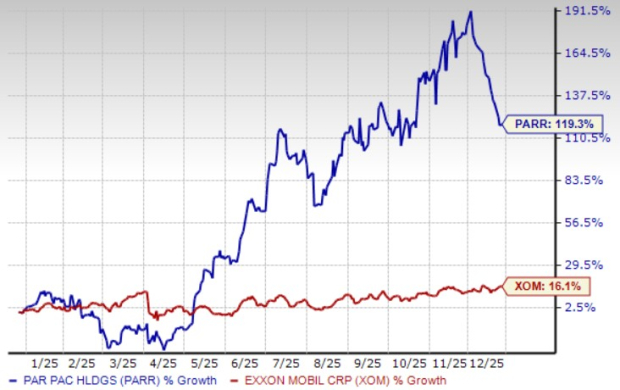
Looking at the one-year price chart, Par Pacific surpassed ExxonMobil. Over the period, PARR jumped 119.3%, surpassing XOM’s 16.1% gain. However, before concluding which stock will outperform in 2026, we need to analyze the companies’ fundamentals and oil pricing environment in detail.
Oil Price May Be Soft in 2026
The U.S. Energy Information Administration (“EIA”), in its latest short-term energy outlook, stated that the spot average price of West Texas Intermediate crude will be $65.32 per barrel this year, lower than the $76.60 per barrel recorded last year. For 2026, EIA expects the commodity price to decline further to $51.42 per barrel. EIA stated that rising worldwide oil inventory will hurt the commodity price.
Low oil prices benefit the refining industry, as companies process raw crude to produce final products like gasoline, diesel and jet fuel. Thus, softness in crude prices will likely benefit refining operations in 2026.
Also, with the advent of advanced drilling techniques like horizontal drilling and hydraulic fracturing (fracking), the cost of operations in oil and gas resources has declined considerably over the years, leading to low breakeven costs. Thus, although oil prices will likely be soft next year, the cost of operations for exploration and production activities might be profitable.
ExxonMobil to Bank on Advantageous Upstream Assets
XOM has a strong footprint in the Permian, the most prolific oil and gas play in the United States, and offshore Guyana. In the Permian, the integrated giant has been employing lightweight proppant technology and hence has been capable of boosting its well recoveries by up to as much as 20%.
In Guyana, XOM has made several oil and gas discoveries, further highlighting the company’s solid production outlook. Notably, record production from both resources has been aiding its top and bottom lines. Importantly, in both resources, the breakeven costs are low, thereby aiding XOM in continuing its upstream business even during a low crude pricing environment.
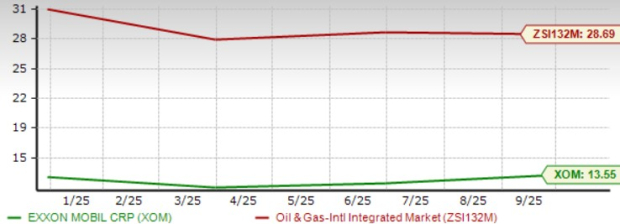
Thanks to the low-cost advantageous assets and strong balance sheet, ExxonMobil, which generates the majority of its earnings from upstream operations, is expected to combat oil price softness next year. Notably, XOM’s debt-to-capitalization being 13.6%, reflecting significantly lower exposure to debt capital.
Par Pacific's Resilient & Competitive Refining Business
While the EIA expects oil prices to remain low next year, a positive for refiners like Par Pacific, several other factors are aiding the company’s refining business that investors should keep in mind.
Instead of relying on a single source of crude, PARR has been depending on crude from a variety of sources, comprising U.S. inland oil fields, imported oil delivered by ship and Canadian heavy crude.
Notably, a significant portion of crude oil sources is waterborne, while 22% consists of Canadian heavy oil. While exposed to multiple sources, Par Pacific has the option to switch if the price of one crude oil type rises.
Additionally, having exposure to Canadian heavy oil, which is cheaper than lighter crude, Par Pacific is likely to have been enjoying a cost advantage. In other words, the refining player has been capable of using lower-priced fuel to produce high-value end products, giving it an edge over other refiners.
Which is a Better Stock for 2026? PARR or XOM
Considering the backdrop, we can say that the business environment in 2026 will be more favorable for Par Pacific.
Turning to valuation, investors currently assign a higher premium to ExxonMobil than to Par Pacific. ExxonMobil is currently trading at a 7.74x trailing 12-month Enterprise Value to Earnings Before Interest, Taxes, Depreciation and Amortization (EV/EBITDA), which is at a premium compared with the broader industry average of 4.46x.
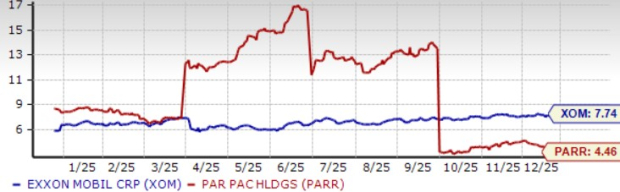
Higher premium for XOM is mostly because investors prefer to remain invested in an integrated energy giant, with a relatively diversified business. However, investors who are willing to take risks can remain invested in Par Pacific, which, while significantly smaller than ExxonMobil, offers a different risk–reward profile.
Both XOM and PARR currently carry a Zacks Rank #3 (Hold). You can see the complete list of today’s Zacks #1 Rank (Strong Buy) stocks here.
Want the latest recommendations from Zacks Investment Research? Today, you can download 7 Best Stocks for the Next 30 Days. Click to get this free report
Exxon Mobil Corporation (XOM): Free Stock Analysis Report
Par Pacific Holdings, Inc. (PARR): Free Stock Analysis Report
This article originally published on Zacks Investment Research (zacks.com).
Mentioned In This Article
Latest News
| 2 hours | |
| Oct-08 | |
| Oct-08 | |
| Oct-08 | |
| Oct-08 | |
| Oct-07 | |
| Oct-07 | |
| Oct-06 | |
| Oct-05 | |
| Oct-05 | |
| Oct-04 | |
| Oct-04 | |
| Oct-02 | |
| Oct-02 | |
| Oct-01 |
