How Does Duke Energy's Regulated Utility Model Drive Stable Growth?
Duke Energy DUK benefits from operating primarily as a regulated utility because regulation provides stable and predictable revenues. Regulators allow the company to earn approved returns on its investments, which supports consistent spending on grid modernization and clean energy projects. Its large customer base across multiple states further reduces risk by diversifying revenue sources and ensuring dependable returns.
Regulated structures allow the company to recover its costs through customer rates, including fluctuating fuel expenses. This cost-recovery framework enables the company to invest in large-scale generation assets, such as nuclear plant life extensions, while managing fuel price volatility and maintaining more stable electricity costs for customers.
Operating in constructive and growing jurisdictions with supportive regulatory environments reduces business risk and creates a lower-risk investment profile for Duke Energy. The company plans to invest nearly $190-$200 billion over the next decade, demonstrating its long-term growth strategy. Of this amount, $95-$105 billion is expected to be spent during 2026-2030, primarily on regulated infrastructure, grid upgrades and clean energy projects.
Regulatory frameworks also support timely returns on Duke Energy’s investments, with most electric capital spending eligible for efficient recovery mechanisms. Growth in gas utilities is supported by riders and annual rate adjustments. The company’s adjusted earnings per share (EPS) growth rate is anticipated to remain in the range of 5-7% through 2029.
Regulated Utilities Driving Stable Growth
Utilities benefit from being a regulated model through a supportive regulatory environment that allows for cost recovery on capital investments and helps maintain a stable earnings.
The Southern Company SO: The majority of SO’s $76 billion, five-year capital plan is allocated to its state-regulated utilities. The focus on regulated assets reduces merchant risk and provides a transparent pathway for earnings growth through rate base expansion and subsequent regulatory recovery.
PPL Corporation’s PPL regulated model allows it to earn approved returns and recover costs efficiently, using streamlined mechanisms for 60% of investments, while its $20 billion infrastructure plan through 2028 is expected to drive 9.8% annual rate base growth.
Estimates for DUK’s Earnings
The Zacks Consensus Estimate for 2025 and 2026 EPS indicates an increase of 7.12% and 6.1%, respectively, year over year.

Image Source: Zacks Investment Research
DUK Stock Trading at a Premium
DUK is trading at a premium relative to the industry, with a forward 12-month price-to-earnings of 17.49X compared with the industry average of 15.31X.
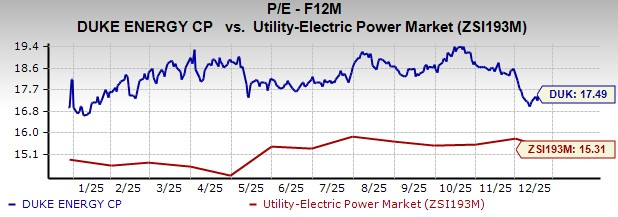
Image Source: Zacks Investment Research
DUK Stock Price Performance
In the past year, the company’s shares have risen 8.8% compared with the industry’s 22.9% growth.
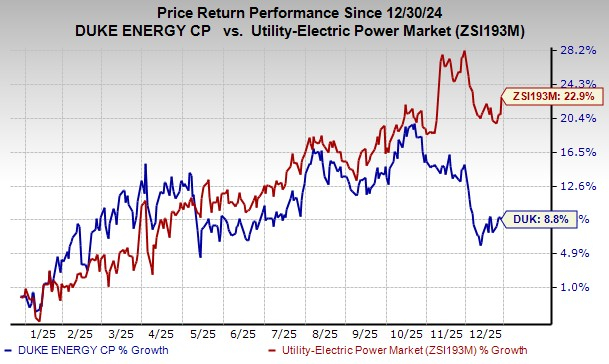
Image Source: Zacks Investment Research
DUK’s Zacks Rank
The company currently has a Zacks Rank #4 (Sell). You can see the complete list of today’s Zacks #1 Rank (Strong Buy) stocks here.
Want the latest recommendations from Zacks Investment Research? Today, you can download 7 Best Stocks for the Next 30 Days. Click to get this free report
PPL Corporation (PPL): Free Stock Analysis Report
Southern Company (The) (SO): Free Stock Analysis Report
Duke Energy Corporation (DUK): Free Stock Analysis Report
This article originally published on Zacks Investment Research (zacks.com).
Mentioned In This Article
Latest News
| 5 hours | |
| 6 hours | |
| 7 hours | |
| 7 hours | |
| Oct-13 | |
| Oct-12 | |
| Oct-12 | |
| Oct-10 | |
| Oct-10 | |
| Oct-09 | |
| Oct-09 | |
| Oct-09 | |
| Oct-09 | |
| Oct-09 | |
| Oct-08 |
