Here's Why Tesla Will Win the EV Market
Key Points
Tesla's robotaxis will revolutionize how consumers think about the cost of mobility.
The company will begin mass production of Cybercabs in 2026, in anticipation of regulatory approvals for robotaxis.
Even if robotaxi adoption is slower than anticipated, Tesla can still tactically respond in ways that its peers cannot.
The coming year is shaping up to be a pivotal one for Tesla (NASDAQ: TSLA), and it will be a year in which the underlying debate about the future of the electric vehicle (EV) industry will come into intense focus. There are two polemic positions that automakers and investors can take on the debate, but as ever, the reality probably lies somewhere in between.
The good news for Tesla investors is that the company has the opportunity to emerge victorious, regardless of the outcome.
Where to invest $1,000 right now? Our analyst team just revealed what they believe are the 10 best stocks to buy right now, when you join Stock Advisor. See the stocks »
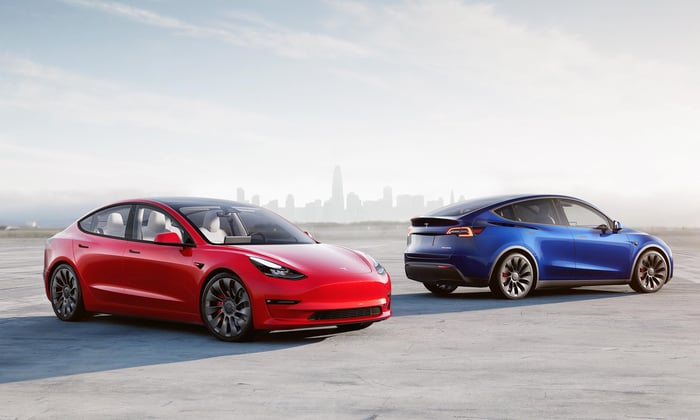
Image source: Tesla.
The great debate over electric vehicles
The crux of the matter was outlined during Tesla's third earnings call in 2024 when management fielded a question on the timing of a $25,000 "non-robotaxi regular car model." Musk's response was to reiterate that "the future is autonomous electric vehicles," which he then claimed most automakers hadn't "internalized" yet. He went on to argue that "I think having a regular $25,000 model is pointless" and "It's fully considered cost per mile is what matters."
Musk is arguing that the lower cost per mile advantage of EVs becomes apparent when the car is driven. Moreover, if the car driven is an autonomous EV in the form of a robotaxi, then that advantage is even higher. Consequently, the most efficient use of an EV is as a robotaxi.
In terms of cost per mile, you could think of matters as follows: Tesla Cybercab robotaxi > Tesla transformed into robotaxi using autonomous full self driving (FSD) > EVs (including Teslas) > regular internal combustion engine (ICE) car > ICE taxi.
Estimates for the cost per mile fluctuate due to external factors (such as fuel costs), but for a rough idea, Musk has mentioned as low as $0.30 per mile for a Cybercab, compared to an average of over $2 for an ICE taxi.
There are a couple of points to consider in addition to this argument. First, a Tesla with autonomous FSD has the potential to have a lower cost per mile than other EVs because the software can drive it in a more efficient manner.
Second, and this is a crucial point in the ICE world, the ICE taxi is the more expensive option on a cost-per-mile basis, which is a major reason why consumers buy cars. However, in the EV world, a consumer will see a robotaxi as a cheaper option on a cost-per-mile basis.
As such, the advent of robotaxis will usher in a fundamentally different way of thinking about mobility than applied in the ICE era.
Tesla's robotaxi plan is to build that future, and investors are buying the stock in anticipation of a massive stream of recurring revenue from its robotaxis in the future. That's why Tesla is aggressively pursuing its robotaxi rollout.
The market needs cheaper electric vehicles
The alternative view has it that the immediate future of the EV industry (the growth area of the auto market) is through the development of low-cost models to reduce the overall cost of ownership. That's why Ford (whose management, in 2016, promised commercial robotaxis by 2021) is investing $5 billion in a universal EV platform, with the aim of offering a $30,000 electric pickup truck in 2027.
Moreover, Ford and General Motors (an automaker that only ended robotaxi development in 2024) are among many automakers that have scaled back their pre-existing EV plans in response to weaker-than-expected sales in 2025 and significant losses on their EV investments.
They believe they are responding to consumer preferences, and the near future will feature the kind of affordable EVs that Musk thought were "pointless," as discussed above.
Which side is right?
They are probably both right, at least in the near term.
The costly Cybertruck and Ford's F-150 Lightning pickup truck have underperformed in sales, while Tesla's most affordable car, the Model 3, has seen sales growth of nearly 18% through 2025, and GM's affordable Chevy Equinox has also experienced strong sales growth. At the same time, the pace of robotaxi rollouts, adoption, and regulatory approval is uncertain and slower than most hoped it would be.
However, Tesla and others are making progress on robotaxis, and the long-term case remains intact. It appears to be an issue of timing.
Image source: Tesla.
Why Tesla could win either way
But here's the thing. Tesla is well-positioned to strategically win in the long term with its robotaxi development, and it's arguably best positioned to win in the near term if the transition takes longer than expected. Unlike peers like Ford and GM, Tesla's EV business is profitable, and in fact, it's already producing lower-cost versions of the Model Y and Model 3 in reaction to market conditions.
It also has the market position and scale to develop lower-cost models. While that's no guarantee that Tesla will produce one if the robotaxi transition is slow, the company is in a much better position to do so than its peers, and that counts for a lot in the investing world.
Don’t miss this second chance at a potentially lucrative opportunity
Ever feel like you missed the boat in buying the most successful stocks? Then you’ll want to hear this.
On rare occasions, our expert team of analysts issues a “Double Down” stock recommendation for companies that they think are about to pop. If you’re worried you’ve already missed your chance to invest, now is the best time to buy before it’s too late. And the numbers speak for themselves:
- Nvidia: if you invested $1,000 when we doubled down in 2009, you’d have $486,427!*
- Apple: if you invested $1,000 when we doubled down in 2008, you’d have $51,943!*
- Netflix: if you invested $1,000 when we doubled down in 2004, you’d have $505,749!*
Right now, we’re issuing “Double Down” alerts for three incredible companies, available when you join Stock Advisor, and there may not be another chance like this anytime soon.
*Stock Advisor returns as of January 1, 2026.
Lee Samaha has no position in any of the stocks mentioned. The Motley Fool has positions in and recommends Tesla. The Motley Fool recommends General Motors. The Motley Fool has a disclosure policy.
Mentioned In This Article
Latest News
| 4 hours | |
| 7 hours | |
| 16 hours | |
| 17 hours | |
| Oct-09 | |
| Oct-09 | |
| Oct-09 | |
| Oct-09 | |
| Oct-09 |
Tesla's China Retail Sales Fall 9% Even as Shanghai Exports Surge 58%
TSLA
Benzinga Prediction Markets
|
| Oct-09 | |
| Oct-09 | |
| Oct-09 | |
| Oct-09 | |
| Oct-09 | |
| Oct-09 |
