Uber & Partners Reveal Robotaxi Design at CES: Sign of More Upside?
The race to develop autonomous vehicles (AVs) is entering an exciting phase. At the Consumer Electronics Show (“CES”) 2026, Uber Technologies UBER and partners Lucid Group LCID and Nuro, revealed the production-ready vehicles that will power their upcoming global robotaxi service. Moreover, for the first time, they showcased the Uber-designed in-cabin rider experience.
In addition, the companies confirmed that autonomous on-road testing commenced last month, marking a significant step in the development and validation of the robotaxi program ahead of its anticipated launch in the San Francisco Bay Area later this year. Nuro is overseeing the testing phase, deploying robotaxi engineering prototypes under the supervision of autonomous vehicle operators, starting in the Bay Area.
Autonomous on-road testing forms a core component of Nuro’s safety and validation framework, which has been refined through years of commercial autonomous vehicle deployments. The testing program assesses dozens of essential capabilities across the entire autonomy stack, including Nuro’s end-to-end AI foundation model that combines advanced artificial intelligence with transparent, verifiable safety logic to deliver smooth and dependable performance.
Beyond real-world road testing, the validation process also incorporates closed-course evaluations and extensive simulation to ensure robust operation across a broad range of driving scenarios. Subject to final validation, production of the robotaxi vehicle is expected to begin later this year at Lucid’s manufacturing facility in Arizona.
We remind investors that in July 2025, Lucid signed a major deal with Uber to supply 20,000 vehicles over six years equipped with Nuro’s self-driving tech. For Lucid, the initiative marks an effort to expand beyond its core consumer electric vehicle business, as the luxury EV manufacturer contends with weakening demand in the U.S. market.
Uber has adopted an asset-light approach through strategic partnerships to gain a stronghold in the robotaxi market. Multiple agreements in this area underscore Uber’s commitment to integrating cutting-edge AV technologies into its platform. With this partnership-driven approach, Uber has avoided the massive R&D costs associated with developing autonomous systems independently.
Uber’s dominant market share in the ride-hailing industry also gives it a unique advantage. With its vast network of drivers and customers, Uber can quickly scale autonomous services once the technology matures. Its app is designed to integrate AVs from multiple partners, giving users a variety of options. Uber’s AV ambitions are gaining real-world traction through scalable, cross-market deployments. While macro risks and regulatory scrutiny remain, Uber’s ability to scale both core businesses (mobility and delivery) and emerging automation initiatives positions it well for long-term growth. Uber is focused on unlocking growth in suburban and low-density markets.
Alphabet’s GOOGL Waymo is another major player and a force to reckon with in the evolving and lucrative space. The company, through its Waymo arm, already has commercial operations in several cities across the United States. Waymo has been operating truly driverless vehicles for years and recently crossed 450,000 weekly paid rides, almost double the 250,000 it reported in April.
Autonomous or self-driving cars offer a wide range of advantages that position them to reshape the future of transportation fundamentally. One of the most significant benefits is improved road safety. Human error accounts for the majority of traffic accidents and self-driving systems — powered by sensors, cameras and artificial intelligence — can reduce collisions by reacting faster, maintaining constant attention and following traffic rules consistently.
UBER’s Price Performance, Valuation and Estimates
Shares of UBER have gained 31.8% in a year compared with the Zacks Internet-Services industry’s 58.5% growth in the same timeframe.

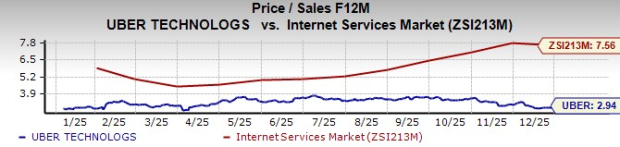
From a valuation standpoint, UBER trades at a 12-month forward price-to-sales of 2.94X. UBER is inexpensive compared with its industry, having a Value Score of D.
The Zacks Consensus Estimate for UBER’s fourth-quarter 2025, full-year 2025 and 2026 earnings have moved north over the past 60 days.

UBER's Zacks Rank
UBER currently carries a Zacks Rank #3 (Hold). You can see the complete list of today’s Zacks #1 Rank (Strong Buy) stocks here.
Want the latest recommendations from Zacks Investment Research? Today, you can download 7 Best Stocks for the Next 30 Days. Click to get this free report
Alphabet Inc. (GOOGL): Free Stock Analysis Report
Uber Technologies, Inc. (UBER): Free Stock Analysis Report
Lucid Group, Inc. (LCID): Free Stock Analysis Report
This article originally published on Zacks Investment Research (zacks.com).
Mentioned In This Article
Latest News
| 1 hour | |
| 6 hours | |
| 10 hours | |
| Oct-09 | |
| Oct-09 | |
| Oct-09 | |
| Oct-09 | |
| Oct-09 | |
| Oct-09 | |
| Oct-09 | |
| Oct-09 | |
| Oct-09 | |
| Oct-09 | |
| Oct-09 | |
| Oct-09 |
