Only 2 "Magnificent Seven" Stocks Beat the S&P 500 Index in 2025. Should You Buy Them in 2026?
Key Points
Investors pulled back from large artificial intelligence stocks due to concerns over valuation and excessive AI infrastructure spending.
The market seems torn on how AI stocks will perform in 2026.
Will the winners keep winning? Or are they poised for a pullback?
Despite the hype surrounding artificial intelligence (AI) and the "Magnificent Seven" in 2025, only two stocks in the elite group actually outperformed the broader benchmark S&P 500 index, which gained nearly 16.4% last year, marking a third consecutive year of strong returns. That may leave some investors wondering if the group really did have a down year and could be poised for a bounce, or if perhaps it's the beginning of a broader pullback.
The two stocks that outperformed the S&P 500 crushed the market, with gains that at least doubled the market's performance. In fact, one Magnificent Seven stock was not far off from quadrupling the market's performance. Should you buy the two S&P 500 outperformers in 2026?
Where to invest $1,000 right now? Our analyst team just revealed what they believe are the 10 best stocks to buy right now, when you join Stock Advisor. See the stocks »
Alphabet: From value to outperformer
If there was a value stock in the Magnificent Seven heading into 2025, it was definitely Alphabet (NASDAQ: GOOG)(NASDAQ: GOOGL). The company faced several headwinds, including a U.S. Department of Justice lawsuit and threats from artificial intelligence (AI) chatbots like ChatGPT.

Image source: Alphabet.
In 2024, a federal judge ruled in favor of the DOJ, which had sued Google for employing monopolistic practices in the digital advertising industry that gave Google immense pricing power and made it prohibitive for other web publishers to compete with the search giant. Google at times has controlled over 90% of the traditional search market.
The DOJ requested that Google be required to divest its Chrome browser, a critical component of the company's search business, which makes up over half of Alphabet's revenue. Google also faced threats from AI because many believed that chatbots like OpenAI's ChatGPT, the fastest growing consumer app in history, would simply steal traffic from Google because it is better at answering search queries.
Ironically, a federal judge ruled Google would not have to divest Chrome because the company faces new threats from AI that could erode its market position. The judge also ruled that Alphabet could continue to pay Apple tens of billions of dollars per year to make Google Safari the default search engine. This removed a key regulatory risk from Alphabet.
Additionally, Google appears to have demonstrated that its Gemini AI model can compete with ChatGPT. The market became more impressed with Google's AI summary overviews, new AI Mode, and updated Gemini models, leading investors to believe that Google can compete with new AI companies and maintain its dominance in at least the traditional search market. The stock blasted nearly 65% higher last year, nearly quadrupling the broader market's performance.
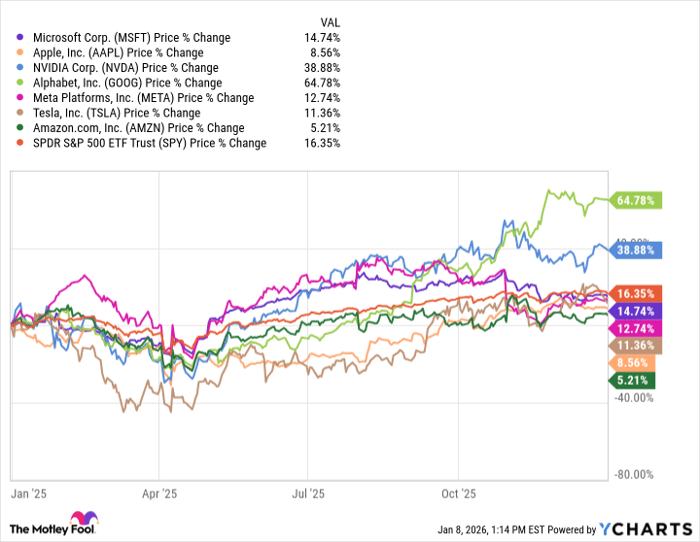
Trading at 29 times forward earnings, I do think investors can continue to buy Alphabet. While risks from competitors remain, the nice thing about the company is that it operates many strong businesses, including YouTube, Waymo, and Google Cloud, so it's not a total bet on AI.
Nvidia: Will the chip giant continue its dominance, or is competition inevitable?
Like most in the Magnificent Seven, Nvidia (NASDAQ: NVDA) endured an up-and-down year. Geopolitical concerns affected the chipmaker, as the Trump administration sought to prevent the company from selling certain chips to China. However, Nvidia's CEO, Jensen Huang, spent time lobbying the administration, and it appears that the company may be able to reopen its China business at some point in the near future.
In the second half of last year, many investors became concerned that Nvidia could struggle to maintain its dominance, as hyperscalers sought to build their own chips in-house and custom chips gained more traction.
For instance, Google unveiled the seventh generation of its Tensor Processing Units (TPUs), which some experts see as a strong alternative to Google's more general-purpose graphics processing units (GPUs). TPUs are believed to be superior when it comes to training the large language models on more specific tasks.
However, Nvidia has continued to report strong quarterly earnings, growing revenue 62% year over year in its most recent report in December. The company also continues to innovate quickly on its chip designs. The company recently unveiled its Rubin platform, featuring six new chip designs that the company believes will accelerate agentic AI, such as autonomous driving.
While the reopening of China could significantly improve revenue and earnings for the company this year, I remain neutral on Nvidia, with the stock trading at close to 40 times earnings. I'm sure the company will continue to be at the center of the AI revolution for decades to come, but I'm curious to see how competition impacts the company's control of the chip market this year, and its margins.
Should you buy stock in Alphabet right now?
Before you buy stock in Alphabet, consider this:
The Motley Fool Stock Advisor analyst team just identified what they believe are the 10 best stocks for investors to buy now… and Alphabet wasn’t one of them. The 10 stocks that made the cut could produce monster returns in the coming years.
Consider when Netflix made this list on December 17, 2004... if you invested $1,000 at the time of our recommendation, you’d have $482,451!* Or when Nvidia made this list on April 15, 2005... if you invested $1,000 at the time of our recommendation, you’d have $1,133,229!*
Now, it’s worth noting Stock Advisor’s total average return is 968% — a market-crushing outperformance compared to 197% for the S&P 500. Don't miss the latest top 10 list, available with Stock Advisor, and join an investing community built by individual investors for individual investors.
*Stock Advisor returns as of January 12, 2026.
Bram Berkowitz has no position in any of the stocks mentioned. The Motley Fool has positions in and recommends Alphabet, Amazon, Apple, Meta Platforms, Microsoft, Nvidia, and Tesla. The Motley Fool recommends the following options: long January 2026 $395 calls on Microsoft and short January 2026 $405 calls on Microsoft. The Motley Fool has a disclosure policy.
Mentioned In This Article
Latest News
| 12 min | |
| 16 min | |
| 25 min | |
| 36 min | |
| 41 min | |
| 50 min | |
| 1 hour | |
| 1 hour | |
| 1 hour | |
| 2 hours | |
| 2 hours | |
| 2 hours | |
| 2 hours | |
| 3 hours | |
| 3 hours |
