|
|
|

|
|||||
|
|
|
Moody's Chief Economist Mark Zandi warns that President Donald Trump‘s directive for Fannie Mae (OTC:FNMA) and Freddie Mac (OTC:FMCC) to purchase $200 billion in mortgage bonds will likely backfire, driving home prices higher rather than solving the nation’s “severe housing affordability problem.”
While President Trump claims his executive order will restore “affordability” and bring the “American Dream” back by lowering monthly payments, Zandi argues the plan ignores basic economics.
Following the announcement, fixed mortgage rates declined by 10-20 basis points to just over 6%.
However, Zandi cautions that this relief is illusory. He argues that while lower rates will support housing demand, the “severe housing shortage” means the stimulus will “result in higher house prices, all else equal.”
According to Zandi, the move will do “little to make homebuying more affordable” because the influx of cash will bid up the cost of limited inventory, negating the benefit of slightly lower rates.
President Trump says he is directing Fannie Mae and Freddie Mac to purchase $200 billion of mortgage-backed securities in an effort to bring down mortgage rates and address the severe housing affordability problem. Fixed mortgage rates have, in fact, declined by 10-20 basis…
— Mark Zandi (@Markzandi) January 12, 2026
Zandi identifies a deeper institutional conflict regarding the Federal Reserve. Although the central bank pivoted back to quantitative easing in December, Zandi points out that it is still “allowing its holdings of MBS (mortgage-backed securities) to prepay and mature.”
Zandi warns that Trump's order for the Government Sponsored Enterprises (GSEs) to aggressively buy these same bonds effectively “countervails the Fed's efforts” to manage its mortgage portfolio.
He describes the directive as a “backdoor way” for the White House to “circumvent the Federal Reserve,” creating a clash over who controls the money supply.
“Who is in charge of setting monetary policy?” Zandi asked, calling the executive overreach “even more worrisome” than the market mechanics.
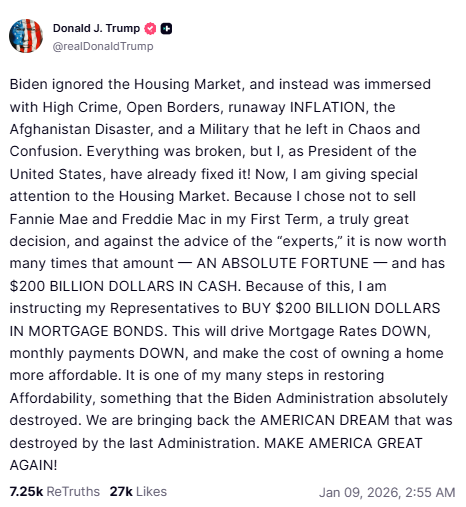
Trump touted his decision not to sell Fannie and Freddie in his first term as a “truly great decision” that amassed an “absolute fortune” in cash. Zandi views this re-expansion of their balance sheets as a dangerous regression.
He warns that the “principal constraints” placed on the agencies after the 2008 collapse are now “eroding.”
By uncapping their portfolios, Zandi fears a return to the pre-crisis era where the agencies acted as “huge hedge funds,” a model he notes went “badly awry” during the Global Financial Crisis.
The CME Group's FedWatch tool‘s projections show markets pricing a 95% likelihood of the Federal Reserve leaving the current interest rates unchanged in January.
The SPDR S&P 500 ETF Trust (NYSE:SPY) and Invesco QQQ Trust ETF (NASDAQ:QQQ), which track the S&P 500 index and Nasdaq 100 index, respectively, closed higher on Monday. The SPY was up 0.16% at $695.16, while the QQQ advanced 0.083% to $627.17, according to Benzinga Pro data.
The futures of the S&P 500, Nasdaq 100, and Dow Jones indices were trading lower on Tuesday.
Disclaimer: This content was partially produced with the help of AI tools and was reviewed and published by Benzinga editors.
Photo courtesy: Tada Images / Shutterstock.com
| Jun-08 | |
| Jun-08 | |
| Jun-08 | |
| Jun-07 | |
| Jun-06 | |
| Jun-05 | |
| Jun-05 | |
| Jun-05 | |
| Jun-05 | |
| Jun-04 | |
| Jun-04 | |
| Jun-04 | |
| Jun-04 | |
| Jun-04 | |
| Jun-03 |

Join thousands of traders who make more informed decisions with our premium features. Real-time quotes, advanced visualizations, alerts, and much more.
Learn more about Finviz Elite