How Will Mounjaro and Zepbound Sales Aid LLY's Upcoming Q4 Results?
Eli Lilly LLY has emerged as a dominant force in the cardiometabolic market, driven by strong demand for its blockbuster GLP-1 therapies, Mounjaro for type II diabetes (T2D) and Zepbound for obesity. Although both drugs have been on the market for just over three years, they have become LLY’s key top-line drivers. In the first nine months of 2025, the drugs generated combined sales of $24.8 billion, accounting for 54% of Eli Lilly’s total revenues. Investors will be closely watching the sales performance of Mounjaro and Zepbound when LLY reports its fourth-quarter and full-year 2025 results on Feb 4.
The robust performance of Mounjaro and Zepbound in the recent quarters has largely been driven by improved domestic supply following the expansion of manufacturing capacity. Additionally, sales of both drugs have been boosted by their rollout across new international markets. The strong momentum of its GLP-1 franchise is also the key reason Eli Lilly raised its sales and earnings guidance twice in 2025.
We believe that stronger penetration in the U.S. market and rising adoption across international markets likely fueled the growth of both drugs in the fourth quarter of 2025. However, some headwinds are expected from lower pricing. Our model estimates for Mounjaro and Zepbound sales are pegged at $6.55 billion and $3.62 billion, respectively, for the to-be-reported quarter.
Beyond cardiometabolic health, Lilly’s broader portfolio, including the oncology drug Verzenio and immunology drug Taltz, also continues to deliver steady growth. The company’s newly launched drugs, such as Omvoh and Ebglyss in immunology, Jaypirca in oncology, and Kisunla in neuroscience, are all contributing to top-line growth.
LLY’s Peers in the Obesity Space
Eli Lilly and Novo Nordisk NVO presently dominate the obesity market. Mounjaro and Zepbound directly compete with NVO’s semaglutide medicines, Ozempic for T2D and Wegovy for obesity. Like Eli Lilly, Novo Nordisk also generates a substantial portion of revenues from both drugs.
Novo Nordisk secured the long-awaited FDA approval for its oral Wegovy pill to treat obesity and reduce cardiovascular risk in late December, followed by its commercial launch in early January. This marked a major milestone, making Wegovy the first GLP-1 RA available in an oral form for weight management. Compared to injectable formulations, the pill offers a far more convenient administration option. However, Eli Lilly remains close on the heels of Novo Nordisk as a regulatory application seeking the approval of its oral GLP-1 pill, orforglipron, for obesity is currently under review by the FDA.
The obesity space has garnered much of the spotlight over the past year due to the sizeable and still underpenetrated market opportunity. Smaller biotech firms, like Viking Therapeutics VKTX and Structure Therapeutics GPCR, are also advancing GLP-1–based therapies to challenge the incumbents. Viking Therapeutics is developing its dual GIP/GLP-1 RA, VK2735, both as oral and subcutaneous formulations for the treatment of obesity. Last year, VKTX started two late-stage studies evaluating the subcutaneous formulation of VK2735. While one of these studies completed enrolment in November 2025 at a rapid pace, Viking Therapeutics expects to complete enrolment in the other study by the end of this quarter.
Structure Therapeutics’ ACCESS study on its orally GLP-1 RA, aleniglipron, for obesity, met its primary and all key secondary endpoints. In the study, the 120 mg dose delivered an 11.3% placebo-adjusted weight loss. Higher doses drove deeper reductions, reaching 15.3% at 240 mg. Structure Therapeutics expects to initiate the late-stage program of aleniglipron in obesity around mid-2026.
LLY’s Stock Price, Valuation and Estimates
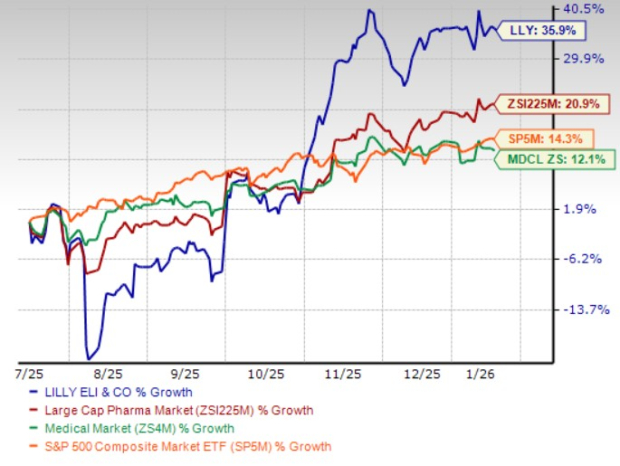
Shares of Eli Lilly have gained 35.9% in the past six months compared with the industry’s 20.9% growth. The company has also outperformed the sector and the S&P 500 during the same time frame, as seen in the chart below.
LLY Stock Price Movement
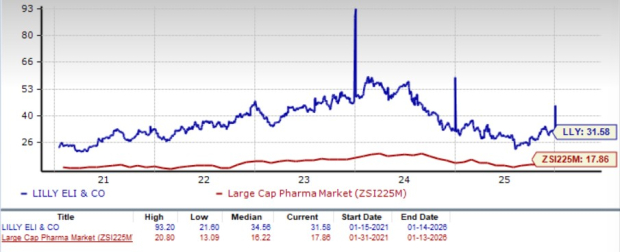
From a valuation standpoint, LLY stock is expensive. Going by the price/earnings ratio, the company’s shares currently trade at 31.58 forward earnings, higher than 17.86 for the industry. However, the stock is trading below its five-year mean of 34.56.
LLY Stock Valuation
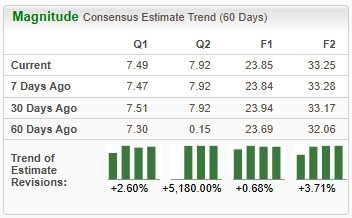
Estimates for Eli Lilly’s 2025 earnings have improved from $23.69 to $23.85 per share in the past 60 days, and estimates for 2026 earnings have improved from $32.06 to $33.25 over the same time frame.
LLY Estimate Movement
Eli Lilly currently carries a Zacks Rank #3 (Hold). You can see the complete list of today’s Zacks #1 (Strong Buy) Rank stocks here.
Want the latest recommendations from Zacks Investment Research? Today, you can download 7 Best Stocks for the Next 30 Days. Click to get this free report
Novo Nordisk A/S (NVO): Free Stock Analysis Report
Eli Lilly and Company (LLY): Free Stock Analysis Report
Viking Therapeutics, Inc. (VKTX): Free Stock Analysis Report
Structure Therapeutics Inc. Sponsored ADR (GPCR): Free Stock Analysis Report
This article originally published on Zacks Investment Research (zacks.com).
Mentioned In This Article
Latest News
| Oct-09 | |
| Oct-09 | |
| Oct-09 | |
| Oct-09 | |
| Oct-09 | |
| Oct-09 | |
| Oct-09 | |
| Oct-08 | |
| Oct-08 | |
| Oct-08 | |
| Oct-08 | |
| Oct-08 | |
| Oct-08 | |
| Oct-07 | |
| Oct-07 |
