4 Stock Market Predictions for 2026
Key Points
The artificial intelligence (AI) train is barreling ahead at full speed, but there are a couple of areas of concern.
The market could respond negatively if concerns are confirmed, but the long-term outlook remains bright.
People who have read my market predictions in the past have likely already clicked away -- they know that I've been wrong many times before.
That's OK. Author Morgan Housel said it best in his book The Psychology of Money: "We should use past surprises as an admission that we have no idea what might happen next."
Where to invest $1,000 right now? Our analyst team just revealed what they believe are the 10 best stocks to buy right now. Continue »

Image source: Getty Images.
In a real sense, I have no idea what will happen in 2026. Making bold, confident market predictions for the year is consequently challenging. Therefore, take these predictions with a grain of salt.
However, several economic developments have caught my attention. And if current trends continue, they could have big implications for the coming year.
So, while one shouldn't take these as prophecy, allow me to share my four market predictions for 2026.
1. Gemini will upset the AI apple cart
OpenAI's ChatGPT kicked off the artificial intelligence (AI) trend that has unlocked hundreds of billions of dollars in new infrastructure spending. At one point, the popular chatbot had a virtual monopoly. But Alphabet's (NASDAQ: GOOG)(NASDAQ: GOOGL) Gemini is suddenly skyrocketing.
According to analytics firm Similarweb, Gemini's market share jumped from 5% to 18% in 2025. Meanwhile, ChatGPT's market share plunged from 87% to 68%. For a single year, this is a major change, and the trend could be accelerating.
Newer data shows that Gemini may now have an over 21% market share, more than doubling from six months ago. The difference-maker may be Gemini 3, which launched in November to strong reviews. The growth curve could continue in the right direction as well, considering Apple just picked Gemini to power Siri.
This shift from ChatGPT to Gemini could really upset the AI apple cart. OpenAI is reportedly looking to go public, and some believe its valuation could reach $1 trillion. The motivation may be money -- investment bank HSBC estimates that it needs over $200 billion to fulfill its growth plans.
If Gemini becomes the new king of chatbots, OpenAI could struggle to win over investors, potentially leading to a funding shortfall. The AI trend will undoubtedly continue in 2026. But a shift away from OpenAI leading the charge could have a ripple effect throughout the space, as planned spending deals fall through.
2. The market will have a correction (or crash)
If my first prediction is correct, then my second prediction is virtually guaranteed. Many investors fear an AI bubble in the stock market, whether that's actually true or not. The point is, fearful investors would immediately flee if it looked like the bubble was finally popping.
However, I'm not being bold by predicting a stock market correction in 2026. A correction is a drop of at least 10%. On average, this happens once every one or two years. In other words, it's quite normal, as the chart of the S&P 500 (SNPINDEX: ^GSPC) shows.
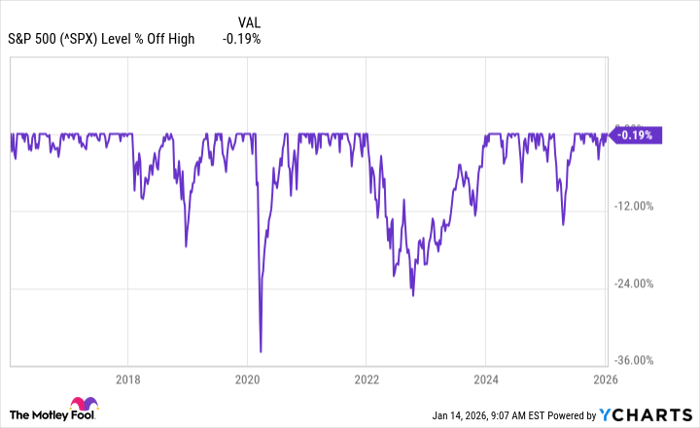
The last market correction happened in early 2025. If history is any guide, investors should expect another one in the second half of 2026.
3. The power bottleneck will provide opportunities
I've mentioned that a correction could start if OpenAI loses steam. After all, the stock market is soaring in large part thanks to the incredible growth in AI and correlated infrastructure spending. However, there's another factor that could slow the AI trend in 2026: the power bottleneck.
In short, the electricity demand from AI infrastructure is increasing much faster than it can be generated. This imbalance in supply and demand is manifesting in higher electricity prices. It's an issue being addressed directly by the Trump administration, which is saying that Microsoft needs to ensure the higher costs aren't passed on to consumers.
The bottleneck with electricity creates some interesting opportunities, in my opinion. It takes years to bring new capacity online. But AI needs power now. Therefore, I believe the opportunity lies with businesses that can help power companies do more with what they already have.
One example of this is Itron (NASDAQ: ITRI). This company deploys smart meters at the edge of the power grid, enabling power companies to monitor demand in real time. Itron's customers will likely value these products and services more and more because they help maximize the existing grid while waiting for new capacity to come online.
Another example of this could be Tesla (NASDAQ: TSLA). CEO Elon Musk recently pointed out that power plants could meet much more demand if the demand were evenly distributed throughout a 24-hour day. But it's not; there are peaks and troughs. However, demand could be smoothed out with batteries, such as Tesla's Megapack.
Itron and Tesla are two businesses that I believe can benefit from a bottleneck in electricity, but there could be others as well.
4. The market will end higher by Dec. 31
Finally, I don't want my prediction of a stock market correction to sound like doom and gloom. In investing, it feels smart to be a pessimist, but it pays to be an optimist. The S&P 500 goes up most years. And it tends to recover quickly from drawdowns.
Just consider 2025. At one point, the S&P 500 was down almost 19% from the start of the year. But it finished up 16%, which is an above-average year overall.
Therefore, I think investors are likely to experience a painful hiccup at some point this year. But I believe the outlook remains solid. There are many things to celebrate, including strong infrastructure spending, lower inflation and mortgage rates, and more.
In conclusion, there are trends in the AI space that could contribute to a drop in stocks this year -- those are among my predictions. But I also predict that 2026 will be a good year for a handful of stocks and, most likely, for the market as a whole. Therefore, I intend to continue investing this year through the ups and downs.
Should you buy stock in Alphabet right now?
Before you buy stock in Alphabet, consider this:
The Motley Fool Stock Advisor analyst team just identified what they believe are the 10 best stocks for investors to buy now… and Alphabet wasn’t one of them. The 10 stocks that made the cut could produce monster returns in the coming years.
Consider when Netflix made this list on December 17, 2004... if you invested $1,000 at the time of our recommendation, you’d have $474,578!* Or when Nvidia made this list on April 15, 2005... if you invested $1,000 at the time of our recommendation, you’d have $1,141,628!*
Now, it’s worth noting Stock Advisor’s total average return is 955% — a market-crushing outperformance compared to 196% for the S&P 500. Don't miss the latest top 10 list, available with Stock Advisor, and join an investing community built by individual investors for individual investors.
*Stock Advisor returns as of January 17, 2026.
HSBC Holdings is an advertising partner of Motley Fool Money. Jon Quast has no position in any of the stocks mentioned. The Motley Fool has positions in and recommends Alphabet, Apple, Microsoft, and Tesla. The Motley Fool recommends HSBC Holdings and recommends the following options: long January 2026 $395 calls on Microsoft and short January 2026 $405 calls on Microsoft. The Motley Fool has a disclosure policy.
Mentioned In This Article
Latest News
| 2 hours | |
| Oct-10 | |
| Oct-10 | |
| Oct-10 | |
| Oct-10 | |
| Oct-10 | |
| Oct-09 | |
| Oct-09 | |
| Oct-09 | |
| Oct-09 | |
| Oct-09 | |
| Oct-09 | |
| Oct-09 | |
| Oct-09 | |
| Oct-09 |
