Caterpillar vs. Volvo: Which Heavy Equipment Stock is the Better Buy?
Caterpillar Inc. CAT and Volvo VLVLY are global leaders in the heavy machinery and construction equipment industry, offering a wide range of products, including trucks, excavators, and industrial engines. They are key players in infrastructure development and are actively investing in electrification and autonomous technologies to shape the future of construction and transportation.
Caterpillar has a market capitalization of $302.7 billion, while Volvo has a market capitalization of $68.9 billion. Both are closely watched by investors to gauge the health of the broader manufacturing and infrastructure landscape, especially during economic uncertainty. The question is which stock you should put your money on.
To find out, let us dive into the fundamentals, growth prospects and challenges of Caterpillar and Volvo.
The Case for Caterpillar
Caterpillar is the world’s leading manufacturer of construction and mining equipment, off-highway diesel and natural gas engines, industrial gas turbines, and diesel-electric locomotives.
In the third quarter of 2025, Caterpillar posted record revenues of $17.6 billion, up 9.5% year over year, driven by a 10% increase in sales volume. The company returned to revenue growth after six quarters of declines, supported by upbeat performances across all regions and segments. Earnings per share, however, moved down 4% year over year to $4.95 due to tariff-related pressures.
CAT expects revenues for 2025 to be “modestly” higher than that reported in 2024, an improvement from its prior projection of “slightly” higher revenues. The company projected net incremental tariffs of $1.6-$1.75 billion for 2025. Caterpillar, thus, expects the adjusted operating margin to land near the bottom of its target range, considering the impacts of tariffs. The company’s pricing and cost-control initiatives should help cushion the impacts.
Looking ahead, CAT stands to benefit from the surge in projects, driven by the United States Infrastructure Investment and Jobs Act, creating opportunities for its diverse construction equipment portfolio. The shift toward clean energy will drive the demand for essential commodities, boosting the need for Caterpillar’s mining equipment. Meanwhile, given their efficiency and safety, CAT’s autonomous fleet is gaining momentum among miners.
As technology companies establish data centers globally to support their generative AI applications, the company is witnessing robust order levels for reciprocating engines for data centers. It is planning to double its output with a multi-year capital investment. Caterpillar recently entered a long-term strategic collaboration with Hunt Energy Company, L.P., to meet the surging power needs of data centers. The first project is planned for Texas and is expected to serve as the launchpad for a multi-year program to deliver up to one gigawatt of power generation capacity for data centers across North America.
Caterpillar also entered an agreement to develop advanced energy optimization solutions for data centers. This collaboration focuses on integrating Vertiv's power distribution and cooling portfolio with Caterpillar’s know-how in power generation and CCHP (Combined Cooling, Heat and Power).
CAT has been seeing growth in aftermarket parts and service-related revenues, which generate high margins. The company is, thus, focused on doubling its service revenues from $14 billion in 2016 to $28 billion in 2026.
The Case for Volvo
Volvo is one of the leading manufacturers of trucks, buses and construction equipment, as well as marine and industrial engines. Its subsidiary, Volvo Construction Equipment (Volvo CE), produces a wide range of machinery for the construction, extraction, waste processing and materials handling sectors. It manufactures haulers, wheel loaders, excavators, road construction machines and compact equipment.
Since 2024, the demand for construction equipment has weakened across most regions. High interest rates and low confidence in Europe, and cooling demand in North America led Volvo CE to scale back production. In 2024, Volvo CE’s net sales decreased 16%. Earnings were also negatively impacted by an unfavorable brand and market mix, and lower volumes.
This continued in 2025 with net sales dropping 8.5% in the first nine months of 2025. In the third quarter of 2025, sales dipped 5% year over year. Increased uncertainty surrounding tariffs and their effects on global trade continues to weigh on the results.
Despite the slowdown, the company continues to push innovation with the rollout of products. The company has recently expanded its European industrial footprint with a new crawler excavator assembly factory in Eskilstuna. The new 30,000 square meter facility will boost Volvo CE’s capacity and aid in addressing rising European customer demand. The move is in sync with Volvo CE’s goals to solidify its position in the key excavator market.
With the need to expand and upgrade existing infrastructure in many countries across the globe, these investments will position Volvo CE for long-term growth.
Volvo CE also announced a global investment in crawler excavator production at three key Volvo CE locations to meet growing demand and mitigate supply-chain risks through localized production.
How Do Estimates Compare for CAT & VLVLY?
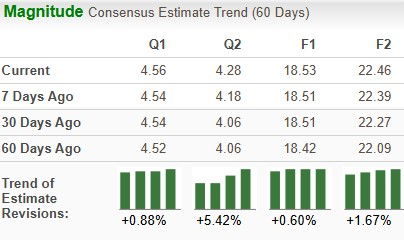
The Zacks Consensus Estimate for Caterpillar’s 2025 earnings is $18.53 per share, indicating a year-over-year decline of 15.4%. The estimate for 2026 of $22.46 suggests a rise of 21.2%. EPS estimates for both 2025 and 2026 have been trending north over the past 60 days.
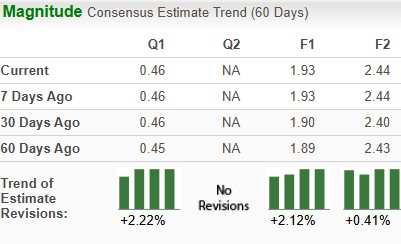
The Zacks Consensus Estimate for Volvo’s 2025 earnings is $1.93 per share, indicating a year-over-year dip of 17.5%. The 2026 estimate of $2.44 implies growth of 26.4%. Both estimates have been trending north over the past 60 days.
Caterpillar & Volvo: Price Performance, Valuation & Other Comparisons
In a year, the CAT stock has surged 70.1%, whereas VLVLY has gained 41.4%. The stocks have outperformed the Industrial Products Sector and the S&P 500, as shown in the chart below.

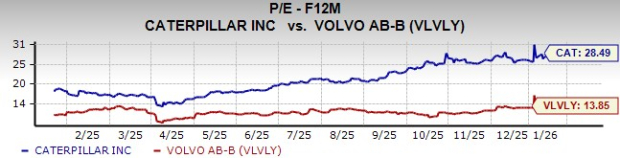
Caterpillar is currently trading at a forward 12-month earnings multiple of 28.49X, lower than its five-year median. Volvo’s stock is trading at a forward 12-month earnings multiple of 13.85X, lower than its five-year median.
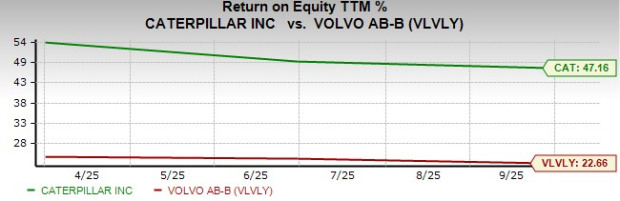
CAT’s return on equity of 47.16% is way higher than VLVLY’s 22.66%. CAT also outscores the sector’s 22.06% and the S&P 500’s 32.49%. This reflects Caterpillar’s efficient use of shareholder funds in generating profits.
CAT or VLVLY: Which Stock Is Better for Your Portfolio?
Caterpillar and Volvo are navigating near-term challenges, as evident from the recent results, and the expected decline in the 2025 results. However, both are poised well for long-term growth, underpinned by global infrastructure needs driven by GDP growth, urbanization, regionalization and e-commerce.
Despite a higher valuation, Caterpillar’s return on equity is significantly higher. Investors looking for exposure to construction equipment might consider Caterpillar to be the more favorable option at this time.
Both stocks carry a Zacks Rank #3 (Hold). You can see the complete list of today’s Zacks #1 Rank (Strong Buy) stocks here.
Want the latest recommendations from Zacks Investment Research? Today, you can download 7 Best Stocks for the Next 30 Days. Click to get this free report
Caterpillar Inc. (CAT): Free Stock Analysis Report
AB Volvo (VLVLY): Free Stock Analysis Report
This article originally published on Zacks Investment Research (zacks.com).
Mentioned In This Article
Latest News
| Oct-09 | |
| Oct-09 | |
| Oct-08 | |
| Oct-08 | |
| Oct-08 | |
| Oct-08 | |
| Oct-07 | |
| Oct-07 | |
| Oct-07 | |
| Oct-07 | |
| Oct-07 | |
| Oct-07 | |
| Oct-07 | |
| Oct-06 | |
| Oct-06 |
