Is Taiwan Semiconductor a Better Buy Than Intel for 2026?
Key Points
Taiwan Semiconductor controls a larger share of the semiconductor fabrication market than Intel.
It also beats Intel in virtually every financial metric.
If you can only buy one, the financials alone make a compelling case for Taiwan Semiconductor.
The semiconductor chip industry is, perhaps more than any other, a business sector on which the modern world is built. Whatever device you happen to be reading this on, it would not be possible without the semiconductor.
For a long time, Intel (NASDAQ: INTC) was the undisputed world leader in semiconductor production, but today that title has been taken by Taiwan Semiconductor Manufacturing (NYSE: TSM).
Where to invest $1,000 right now? Our analyst team just revealed what they believe are the 10 best stocks to buy right now, when you join Stock Advisor. See the stocks »
And if you're looking for a semiconductor investment for 2026, then you should bet on the thoroughbred, not the also-ran.
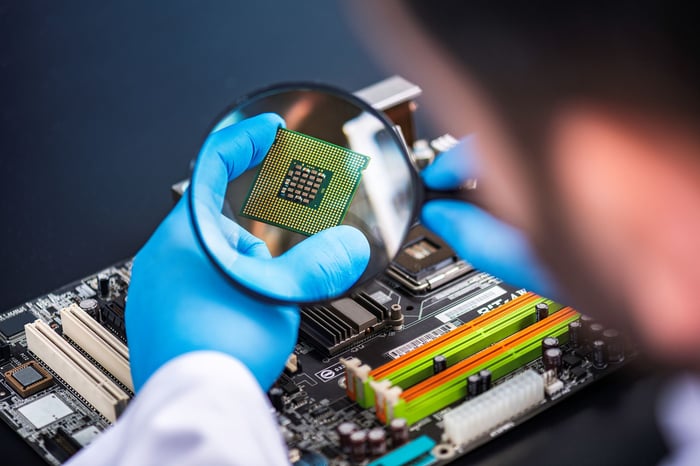
Image source: Getty Images.
The small island with an enormous footprint
The country of Taiwan is the last remnant of China's pre-communist republican government. It's also where 60% of all the world's semiconductor chips are produced and where 90% of its most advanced ones come from.
Most of those chips are made by Taiwan Semiconductor Manufacturing, better known as TSMC. And the company's financials bear that out. For 2025, TSMC brought in $121.3 billion in revenue, up 37% over 2024. Over the past three years, its revenue has grown at a compound annual growth rate (CAGR) of 20.48%. It also routinely beats earnings expectations and is incredibly profitable, boasting a gross margin of 58.98% and a net income margin of 43.29%.
Note too that TSMC pays a dividend that yields 0.99% at current prices, which is impressive considering the stock price is up 66% over the past 12 months. The company has also grown its dividend at an annual rate of 12.3% over the past five years. Compare that to Intel, and it should become pretty clear that TSMC is not likely to relinquish its crown anytime soon.
Despite a massive shot in the arm from the U.S. government, Intel's revenue has actually fallen at an average rate of 8.4% over the past three years. Its gross profit margin is only 33%, and its net income margin is a razor-thin 0.37%. This means that, in net income terms, Intel is only profitable by the skin of its teeth. It's also worth noting that Intel suspended its dividend in late 2024 and doesn't look like it plans to start paying one again anytime soon.
Intel's trailing-12-month (TTM) revenue is less than half of TSMC's, its TTM diluted earnings per share (EPS) is just $0.05 to TSMC's $1.99, and TSMC holds nearly three times the cash as Intel at $90.25 billion to $30.94 billion.
That's also despite having less debt than Intel. TSMC carries a debt of just $33.76 billion to Intel's $46.55 billion. So TSMC has a positive net cash position of $56.49 billion, and Intel is $15 billion in the hole.
Also consider that TSMC is setting up factories in America, Intel's home turf. It has one enormous $165 billion factory in Arizona, with more coming. The New York Times reported last week that TSMC had acquired a second piece of land in Arizona and was looking to expand its American manufacturing footprint.
I'm of a mind that it's generally a good idea to bet on the strongest-looking horse in the race, and TSMC is quite the thoroughbred compared to the competition. If you only make one semiconductor investment in 2026, TSMC makes a compelling case.
Should you buy stock in Taiwan Semiconductor Manufacturing right now?
Before you buy stock in Taiwan Semiconductor Manufacturing, consider this:
The Motley Fool Stock Advisor analyst team just identified what they believe are the 10 best stocks for investors to buy now… and Taiwan Semiconductor Manufacturing wasn’t one of them. The 10 stocks that made the cut could produce monster returns in the coming years.
Consider when Netflix made this list on December 17, 2004... if you invested $1,000 at the time of our recommendation, you’d have $474,578!* Or when Nvidia made this list on April 15, 2005... if you invested $1,000 at the time of our recommendation, you’d have $1,141,628!*
Now, it’s worth noting Stock Advisor’s total average return is 955% — a market-crushing outperformance compared to 196% for the S&P 500. Don't miss the latest top 10 list, available with Stock Advisor, and join an investing community built by individual investors for individual investors.
*Stock Advisor returns as of January 19, 2026.
James Hires has no position in any of the stocks mentioned. The Motley Fool has positions in and recommends Intel and Taiwan Semiconductor Manufacturing. The Motley Fool has a disclosure policy.
Mentioned In This Article
Latest News
| 6 min | |
| 9 min | |
| 11 min | |
| 11 min | |
| 41 min | |
| 58 min | |
| 1 hour | |
| 1 hour | |
| 1 hour | |
| 2 hours | |
| 2 hours | |
| 2 hours | |
| 2 hours | |
| 3 hours | |
| 3 hours |
