Target vs. Macy's: Which Retail Stock Offers More Upside Now?
Target Corporation TGT and Macy’s, Inc. M are two notable retail names currently undergoing transformation in a rapidly evolving consumer environment. Target, with a market capitalization of around $51 billion, is a leading general merchandise retailer known for its strong private-label portfolio, omnichannel capabilities and broad product mix spanning essentials, apparel, home goods and electronics. The company operates nearly 2,000 stores across the United States, supported by a robust digital ecosystem.
Conversely, Macy’s, with a significantly smaller market capitalization closer to $6 billion, operates a multi-brand, multi-category portfolio that spans the flagship Macy’s banner, Bloomingdale’s and Bluemercury. The company runs 685 stores across 43 states, the District of Columbia, Puerto Rico and Guam. Its model leans heavily into discretionary categories such as luxury apparel, beauty and accessories.
Both retailers are navigating a consumer backdrop characterized by cautious discretionary spending, price sensitivity and selective purchasing behavior. For investors, the key question is which retail stock offers more upside at this stage.
The Case for TGT
Target is advancing a pivotal transformation with design-led merchandising, curated assortments and trend-forward owned brands that reinforce its style-and-value positioning. Digital momentum continued in the third quarter of fiscal 2025, supported by convenience-led services like same-day delivery and pickup. Target Plus and Roundel are scaling profitably, strengthening marketplace breadth, retail media monetization and margin mix.
Technology-led innovation remains a differentiator, highlighted by an AI conversational shopping experience integrated with ChatGPT that enables curated browsing, multi-item checkout and flexible fulfillment. Personalization, discovery and convenience are being enhanced in tandem with improved forecasting and in-stock execution. Capital expenditures are set to rise 25% to $5 billion in fiscal 2026 to support remodels, larger formats and upgraded fulfillment, positioning the chain for long-term relevance.
Target is leveraging advanced analytics to enhance demand forecasting, assortment planning and speed to market. Tools like Target Trend Brain and synthetic audiences help identify trends early and test consumer response before launch. On-shelf availability for key items improved more than 150 basis points year over year in the fiscal third quarter, reflecting stronger inventory forecasting and in-stock execution.
Despite operational execution, demand recovery remains muted as macroeconomic pressures continue to constrain discretionary spending. Softer consumer behavior has weighed on store traffic and merchandise performance, with discretionary categories such as Home and Apparel emerging as the most challenged. The weakness has been more pronounced in higher-margin categories, creating an additional drag on profitability and limiting near-term operating leverage. On its last earnings call, Target guided low-single-digit declines in both sales and comparable sales for the fiscal fourth quarter.
The Case for M
M is steadily advancing its omni-channel transformation, digital capabilities and in-store experiences. Through its Bold New Chapter initiative, the company aims to offer a more seamless, efficient and inspiring shopping experience that combines the advantages of traditional retail with the convenience and personalization of digital engagement.
Luxury remains a key growth engine, driven by Bloomingdale’s aspirational positioning and Bluemercury’s focus on prestige beauty and dermatological skincare. Exclusive partnerships, enhanced service experiences and a unified omni-channel approach reinforce loyalty and showcase the durability of the luxury segment.
Strengthening and reimagining Macy’s nameplate remains central to the strategy. Initiatives such as upgraded store environments, clearer product presentation, and expanded contemporary and better-tier brands are deepening customer engagement. The Reimagine 125 locations provide a model for the future, showing how thoughtful floor layouts and improved visual storytelling can elevate the entire shopping journey.
Operational modernization is emerging as a structural advantage as Macy’s sharpens efficiency across fulfillment and supply-chain workflows. The new China Grove distribution center, leveraging automation, robotics and AI, supports faster delivery and broader category coverage from a single hub.
Macy’s has reaffirmed confidence in its fiscal 2025 trajectory, supported by improved visibility into demand trends and underlying fundamentals. On its last earnings call, the company guided net sales between $21.48 billion and $21.63 billion, with adjusted EPS projected at $2.00-$2.20. That said, tariff-related cost pressures continue to weigh on margins and are expected to have persisted into the final quarter, highlighting ongoing structural inflation and limited pricing flexibility. Despite these headwinds, strong cash generation, manageable debt maturities and continued share repurchases provide Macy’s with financial flexibility as it advances its long-term strategy.
How Does the Zacks Consensus Estimate Compare for TGT & M?
The Zacks Consensus Estimate for Target’s EPS for the current fiscal year has moved up 1 cent, while the same for the next fiscal year remained unchanged over the past 30 days.

Image Source: Zacks Investment Research
The Zacks Consensus Estimate for Macy’s EPS for the current and next fiscal years has increased by 16 cents and 11 cents, respectively, over the past 30 days.
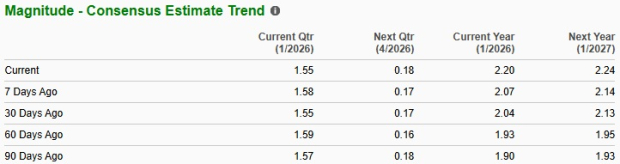
Image Source: Zacks Investment Research
Stock Performances of TGT & M
Over the past year, shares of Target have slumped 16.7%, whereas Macy’s has rallied 55.4%.
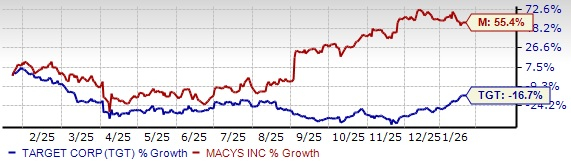
Image Source: Zacks Investment Research
Dive Into Stock Valuations of TGT & M
Target is trading at a forward price-to-sales (P/S) multiple of 0.47, below its median of 0.56 in the last three years. Macy’s forward 12-month P/S multiple sits at 0.27, above its median of 0.20 in the last three years.

Image Source: Zacks Investment Research
TGT or M: Which Is the Better Bet Now?
Macy’s stands out as the stronger investment candidate, supported by disciplined store optimization, growing contributions from higher-margin luxury formats such as Bloomingdale’s and Bluemercury, and improving earnings visibility. Strong cash generation, ongoing share repurchases and positive estimate revisions reinforce confidence in the company’s trajectory.
While Target is making progress with digital initiatives, AI-driven operations and merchandising innovation, it continues to face soft traffic trends, weakness in higher-margin discretionary categories and near-term earnings pressure. In contrast, Macy’s improving execution and more attractive risk-reward profile make it the better stock to buy now, offering a clearer path to upside.
While Macy’s currently sports a Zacks Rank #1 (Strong Buy), Target carries a Zacks Rank #4 (Sell).
You can see the complete list of today’s Zacks #1 Rank stocks here.
Want the latest recommendations from Zacks Investment Research? Today, you can download 7 Best Stocks for the Next 30 Days. Click to get this free report
Macy's, Inc. (M): Free Stock Analysis Report
Target Corporation (TGT): Free Stock Analysis Report
This article originally published on Zacks Investment Research (zacks.com).
Mentioned In This Article
Latest News
| 1 hour | |
| 3 hours | |
| 4 hours | |
| 5 hours | |
| 11 hours | |
| Oct-14 | |
| Oct-14 | |
| Oct-14 | |
| Oct-13 | |
| Oct-12 | |
| Oct-12 | |
| Oct-12 | |
| Oct-12 | |
| Oct-11 |
Business People: Hilton exec Mark Weinstein to lead Target marketing
TGT
Pioneer Press, St. Paul, Minn.
|
| Oct-09 |
